

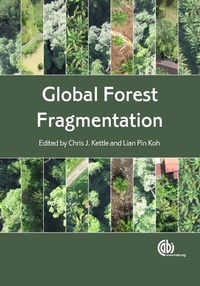
Global Forest Fragmentation
Published on 12. September 2014
Book
Paperback/Softback
192 pages
978-1-78064-497-4 (ISBN)
Description
Forest fragmentation will inevitably continue over the coming years, especially in developing economies. This book provides a cutting edge review of the multi-disciplinary sciences related to studies of global forest fragmentation. It specifically addresses cross-cutting themes from both an ecological and a social sciences perspective. The ultimate goal of Global Forest Fragmentation is to provide a detailed scientific base to support future forest landscape management and planning to meet global environmental and societal needs.
More details
Language
English
Place of publication
Wallingford
United Kingdom
Target group
College/higher education
Product notice
Paperback (trade)
Unsewn / adhesive bound
Dimensions
Height: 241 mm
Width: 170 mm
Thickness: 13 mm
Weight
431 gr
ISBN-13
978-1-78064-497-4 (9781780644974)
Copyright in bibliographic data and cover images is held by Nielsen Book Services Limited or by the publishers or by their respective licensors: all rights reserved.
Schweitzer Classification
Other editions
Additional editions
Chris Kettle | Lian Pin Koh
Global Forest Fragmentation
E-Book
09/2014
CABI Publishing
€78.49
Available for download
Persons
Chris J Kettle is senior scientist and lecturer at ETH Zurich, Switzerland Lian Pin Koh is assistant professor at ETH Zurich, Switzerland
Editor
ETH Zurich, Switzerland
The University of Adelaide, Australia
Contributions
Institute of Ecology, Germany
Royal Botanic Garden Edinburgh, UK
J.F. Blumenbach Institute of Zoology & Anthropology, Germany
CSIRO Ecosystem Sciences, Australia
The Arnold Arboretum of Harvard University, USA
Woods & Wayside International, USA
Switzerland and Goods and Services of Tropical Forest Ecosystems, Switzerland
University of Cambridge, UK
Content
a: Acknowledgements b: Preface Chapter 1: Global Forest Fragmentation: Introduction Chapter 2: The history of deforestation and forest fragmentation: a global perspective Chapter 3: Contemporary drivers of habitat fragmentation Chapter 4: Forest fragmentation and biodiversity conservation in human-dominated landscapes Chapter 5: Forest Fragmentation Genetics: What can genetics tell us about forest fragmentation? Chapter 6: Forest Fragmentation and Climate Change Chapter 7: Forest islands in an agricultural sea Chapter 8: Forest fragmentation and ecosystem function Chapter 9: Beyond the mirror: Tropical forest fragmentation and its impact on rural livelihoods. Chapter 10: Governance Failures and the Fragmentation of Tropical Forests Chapter 11: Future Forests, Fantasy or Facade