

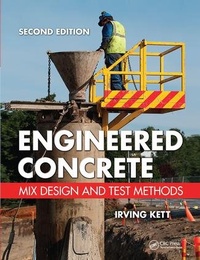
Engineered Concrete
Mix Design and Test Methods, Second Edition
2nd Edition
Published on 2. August 2017
Book
Hardback
246 pages
978-1-138-41406-8 (ISBN)
Description
As every civil engineer knows, Portland Cement is the most versatile and important material of construction, and will probably remain so far into the future. Yet few books, if any, exist that offer an in-depth analysis of the mixing and testing methods of this vital hydraulic cement. This statement, written about the first edition of Engineered Concrete: Mix Design and Test Methods, remains as true today as it was ten years ago. Revised and updated, the second edition of this groundbreaking resource completely covers Portland Cement, Portland Cement Concrete, and their uses.
See what's new in the Second Edition:
New coverage of the latest concrete technologies such as high-performance and lightweight concrete
Several new tests and sample tearsheets
Additional and updated data sheets
The body of the book is divided into several sections, with the first explaining how concrete batches are designed, mixed, and measured for various consistencies. Another section details the tests of the primary component materials of concrete other than water namely Portland Cement, aggregates, and mortar while the final section includes some of the fundamental concrete testing procedures for different strength parameters in conformity with the standards of the American Society for Testing Materials. Solidly researched and written, the book supplies a fundamental understanding of cement, concrete, and mixing and testing methods that allow readers to produce the most economical combinations of concrete materials and satisfy performance requirements and specifications.
See what's new in the Second Edition:
New coverage of the latest concrete technologies such as high-performance and lightweight concrete
Several new tests and sample tearsheets
Additional and updated data sheets
The body of the book is divided into several sections, with the first explaining how concrete batches are designed, mixed, and measured for various consistencies. Another section details the tests of the primary component materials of concrete other than water namely Portland Cement, aggregates, and mortar while the final section includes some of the fundamental concrete testing procedures for different strength parameters in conformity with the standards of the American Society for Testing Materials. Solidly researched and written, the book supplies a fundamental understanding of cement, concrete, and mixing and testing methods that allow readers to produce the most economical combinations of concrete materials and satisfy performance requirements and specifications.
More details
Edition
2nd edition
Language
English
Place of publication
London
United Kingdom
Publishing group
Taylor & Francis Ltd
Target group
Professional and scholarly
Academic and Professional Practice & Development
Dimensions
Height: 280 mm
Width: 210 mm
Weight
620 gr
ISBN-13
978-1-138-41406-8 (9781138414068)
Copyright in bibliographic data and cover images is held by Nielsen Book Services Limited or by the publishers or by their respective licensors: all rights reserved.
Schweitzer Classification
Other editions
Additional editions
E-Book
12/2009
2nd Edition
CRC Press
€225.99
Available for download
Book
12/2009
2nd Edition
CRC Press
€209.50
Shipment within 15-20 days
E-Book
12/2009
2nd Edition
CRC Press
€225.99
Available for download
Person
Irving Kett
Content
Acknowledgment, About the Author, Part 1. Introduction, Introduction, Brief Overview of Portland Cement and Concrete Technology, Mix Design Procedures, Part 2. Tests for Aggregates, Portland Cement, and Mortar, Rodded Unit Weight of Coarse Aggregates (C 29), Compressive Strength of Hydraulic Cement Mortars (C 109), Specific Gravity and Absorption Tests of Coarse and Fine Aggregates for Use in the Design of Portland Cement Concrete Mixtures (C 127/128), Resistance to Degradation of Small-Sized Coarse Aggregates by Abrasion and Impact in the Los Angeles Machine (C 131), Dry Sieve Analysis of Fine and Coarse Aggregates (C l36), Material Finer than 75 ?m (No. 200 Sieve) by Washing (C 117), Clay Lumps and Friable Particles in Aggregates (C 142), Density of Hydraulic Cement (C 188), Tensile Strength of Hydraulic Cement Mortars (C 190), Time of Set of Hydraulic Cement by Vicat Needle (C 191), Fineness of Portland Cement by Air Permeability Apparatus (C 204), Sand Equivalent Value of Soils and Fine Aggregates (D 2419), Flat or Elongated Particles in Coarse Aggregate (D 4791), Standard Specifications for Wire Cloth and Sieves for Testing Purposes (E 11), Part 3. Tests for Portland Cement Concrete, Compressive Strength of Cylindrical Concrete Specimens (C 39), Flexural Strength of Concrete Using Simple Beam with Third-Point Loading (C 78), Unit Weight, Yield, and Air Content of Concrete (C 138), Slump of Hydraulic Cement Concrete (C 143), Air Content of Freshly Mixed Concrete by the Volumetric Method (C 173), Making and Curing Concrete Test Specimens in the Laboratory (C 192), Air Content of Freshly Mixed Concrete by the Pressure Method (C 231), Bond Strength of Concrete Developed with Reinforcing Steel (C 234), Ball Penetration in Freshly Mixed Concrete (C 360), Static Modulus of Elasticity and Poisson's Ratio of Concrete in Compression (C 469), Splitting Tensile Strength of Cylindrical Concrete Specimens (C 496), Rebound Number of Hardened Concrete (C 805), Direct Tensile Test of Portland Cement Concrete, Part 4. Appendices, Additional Copies of Laboratory Data Sheets