

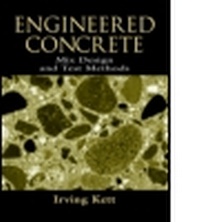
Engineered Concrete
Mix Design and Test Methods
1st Edition
Published on 29. November 1999
Book
Paperback/Softback
X, 234 pages
978-0-8493-2277-8 (ISBN)
Description
The Romans used an early type of concrete made with natural pozzuolanic cement more than 2,000 years ago. Today, Portland Cement Concrete is the most important material of construction. Yet few books, if any, exist that offer an in-depth analysis of the mixing and testing methods of this vital hydraulic cement. Until now that is. Engineered Concrete: Mix Design and Test Methods helps engineers, as well as laboratory technicians, grasp a better understanding of Portland Cement and Portland Cement Concrete.
The book is divided into several sections, with the first, Mix Design Procedures, explaining how concrete batches are designed, mixed, and measured for various consistencies. Another section details the tests of the primary component materials of concrete other than water - namely Portland Cement, aggregates, and mortar - while the final section includes some of the fundamental concrete testing procedures for different strength parameters in conformity with the standards of the American Society for Testing Materials.
While focusing solely on Portland Cement, the book also includes information on other hydraulic cementitious materials and additives because of their modern applications. Solidly researched and written, Engineered Concrete: Mix Design and Test Methods provides a clear understanding of mix design and testing of Portland Cement Concrete. As every civil engineer knows, it is the most versatile and important material of construction, and will probably remain so as far into the future as we can see.
The book is divided into several sections, with the first, Mix Design Procedures, explaining how concrete batches are designed, mixed, and measured for various consistencies. Another section details the tests of the primary component materials of concrete other than water - namely Portland Cement, aggregates, and mortar - while the final section includes some of the fundamental concrete testing procedures for different strength parameters in conformity with the standards of the American Society for Testing Materials.
While focusing solely on Portland Cement, the book also includes information on other hydraulic cementitious materials and additives because of their modern applications. Solidly researched and written, Engineered Concrete: Mix Design and Test Methods provides a clear understanding of mix design and testing of Portland Cement Concrete. As every civil engineer knows, it is the most versatile and important material of construction, and will probably remain so as far into the future as we can see.
More details
Language
English
Place of publication
Bosa Roca
United States
Publishing group
Taylor & Francis Inc
Target group
Professional and scholarly
Audience: Civil Engineers, Construction Engineers, Materials Science Engineers, Structural Engineers .
Illustrations
21 s/w Photographien bzw. Rasterbilder, 59 s/w Tabellen
20 equations; 21 Halftones, black and white; 59 Tables, black and white
Dimensions
Height: 279 mm
Width: 216 mm
Weight
584 gr
ISBN-13
978-0-8493-2277-8 (9780849322778)
Schweitzer Classification
Other editions
New editions
Book
12/2009
2nd Edition
CRC Press
€209.50
Shipment within 15-20 days
Content
INTRODUCTION
Brief Overview of Portland Cement and Concrete Technology
Mix Design Procedures
TESTS FOR AGGREGATES, PORTLAND CEMENT, AND MORTAR
Rodded Unit Weight of Coarse Aggregates
Compressive Strength of Hydraulic Cement Mortars
Specific Gravity and Absorption Tests of Coarse and Fine Aggregates
Resistance to Degradation of Small-Size Coarse Aggregate in the Los Angeles Machine
Test Method for Sieve Analysis of Fine and Coarse Aggregates
Clay Lumps and Friable Particles in Aggregates
Test Method for Density of Hydraulic Cement
Tensile Strength of Hydraulic Cement Mortars
Test Method for Time of Setting of Hydraulic Cement by the Vicat Needle
Fineness of Portland and Other Hydraulic Cements by Air Permeability Apparatus
Sand Equivalent Value of Soils and Fine Aggregate
Index of Aggregate Particle Shape and Texture
Flat and Elongated Particles in Coarse Aggregate
Standard Specifications for Wire Cloth and Sieves for Testing Purposes
TESTS FOR PORTLAND CEMENT CONCRETE
Compressive Strength Cylindrical Concrete Specimens
Flexural Strength of Concrete Using Simple Beam with Third-Point Loading
Unit Weight, Yield, and Air Content of Concrete
Slump of Hydraulic Cement Concrete
Air Content of Freshly Mixed Concrete by the Volumetric Method
Making and Curing Concrete Test Specimens in the Laboratory
Air Content of Freshly Mixed Concrete by the Pressure Method
Bond Strength of Concrete Developed with Reinforcing Steel
Ball Penetration in Fresh Portland Cement Concrete
Static Modulus of Elasticity and Poisson's Ratio of Concrete in Compression
Splitting Tensile Strength of Cylindrical Concrete Specimens
Rebound Number of Hardened Concrete by the Swiss Hammer
Direct Tensile Test of Portland Cement Concrete
APPENDICES
A-Measurement Conversion Factors Between the S.I. System and the U.S. Standard Units
B-Laboratory Rules of Safety and Procedures
C-Tables of Portland Cement Specifications from ASTM Designation
D-Concrete Admixtures and Other Cementitious Materials
E-Development of ASTM Standards
F-Sample Course Outlines for 10 Week and 15 Week Laboratory Sessions
G-Bibliography
INDEX
ADDITIONAL COPIES OF LABORATORY DATA SHEETS
Brief Overview of Portland Cement and Concrete Technology
Mix Design Procedures
TESTS FOR AGGREGATES, PORTLAND CEMENT, AND MORTAR
Rodded Unit Weight of Coarse Aggregates
Compressive Strength of Hydraulic Cement Mortars
Specific Gravity and Absorption Tests of Coarse and Fine Aggregates
Resistance to Degradation of Small-Size Coarse Aggregate in the Los Angeles Machine
Test Method for Sieve Analysis of Fine and Coarse Aggregates
Clay Lumps and Friable Particles in Aggregates
Test Method for Density of Hydraulic Cement
Tensile Strength of Hydraulic Cement Mortars
Test Method for Time of Setting of Hydraulic Cement by the Vicat Needle
Fineness of Portland and Other Hydraulic Cements by Air Permeability Apparatus
Sand Equivalent Value of Soils and Fine Aggregate
Index of Aggregate Particle Shape and Texture
Flat and Elongated Particles in Coarse Aggregate
Standard Specifications for Wire Cloth and Sieves for Testing Purposes
TESTS FOR PORTLAND CEMENT CONCRETE
Compressive Strength Cylindrical Concrete Specimens
Flexural Strength of Concrete Using Simple Beam with Third-Point Loading
Unit Weight, Yield, and Air Content of Concrete
Slump of Hydraulic Cement Concrete
Air Content of Freshly Mixed Concrete by the Volumetric Method
Making and Curing Concrete Test Specimens in the Laboratory
Air Content of Freshly Mixed Concrete by the Pressure Method
Bond Strength of Concrete Developed with Reinforcing Steel
Ball Penetration in Fresh Portland Cement Concrete
Static Modulus of Elasticity and Poisson's Ratio of Concrete in Compression
Splitting Tensile Strength of Cylindrical Concrete Specimens
Rebound Number of Hardened Concrete by the Swiss Hammer
Direct Tensile Test of Portland Cement Concrete
APPENDICES
A-Measurement Conversion Factors Between the S.I. System and the U.S. Standard Units
B-Laboratory Rules of Safety and Procedures
C-Tables of Portland Cement Specifications from ASTM Designation
D-Concrete Admixtures and Other Cementitious Materials
E-Development of ASTM Standards
F-Sample Course Outlines for 10 Week and 15 Week Laboratory Sessions
G-Bibliography
INDEX
ADDITIONAL COPIES OF LABORATORY DATA SHEETS