

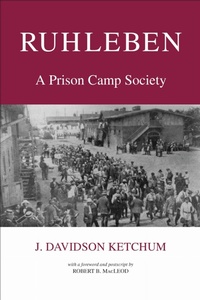
Ruhleben
A Prison Camp Society
Published on 18. February 2020
Book
Paperback/Softback
422 pages
978-1-4875-2575-0 (ISBN)
Description
This is an unusual book in that it is an important contribution to social psychology and also an absorbing story of four strange years in a German prison camp of World War I. Four thousand men and boys from the most varied walks of life-professors, seamen, jockeys, schoolboys, bank directors, musicians, clerks, scientists-were taken from civilian life and placed in Ruhleben on the outbreak of war; no activities were prescribed for them, no direction was given to their communal life. In the event, this miscellaneous group of people, closed off from the world, create d their own society. This book is the story of how they did it and what the society they made was like; much more than this, the camp provides a gifted and sympathetic social psychologist with a rare opportunity for study and analysis of an important if inadvertent social experiment. The time elapsed between the event itself and the completion of the book may in one way be regretted; it did, however, allow the author, who was himself and inmate of Ruhleben, the opportunity for mature reflection on its meaning. The book is a contribution to the history of World War I; it is also a basic and timeless study of the dynamics of individual and group behaviour.
More details
Series
Language
English
Place of publication
Toronto
Canada
Target group
College/higher education
Professional and scholarly
Product notice
Paperback (trade)
Dimensions
Height: 229 mm
Width: 152 mm
Thickness: 24 mm
Weight
617 gr
ISBN-13
978-1-4875-2575-0 (9781487525750)
Copyright in bibliographic data and cover images is held by Nielsen Book Services Limited or by the publishers or by their respective licensors: all rights reserved.
Schweitzer Classification
Persons
J. Davidson Ketchum was studying music in Germany in 1914 when he was caught by the war and interned for four years in the prison camp at Ruhleben. The experience generated an interest in human problems which led him first to religion and then to psychology-and eventually to a distinguished career in the Department of Psychology in the University of Toronto, where he was a Professor at the time of his death, in 1962.
Robert B. Macleod is Professor of Psychology at Cornell University.
Robert B. Macleod is Professor of Psychology at Cornell University.