

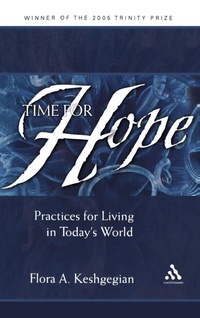
Time for Hope
Practices for Living in Today's World
Published on 31. December 2006
Book
Hardback
240 pages
978-0-8264-1915-6 (ISBN)
Description
This book begins with the premise that there is a crisis of hope today, especially in the modern/postmodern west. For many, including the baby boomer generation that came to adulthood in the 60s and 70s, optimism about the future has been increasingly challenged by historical realities such as global conflicts, ecological crises, economic distress, and political disillusion. Often the religious response to historical despair is to remove hope from history to an afterlife or from ethical action to aesthetic experience. This books seeks instead to re-imagine hope in history and in life by exploring the narratives of time which shape and determine how human beings understand their lives. Within those narratives, human beings are habituated to think and act in ways that may no longer be fruitful. The book, therefore, proposes new habits that are more life giving and hope producing. It outlines practices meant to cultivate these habits. The book sets up the problem of hope as located in the dominant western narrative of time, which is derived from Jewish and Christian perspectives.
In this narrative, God is directing time and history toward the eschaton, which is not only an end, but a culmination and a resolution. The plotline of this narrative of time, which is also the story of redemption, is linear and comedic. In modernity, the linear vector of history was also understood to be progressive. The movement of time and history was toward a better future. "Time for Hope" examines and criticizes this dominant view of time and looks at attempting to revise or correct it. It also explores alternative views of time that attend more to the past, especially a traumatic past that cannot be resolved by any future fulfilment, and to the present moment. Attention is given to views of time that are more cyclical and/or which focus on past/present/future as converging. The most familiar example of such convergence is in ritual or liturgical time that seems to offer an alternative experience that holds promise for learning to tell time differently. The goal of the book is to offer a remedy for hope, not only by proposing alternative narratives, but by suggesting specific practices and habits that will lead to thinking about and living in time differently.
The book outlines a theology of hope that is life giving and thus appropriate and adequate for the historical, social, and theological challenges of life today.
In this narrative, God is directing time and history toward the eschaton, which is not only an end, but a culmination and a resolution. The plotline of this narrative of time, which is also the story of redemption, is linear and comedic. In modernity, the linear vector of history was also understood to be progressive. The movement of time and history was toward a better future. "Time for Hope" examines and criticizes this dominant view of time and looks at attempting to revise or correct it. It also explores alternative views of time that attend more to the past, especially a traumatic past that cannot be resolved by any future fulfilment, and to the present moment. Attention is given to views of time that are more cyclical and/or which focus on past/present/future as converging. The most familiar example of such convergence is in ritual or liturgical time that seems to offer an alternative experience that holds promise for learning to tell time differently. The goal of the book is to offer a remedy for hope, not only by proposing alternative narratives, but by suggesting specific practices and habits that will lead to thinking about and living in time differently.
The book outlines a theology of hope that is life giving and thus appropriate and adequate for the historical, social, and theological challenges of life today.
Reviews / Votes
'As eloquent as it is erudite, Keshgegian has written an exhilarating meditation on hope, wonder and justice in our complex and fragile world. Weaving together personal narrative and theological reflection, she invites all of us, lay people, students, activists, and scholars to cultivate new stories and new habits of living, ones that allow us, and all of life, to flourish.' - Sharon D. Welch, Chair and Professor of Religious Studies, University of Missouri, Columbia, and author of Sweet Dreams in America and After Empire -- Sharon D. Welch * Blurb from reviewer * 'In this powerful tale of time, hope and what makes humans tick, Keshgegian rescripts the Christian narrative of history.... With profound compassion, she translates messianic ends<like justice, peace and freedom<into present values. An important contribution to the reconstruction of eschatology, warm, wise and accessible to students of theology, religion and life - at every level.' - Catherine Keller, Professor of Constructive Theology, Drew University, and author of The Face of the Deep and God and Power -- Catherine Keller * Blurb from reviewer *More details
Language
English
Place of publication
London
United Kingdom
Publishing group
Bloomsbury Publishing PLC
Target group
General
Dimensions
Height: 235 mm
Width: 157 mm
Thickness: 19 mm
Weight
549 gr
ISBN-13
978-0-8264-1915-6 (9780826419156)
Copyright in bibliographic data and cover images is held by Nielsen Book Services Limited or by the publishers or by their respective licensors: all rights reserved.
Schweitzer Classification
Person
Flora A. Keshgegian is a theologian and an ordained Episcopal priest. She is the author of Redeeming Memories: A Theology of Healing and Transformation and numerous articles. She taught theology for five years at the Episcopal Theological Seminary of the Southwest and served for fourteen years as Associate University Chaplain at Brown University. She is currently a Visiting Scholar at Brown University.
Content
Introduction; 1. Divine Comedy: Christian Narratives of Hope and History; 2. Outside the Lines: Contemporary Threats and Challenges; 3. Are We There Yet?: Rethinking the Journey; 4. Black Holes and Fractured Fairy Tales: Trauma and Tragedy in History; 5. Here and Now: Moments in the Hallowing of Time; 6. The Habitation of Time: Contours of Hope; 7. Practices of Habitation: Hope for Life; 8. Epilogue: Time's Tale.