

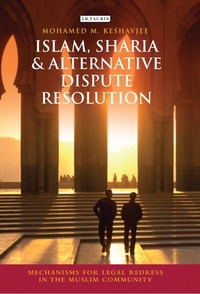
Islam, Sharia and Alternative Dispute Resolution
Mechanisms for Legal Redress in the Muslim Community
Published on 17. June 2013
Book
Hardback
256 pages
978-1-84885-732-2 (ISBN)
Description
The meanings and contexts of Shari'a are the subject of both curiosity and misunderstanding by non-Muslims. Shari'a is sometimes crudely characterised by outsiders as a punitive legal system operating broadly outside, and separate from, national laws and customs. This groundbreaking book shows that Shari'a and its 'fiqh' (laws set forward by various Islamic legal schools) comprise a far more nuanced matrix of interpretations than is often assumed to be the case. Far from being monolithic or impervious to change from without, Muslim legal tradition has - since its beginnings in the early Islamic period - placed an emphasis on equity and non-adversarial conflict-resolution. Mohamed Keshavjee examines both Sunni and Shi'a applications of Islamic law, demonstrating how political, cultural and other factors have influenced the practice of fiqh and Shari'a in the West. Exploring in particular the modern development of Alternative Dispute Resolution (ADR), the author shows that this process can revitalise some of the essential principles that underlie Muslim teachings and jurispudence, delivering not only formal remedies but also perceived justice, even to non-Muslims.
Reviews / Votes
Dr Keshavjee's exploration of the use of alternative dispute resolution services (ADR) by a Muslim community in the London area is a deeply insightful study of a Muslim community's approach to the settlement of disputes in sensitive family matters. The study focuses on the services available to this community in their local area and their strong preference for resolving family disputes privately, outside the culturally alien arena of English family law. Religious law - the Sharia - has an important role in Muslim approaches to conflict resolution. Dr Keshavjee's book is of great interest to scholars and practitioners alike. It not only provides a conceptual bridge between Muslim culture and religion and Anglo-American forms of mediation and negotiation, it also provides an essential bridge between theoretical literature on ADR and ADR in practice, applied in a particular cultural context. There are many invaluable insights gained from the author's experience of training mediators in Ismaili communities worldwide. This book is an essential resource for all mediators working with Muslim and cross-cultural families, to develop the great potential of mediation to enhance the well-being of Muslim communities, not only in the United Kingdom but all over the world. -Lisa Parkinson, Member of the Hague Conference Group of Experts advising on the Guide to Good Practice on mediation under the 1980 Child Abduction Convention In this pioneering study of the Muslim community in the London borough of Hounslow, Mohamed Keshavjee, a British-trained barrister, explores the way the Sharia law can exert a positive role in Britain's Muslim communities through its emphasis on mediation and conciliation in resolving personal and family disputes. With clarity and sensitivity he examines the interface between the British legal system and the informal Sharia-based models adopted by the Muslims as they navigate the difficult waters between the majority culture and the divine imperatives of Islam with its manifold local traditions. His book, which does not hesitate to venture into problematic areas such as forced marriages and domestic violence, is a valuable antidote to the hysteria surrounding much of the media comment on the 'introduction' of Sharia law in Britain. -Malise Ruthven, author, Islam in the World This pioneering work by Dr Keshavjee highlights a number of issues that diasporic Muslims have to grapple with to resolve their family disputes. The book demonstrates how traditional methods of dispute resolution can be judiciously combined with modern dispute resolution processes. Appropriate training programmes that respect the cultural sensibilities of the immigrant community and the public laws of the host countries where Muslim minorities are settled today are particularly effective in this respect. The book makes a major contribution to greater cross-cultural understanding. -Makhdoom Ali Khan, Constitutional lawyer, author, former Attorney General of the Islamic Republic of PakistanMore details
Language
English
Place of publication
United Kingdom
Publishing group
Bloomsbury Publishing PLC
Target group
College/higher education
Illustrations
Illustrations
Dimensions
Height: 240 mm
Width: 161 mm
Thickness: 18 mm
Weight
549 gr
ISBN-13
978-1-84885-732-2 (9781848857322)
Copyright in bibliographic data and cover images is held by Nielsen Book Services Limited or by the publishers or by their respective licensors: all rights reserved.
Schweitzer Classification
Other editions
Additional editions
Mohamed M. Keshavjee
Islam, Sharia and Alternative Dispute Resolution
Mechanisms for Legal Redress in the Muslim Community
E-Book
06/2013
1st Edition
I.B. Tauris
€144.99
Available for download
Mohamed M. Keshavjee
Islam, Sharia and Alternative Dispute Resolution
Mechanisms for Legal Redress in the Muslim Community
E-Book
06/2013
1st Edition
I.B. Tauris
€144.99
Available for download
Person
MOHAMED M. KESHAVJEE is an international specialist on cross-cultural mediation. With a background in law from Britain and Canada, from 2000 to 2012 he directed, and lectured in, all the international training programmes in mediation for the National Conciliation and Arbitration Boards of the Ismaili Muslim community worldwide. He specialises in Islamic and international human rights law and obtained his PhD from the University of London.
Content
Foreword
Acknowledgements
List of Figures
1. Introduction
2. The Muslim Community in Britain
3. Overview of the Hounslow Muslim Community
4. The Sharia, Religious Law of Muslims
5. The Muslim Law (Shariah) Council (UK)
6. The Many Faces of ADR in Hounslow
7. The Case for Court-Invoked Adjudication
8. Towards an Islamic Model of ADR
9. Policy Considerations
Appendix: Some Perspectives on ADR
Notes
Glossary of Arabic, Persian and South Asian Terms
Bibliography
Index
Acknowledgements
List of Figures
1. Introduction
2. The Muslim Community in Britain
3. Overview of the Hounslow Muslim Community
4. The Sharia, Religious Law of Muslims
5. The Muslim Law (Shariah) Council (UK)
6. The Many Faces of ADR in Hounslow
7. The Case for Court-Invoked Adjudication
8. Towards an Islamic Model of ADR
9. Policy Considerations
Appendix: Some Perspectives on ADR
Notes
Glossary of Arabic, Persian and South Asian Terms
Bibliography
Index