

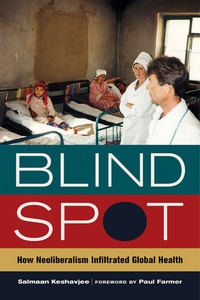
Blind Spot
How Neoliberalism Infiltrated Global Health
1st Edition
Published on 15. August 2014
Book
Paperback/Softback
288 pages
978-0-520-28284-1 (ISBN)
Description
Neoliberalism has been the defining paradigm in global health since the latter part of the twentieth century. What started as an untested and unproven theory that the creation of unfettered markets would give rise to political democracy led to policies that promoted the belief that private markets were the optimal agents for the distribution of social goods, including health care. A vivid illustration of the infiltration of neoliberal ideology into the design and implementation of development programs, this case study, set in post-Soviet Tajikistan's remote eastern province of Badakhshan, draws on extensive ethnographic and historical material to examine a revolving drug fund" program used by numerous nongovernmental organizations globally to address shortages of high-quality pharmaceuticals in poor communities. Provocative, rigorous, and accessible, Blind Spot offers a cautionary tale about the forces driving decision making in health and development policy today, illustrating how the privatization of health care can have catastrophic outcomes for some of the world's most vulnerable populations.
Reviews / Votes
"An accessible summary of the rise of neoliberalism following World War II and its impact on global health and development programs into the late 20th century and beyond... A valuable resource." -- Kristin E. Yarris American Journal of Human Biology "Blind Spot provides much greater clarity in our understanding of the specific agendas promoted by neoliberalism, including the distinct forces involved and their relation to health delivery programs." American AnthropologistMore details
Series
Edition
First Edition
Language
English
Place of publication
Berkerley
United States
Target group
College/higher education
Professional and scholarly
Product notice
Paperback (trade)
Illustrations
9 illus
Dimensions
Height: 229 mm
Width: 152 mm
Thickness: 18 mm
Weight
454 gr
ISBN-13
978-0-520-28284-1 (9780520282841)
Copyright in bibliographic data and cover images is held by Nielsen Book Services Limited or by the publishers or by their respective licensors: all rights reserved.
Schweitzer Classification
Other editions
Additional editions
E-Book
08/2014
1st Edition
University of California Press
€28.99
Available for download

Book
08/2014
1st Edition
University of California Press
€99.20
Article not available at the moment
Persons
Salmaan Keshavjee is a physician and anthropologist with more than two decades of experience working in global health. He is the Director of the Program in Infectious Disease and Social Change in the Department of Global Health at Harvard Medical School, where he is also Associate Professor of Global Health and Social Medicine and Associate Professor of Medicine. He also serves on the faculty of the Division of Global Health Equity (DGHE) at Boston's Brigham and Women's Hospital, and is a physician in the Department of Medicine. Paul Farmer is cofounder of Partners In Health and Chair of the Department of Global Health and Social Medicine at Harvard Medical School. His most recent book is Reimagining Global Health. Other titles include To Repair the World; Pathologies of Power: Health, Human Rights, and the New War on the Poor; Infections and Inequalities: The Modern Plagues; and AIDS and Accusation: Haiti and the Geography of Blame, all by UC Press.
Content
List of Illustrations Foreword Paul Farmer Preface Acknowledgments 1. Introduction: A World Transformed Part I. The Beginning of the Encounter: The Soviet World Meets Its Global Counterparts 2. Health in the Time of the USSR: A Window into the Communist Moral World 3. Seeking Help at the End of Empire: A Transnational Lifeline for Badakhshan Part II. Life at the End of Empire: The Crisis and the Response 4. The Health Crisis in Badakhshan: Sickness and Misery at the End of Empire 5. Minding the Gap? The Revolving Drug Fund Part III. Transplanting Ideology: Village Health Meets the Global Economy 6. Bretton Woods to Bamako: How Free-Market Orthodoxy Infiltrated the International Aid Movement 7. From Bamako to Badakhshan: Neoliberalism's Transplanting Mechanism Part IV. The Aftermath: Neoliberal Success, Global Health Failure 8. Privatizing Health Services: Reforming the Old World 9. Revealing the Blind Spot: Outcomes That Matter 10. Epilogue: Reframing the Moral Dimensions of Engagement Notes Bibliography Index