

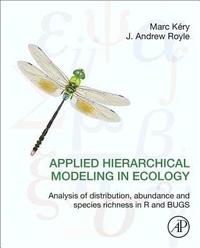
Applied Hierarchical Modeling in Ecology: Analysis of distribution, abundance and species richness in R and BUGS
Volume 1:Prelude and Static Models
Published on 27. November 2015
Book
Hardback
808 pages
978-0-12-801378-6 (ISBN)
Description
Applied Hierarchical Modeling in Ecology: Distribution, Abundance, Species Richness offers a new synthesis of the state-of-the-art of hierarchical models for plant and animal distribution, abundance, and community characteristics such as species richness using data collected in metapopulation designs. These types of data are extremely widespread in ecology and its applications in such areas as biodiversity monitoring and fisheries and wildlife management.
This first volume explains static models/procedures in the context of hierarchical models that collectively represent a unified approach to ecological research, taking the reader from design, through data collection, and into analyses using a very powerful class of models. Applied Hierarchical Modeling in Ecology, Volume 1 serves as an indispensable manual for practicing field biologists, and as a graduate-level text for students in ecology, conservation biology, fisheries/wildlife management, and related fields.
This first volume explains static models/procedures in the context of hierarchical models that collectively represent a unified approach to ecological research, taking the reader from design, through data collection, and into analyses using a very powerful class of models. Applied Hierarchical Modeling in Ecology, Volume 1 serves as an indispensable manual for practicing field biologists, and as a graduate-level text for students in ecology, conservation biology, fisheries/wildlife management, and related fields.
Reviews / Votes
"For the beginning practitioner of hierarchical models,...this is definitely worth the space and may actually be the first place to start developing a strong fundamental understanding of hierarchical modeling. For more seasoned quantitative ecologists, there are lots of useful modeling details for both the unmarked and BUGS/JAGS syntax,...there is value to having it all in one place. Finally, for professors looking to teach a class or short-course on hierarchical models in ecology,...an excellent text for the course." course." --Journal of Agricultural, Biological, and Environmental StatisticsMore details
Language
English
Place of publication
San Diego
United States
Publishing group
Elsevier Science Publishing Co Inc
Target group
Professional and scholarly
Illustrations
Approx. 275 illustrations (275 in full color)
Dimensions
Height: 241 mm
Width: 189 mm
Thickness: 38 mm
Weight
1734 gr
ISBN-13
978-0-12-801378-6 (9780128013786)
Copyright in bibliographic data and cover images is held by Nielsen Book Services Limited or by the publishers or by their respective licensors: all rights reserved.
Schweitzer Classification
Other editions
Additional editions
Marc Kéry | J. Andrew Royle
Applied Hierarchical Modeling in Ecology: Analysis of distribution, abundance and species richness in R and BUGS
Volume 1:Prelude and Static Models
E-Book
11/2015
Academic Press
€64.95
Available for download
Persons
Dr. Marc Kery is a senior scientist at the Swiss Ornithological Institute, a non-profit NGO with about 200 employees dedicated primarily to bird research, monitoring, and conservation. Marc was trained as a plant population ecologist at the universities of Basel and Zuerich, Switzerland. After a 2-year postdoc at the (then) USGS Patuxent Wildlife Center in Laurel, USA, he moved into animal population ecology and during the last 25 years has worked at the interface between population ecology, biodiversity monitoring, wildlife management, and applied statistics. He has published more than 150 peer-reviewed journal articles and six textbooks on applied statistical modeling. He has taught more than 60 one-week workshops all over the world to biologists and wildlife managers about the concepts and practice of modern statistical analysis in their fields, something which goes together with his books, which target the same audiences.
Dr Royle is a Senior Scientist and Research Statistician at the U.S. Geological Survey's Patuxent Wildlife Research Center. His research is focused on the application of probability and statistics to ecological problems, especially those related to animal sampling and demographic modeling. Much of his research over the last 10 years has been devoted to the development of methods illustrated in our new book. He has authored or coauthored more than 100 journal articles, and co-authored the books Spatial Capture Recapture, Hierarchical Modeling and Inference in Ecology and Occupancy Estimation and Modeling: Inferring Patterns and Dynamics of Species Occurrence, all published by Academic Press.
Dr Royle is a Senior Scientist and Research Statistician at the U.S. Geological Survey's Patuxent Wildlife Research Center. His research is focused on the application of probability and statistics to ecological problems, especially those related to animal sampling and demographic modeling. Much of his research over the last 10 years has been devoted to the development of methods illustrated in our new book. He has authored or coauthored more than 100 journal articles, and co-authored the books Spatial Capture Recapture, Hierarchical Modeling and Inference in Ecology and Occupancy Estimation and Modeling: Inferring Patterns and Dynamics of Species Occurrence, all published by Academic Press.
Content
Preface
Part 1: Prelude
1. Distribution, abundance and species richness in ecology
2. What are hierarchical models and how do we analyse them ?
3. Linear models, generalized linear models (GLMs), and random-effects: the components of hierarchical models
4. Introduction to data simulation
5. The Bayesian modeling software BUGS and JAGS
Part 2: Models for static systems
6. Modeling abundance using binomial N-mixture models
7. Modeling abundance using multinomial N-mixture models
8. Modeling abundance using hierarchical distance sampling
9. Advanced hierarchical distance sampling
10. Modeling distribution and occurrence using site-occupancy models
11. Community models (incidence- and abundance-based)
Part 1: Prelude
1. Distribution, abundance and species richness in ecology
2. What are hierarchical models and how do we analyse them ?
3. Linear models, generalized linear models (GLMs), and random-effects: the components of hierarchical models
4. Introduction to data simulation
5. The Bayesian modeling software BUGS and JAGS
Part 2: Models for static systems
6. Modeling abundance using binomial N-mixture models
7. Modeling abundance using multinomial N-mixture models
8. Modeling abundance using hierarchical distance sampling
9. Advanced hierarchical distance sampling
10. Modeling distribution and occurrence using site-occupancy models
11. Community models (incidence- and abundance-based)