

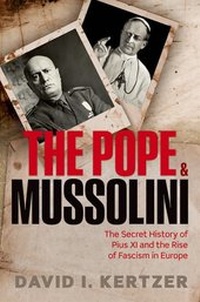
The Pope and Mussolini
The Secret History of Pius XI and the Rise of Fascism in Europe
Published on 27. February 2014
Book
Hardback
592 pages
978-0-19-871616-7 (ISBN)
Description
This is the compelling story of Pope Pius XI's secret relations with Benito Mussolini. A ground-breaking work, based on seven years of research in the Vatican and Fascist archives by US National Book Award-finalist David Kertzer, it will forever change our understanding of the Vatican's role in the rise of Fascism in Europe.
Both Pope Pius XI and Mussolini came to power in Rome in 1922. One was scholarly and devout, the other a violent bully. Yet they also had traits in common. Both had explosive tempers. Both bristled at the charge of being the patsy of the other. Both demanded unquestioned obedience from their subordinates, whose knees literally quaked in fear of provoking their wrath. Both came to be disillusioned by the other, yet dreaded what would happen if their alliance were to end.
The book unravels for the first time the key role played between pope and dictator by the shadowy Jesuit go-between, dubbed Mussolini's Rasputin. It also reveals the details of the secret agreement worked out by Mussolini with the pope's personal envoy, offering Vatican support for Italy's notorious, anti-Semitic 'racial laws'. And dramatic new light is shed on the controversial figure of Eugenio Pacelli, who (as Pope Pius XII) would later come to be idolized by some and reviled by others for
his silence during the Holocaust. In his role as Vatican Secretary of State, Pacelli had to struggle to keep the pope's explosive temper from leading to a break with both Mussolini and Nazi Germany, as the Italian dictator increasingly embraced the German Fuehrer, whom Pius detested.
With the recent opening of the Vatican archives covering Pius XI's papacy, the full story of the two men's relationship can now be told for the first time. It is an account that destroys the widely accepted myth of a heroic Church doing battle with the Fascist regime. On the contrary, as David Kertzer shows, Mussolini would not have been able to impose his dictatorship on Italy without the pope's support. In exchange, the pope expected Mussolini to use his repressive reach to enforce Catholic
morality - and return the Church to a position of power in Italy.
Both Pope Pius XI and Mussolini came to power in Rome in 1922. One was scholarly and devout, the other a violent bully. Yet they also had traits in common. Both had explosive tempers. Both bristled at the charge of being the patsy of the other. Both demanded unquestioned obedience from their subordinates, whose knees literally quaked in fear of provoking their wrath. Both came to be disillusioned by the other, yet dreaded what would happen if their alliance were to end.
The book unravels for the first time the key role played between pope and dictator by the shadowy Jesuit go-between, dubbed Mussolini's Rasputin. It also reveals the details of the secret agreement worked out by Mussolini with the pope's personal envoy, offering Vatican support for Italy's notorious, anti-Semitic 'racial laws'. And dramatic new light is shed on the controversial figure of Eugenio Pacelli, who (as Pope Pius XII) would later come to be idolized by some and reviled by others for
his silence during the Holocaust. In his role as Vatican Secretary of State, Pacelli had to struggle to keep the pope's explosive temper from leading to a break with both Mussolini and Nazi Germany, as the Italian dictator increasingly embraced the German Fuehrer, whom Pius detested.
With the recent opening of the Vatican archives covering Pius XI's papacy, the full story of the two men's relationship can now be told for the first time. It is an account that destroys the widely accepted myth of a heroic Church doing battle with the Fascist regime. On the contrary, as David Kertzer shows, Mussolini would not have been able to impose his dictatorship on Italy without the pope's support. In exchange, the pope expected Mussolini to use his repressive reach to enforce Catholic
morality - and return the Church to a position of power in Italy.
Reviews / Votes
[a] splendid study ... The Pope and Mussolini: The Secret History of Pius XI and the Rise of Fascism, furthermore, is not only meticulously documented, it is very well written. The book marvelously illustrates the larger issues as they played out on very personal levels, from Vatican backstabbing to Mussolini's family relationships. Kertzer's narrative is accessible, lively, and engaging * Roy Domenico, American Historical Review * there is much that is of interest * European History Quarterly *More details
Language
English
Place of publication
Oxford
United Kingdom
Target group
Professional and scholarly
Dimensions
Height: 241 mm
Width: 162 mm
Thickness: 36 mm
Weight
996 gr
ISBN-13
978-0-19-871616-7 (9780198716167)
Copyright in bibliographic data and cover images is held by Nielsen Book Services Limited or by the publishers or by their respective licensors: all rights reserved.
Schweitzer Classification
Other editions
Additional editions
David I. Kertzer
The Pope and Mussolini
The Secret History of Pius XI and the Rise of Fascism in Europe
E-Book
02/2014
1st Edition
OUP eBook
€21.99
Available for download
David I. Kertzer
The Pope and Mussolini
The Secret History of Pius XI and the Rise of Fascism in Europe
E-Book
02/2014
1st Edition
OUP eBook
€21.99
Available for download
Person
David Kertzer is Paul Dupee University Professor of Social Science at Brown University, where he is also professor of anthropology and Italian studies. His Kidnapping of Edgardo Mortara was a finalist for the National Book Award in the U.S. in 1997, and he has twice received the Marraro Prize from the Society for Italian Historical Studies for the best work on Italian history. His 2001 book, The Popes Against the Jews, a look at the Vatican's role
in the rise of modern anti-Semitism, has been published in several languages. He is co-founder former co-editor of the Journal of Modern Italian Studies. In 2005 Kertzer was elected a member of the American Academy of Arts and Sciences. From 2006 to 2011 he was the Provost of Brown University.
in the rise of modern anti-Semitism, has been published in several languages. He is co-founder former co-editor of the Journal of Modern Italian Studies. In 2005 Kertzer was elected a member of the American Academy of Arts and Sciences. From 2006 to 2011 he was the Provost of Brown University.
Content
PART ONE: THE POPE AND THE DICTATOR; PART TWO: ENEMIES IN COMMON; PART THREE: MUSSOLINI, HITLER, AND THE JEWS