

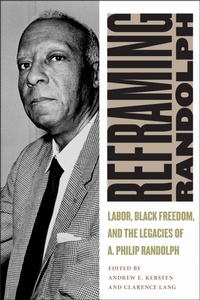
Reframing Randolph
Labor, Black Freedom, and the Legacies of a. Philip Randolph
Published on 9. January 2015
Book
Hardback
320 pages
978-0-8147-8594-2 (ISBN)
Description
At
one time, Asa Philip Randolph (1889-1979) was a household name. As president of
the all-black Brotherhood of Sleeping Car Porters (BSCP), he was an embodiment
of America's multifaceted radical tradition, a leading spokesman for Black
America, and a potent symbol of trade unionism and civil rights agitation for
nearly half a century. But with the dissolution of the BSCP in the 1970s, the
assaults waged against organized labor in the 1980s, and the overall silencing
of labor history in U.S. popular discourse, he has been largely forgotten among
large segments of the general public before whom he once loomed so large.
Historians, however, have not only continued to focus on Randolph himself, but
his role (either direct, or via his legacy) in a wide range of social,
political, cultural, and even religious milieu and movements.
The authors of Reframing Randolph have taken Randolph's dusty portrait down from
the wall to reexamine and reframe it, allowing scholars to regard him in new,
and often competing, lights. This collection of essays gathers, for the very
first time, many genres of perspectives on Randolph. Featuring both established
and emergent intellectual voices, this project seeks to avoid both hagiography
and blanket condemnation alike. The contributors represent the diverse ways
that historians have approached the importance of his long and complex career
in the main political, social, and cultural currents of twentieth-century
African American specifically, and twentieth-century U.S. history overall. The
central goal of Reframing Randolph is
to achieve a combination of synthetic and critical reappraisal.
one time, Asa Philip Randolph (1889-1979) was a household name. As president of
the all-black Brotherhood of Sleeping Car Porters (BSCP), he was an embodiment
of America's multifaceted radical tradition, a leading spokesman for Black
America, and a potent symbol of trade unionism and civil rights agitation for
nearly half a century. But with the dissolution of the BSCP in the 1970s, the
assaults waged against organized labor in the 1980s, and the overall silencing
of labor history in U.S. popular discourse, he has been largely forgotten among
large segments of the general public before whom he once loomed so large.
Historians, however, have not only continued to focus on Randolph himself, but
his role (either direct, or via his legacy) in a wide range of social,
political, cultural, and even religious milieu and movements.
The authors of Reframing Randolph have taken Randolph's dusty portrait down from
the wall to reexamine and reframe it, allowing scholars to regard him in new,
and often competing, lights. This collection of essays gathers, for the very
first time, many genres of perspectives on Randolph. Featuring both established
and emergent intellectual voices, this project seeks to avoid both hagiography
and blanket condemnation alike. The contributors represent the diverse ways
that historians have approached the importance of his long and complex career
in the main political, social, and cultural currents of twentieth-century
African American specifically, and twentieth-century U.S. history overall. The
central goal of Reframing Randolph is
to achieve a combination of synthetic and critical reappraisal.
Reviews / Votes
"The volume succeeds admirably, building a series of partially overlapping portraits from different perspectives but also through lenses of varied focal length." (Journal of American History) "The essays in this important collection . . . probe the breadth and depth of Randolph's social, economic, and political beliefs and leadership commitments during his path breaking yet often contentiouscareer. . . . The collection not only reinterprets Randolph and reframes his place in history, thus complicating our understanding of Randolph in his time, but suggests ways his legacy speaks to struggles for economic and social justice in our time." - Beth T. Bates,Wayne State University "Reframing Randolph is a terrific examination of one of the twentieth centurys most important social and political figures. Along with a stellar list of contributors, Kersten and Lang provide an unmatched assessment of Randolphs social and political activism and labor organizing that uncovers important new insights and exposes critical nuances of his thought and character." - Cornelius L. Bynum,author of A. Philip Randolph and the Struggle for Civil RightsMore details
Series
Language
English
Place of publication
New York
United States
Target group
Professional and scholarly
Product notice
Trade binding
Dimensions
Height: 251 mm
Width: 142 mm
Thickness: 25 mm
Weight
544 gr
ISBN-13
978-0-8147-8594-2 (9780814785942)
Copyright in bibliographic data and cover images is held by Nielsen Book Services Limited or by the publishers or by their respective licensors: all rights reserved.
Schweitzer Classification
Other editions
Additional editions
Andrew E. Kersten | Clarence Lang
Reframing Randolph
Labor, Black Freedom, and the Legacies of a. Philip Randolph
E-Book
01/2015
1st Edition
New York University Press
€105.99
Available for download
Andrew E. Kersten | Clarence Lang
Reframing Randolph
Labor, Black Freedom, and the Legacies of a. Philip Randolph
E-Book
01/2015
New York University Press
€45.99
Available for download
Persons
Andrew Kersten is Dean of the College of Letters, Arts, and Social Sciences at the University of Idaho.
Clarence Lang is Associate Professor of African & African American Studies, and American Studies, at the University of Kansas. He is the author of Grassroots at the Gateway: Class Politics and Black Freedom Struggle in St. Louis, 1936-75.
Clarence Lang is Associate Professor of African & African American Studies, and American Studies, at the University of Kansas. He is the author of Grassroots at the Gateway: Class Politics and Black Freedom Struggle in St. Louis, 1936-75.
Content
Contents Foreword ix Arlene Holt Baker 1 A Reintroduction to Asa Philip Randolph 1 Andrew E. Kersten and Clarence Lang 2 Researching Randolph: Shifting Historiographic Perspectives 21 Joe William Trotter, Jr. 3 A. Philip Randolph: Emerging Socialist Radical 45 Eric Arnesen 4 Keeping His Faith: A. Philip Randolph's Working-Class Religion 77 Cynthia Taylor 5 Brotherhood Men and Singing Slackers: A. Philip Randolph's Rhetoric of Music and Manhood 101 Robert Hawkins 6 "The Spirit and Strategy of the United Front": Randolph and the National Negro Congress, 1936-1940 129 Erik S. Gellman 7 Organizing Gender: A. Philip Randolph and Women Activists 163 Melinda Chateauvert 8 Beyond A. Philip Randolph: Grassroots Protest and the March on Washington Movement 195 David Lucander 9 The "Void at the Center of the Story": The Negro American Labor Council and the Long Civil Rights Movement 223 William P. Jones 10 No Exit: A. Philip Randolph and the Ocean Hill-Brownsville Crisis 245 Jerald Podair Select Bibliography 271 About the Contributors 275 Index 279