

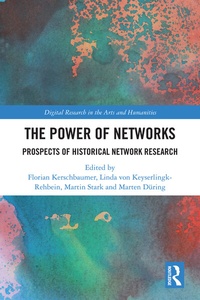
The Power of Networks
Prospects of Historical Network Research
1st Edition
Published on 27. April 2020
Book
Hardback
302 pages
978-1-138-73130-1 (ISBN)
Description
The Power of Networks describes a typology of network-based research practices in the historical disciplines, ranging from the use of quantitative network analysis in cultural, economic, social or political history or religious studies, to novel approaches in the Digital Humanities.
Network data visualisations and calculations have proven to be useful tools for the analysis of mostly textual sources containing relational information, offering new perspectives on complex historical phenomena. Including case studies from antiquity to contemporary history, the book provides a clear demonstration of the opportunities historical network research (HNR) provides for historical studies. The examples presented within the pages of this volume are arranged in a way to highlight three central typological pillars of HNR: (re-)construction and analysis of historical networks; computational extraction of network data and infrastructures for data collection and exploration.
The Power of Networks outlines the history and current state of research in HNR and points towards future research frontiers in the wake of new digital technologies. As such, the book should be essential reading for academics, students and practitioners with an interest in digital humanities, history, archaeology and religion.
Network data visualisations and calculations have proven to be useful tools for the analysis of mostly textual sources containing relational information, offering new perspectives on complex historical phenomena. Including case studies from antiquity to contemporary history, the book provides a clear demonstration of the opportunities historical network research (HNR) provides for historical studies. The examples presented within the pages of this volume are arranged in a way to highlight three central typological pillars of HNR: (re-)construction and analysis of historical networks; computational extraction of network data and infrastructures for data collection and exploration.
The Power of Networks outlines the history and current state of research in HNR and points towards future research frontiers in the wake of new digital technologies. As such, the book should be essential reading for academics, students and practitioners with an interest in digital humanities, history, archaeology and religion.
More details
Series
Language
English
Place of publication
London
United Kingdom
Publishing group
Taylor & Francis Ltd
Target group
College/higher education
Illustrations
63 s/w Abbildungen, 20 s/w Photographien bzw. Rasterbilder, 43 s/w Zeichnungen, 9 s/w Tabellen
9 Tables, black and white; 43 Line drawings, black and white; 20 Halftones, black and white; 63 Illustrations, black and white
Dimensions
Height: 234 mm
Width: 156 mm
Weight
453 gr
ISBN-13
978-1-138-73130-1 (9781138731301)
Copyright in bibliographic data and cover images is held by Nielsen Book Services Limited or by the publishers or by their respective licensors: all rights reserved.
Schweitzer Classification
Other editions
Additional editions
Florian Kerschbaumer | Linda von Keyserlingk-Rehbein | Martin Stark
The Power of Networks
Prospects of Historical Network Research
Book
12/2021
1st Edition
Routledge
€67.80
Shipment within 10-20 days
Florian Kerschbaumer | Linda von Keyserlingk-Rehbein | Martin Stark
The Power of Networks
Prospects of Historical Network Research
E-Book
04/2020
1st Edition
Routledge
€60.49
Available for download
Florian Kerschbaumer | Linda von Keyserlingk-Rehbein | Martin Stark
The Power of Networks
Prospects of Historical Network Research
E-Book
04/2020
1st Edition
Routledge
€60.49
Available for download
Persons
Florian Kerschbaumer is Project Manager at the Danube University Krems and Lecturer at the University of Klagenfurt, Austria.
Linda von Keyserlingk-Rehbein is Curator and Head of the Document Department in the Military History Museum, Dresden, Germany.
Martin Stark is Senior Researcher at the ILS- Research Institute for Regional and Urban Development, Dortmund, Germany.
Marten Duering is Assistant Professor/Senior Research Scientist at the Luxembourg Centre for Contemporary and Digital History (C (2)DH) at the University of Luxembourg.
Linda von Keyserlingk-Rehbein is Curator and Head of the Document Department in the Military History Museum, Dresden, Germany.
Martin Stark is Senior Researcher at the ILS- Research Institute for Regional and Urban Development, Dortmund, Germany.
Marten Duering is Assistant Professor/Senior Research Scientist at the Luxembourg Centre for Contemporary and Digital History (C (2)DH) at the University of Luxembourg.
Content
1. Introduction
Part I: (Re-)construction of historical networks and their analysis
Networking the Res Publica. Social Network Analysis and the Republican Rome
Community detection and structural balance: network analytical modelling of political structures and actions in the Middle Ages
The Value of Network Analysis in Historical Sociology: Economic and Social Relations in Medieval
in Medieval Luebeck
4. Flemish Merchant Networks in Early Modern Seville. Approaches, Comparisons, and Methodical Considerations
5. Kinship Networks in Northwestern German Rural Society (18th/19th Centuries)
6. Mobility and Movements in Intellectual History: a Social Network Approach
3. Computational extraction of network data from large corpora
Utilizing Historical Network Analysis on Meta-data to Model East German Foreign Intelligence Cycle in the Baltic Sea Region 1975-1989
Social and semantic network analysis in the study of religions
4. Infrastructures for data collection and exploration
Deep Networks as Associative Interfaces to Historical Research
Networks as Gateways. Gleanings from Applications for the Exploration of Historical Data
5. Outlook
Historical Network Research, Digital History, and Digital Humanities
Part I: (Re-)construction of historical networks and their analysis
Networking the Res Publica. Social Network Analysis and the Republican Rome
Community detection and structural balance: network analytical modelling of political structures and actions in the Middle Ages
The Value of Network Analysis in Historical Sociology: Economic and Social Relations in Medieval
in Medieval Luebeck
4. Flemish Merchant Networks in Early Modern Seville. Approaches, Comparisons, and Methodical Considerations
5. Kinship Networks in Northwestern German Rural Society (18th/19th Centuries)
6. Mobility and Movements in Intellectual History: a Social Network Approach
3. Computational extraction of network data from large corpora
Utilizing Historical Network Analysis on Meta-data to Model East German Foreign Intelligence Cycle in the Baltic Sea Region 1975-1989
Social and semantic network analysis in the study of religions
4. Infrastructures for data collection and exploration
Deep Networks as Associative Interfaces to Historical Research
Networks as Gateways. Gleanings from Applications for the Exploration of Historical Data
5. Outlook
Historical Network Research, Digital History, and Digital Humanities