

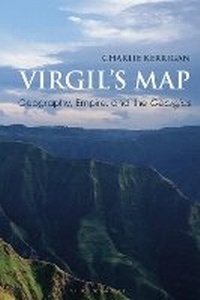
Virgil's Map
Geography, Empire, and the Georgics
Published on 21. April 2022
Book
Paperback/Softback
216 pages
978-1-350-19490-8 (ISBN)
Description
Virgil's Georgics depicts the world and its peoples in great detail, but this geographical interest has received little detailed scholarly attention. Hundreds of years later, readers in the British empire used the poem to reflect upon their travels in acts of imagination no less political than Virgil's own. Virgil's Map combines a comprehensive survey of the literary, economic, and political geography of the Georgics with a case study of its British imperial reception c. 1840-1930.
Part One charts the poem's geographical interests in relation to Roman power in and beyond the Mediterranean; shifting readers' attention away from Rome, it explores how the Georgics can draw attention to alternative, non-Roman histories. Part Two examines how British travellers quoted directly from the poem to describe peoples and places across the world, at times equating the colonial subjects of European empires to the 'happy farmers' of Virgil's poem, perceived to be unaware, and in need, of the blessings of colonial rule.
Drawing attention to the depoliticization of the poem in scholarly discourse, and using newly discovered archival material, this interdisciplinary work seeks to re-politicize both the poem and its history in service of a decolonizing pedagogy. Its unique dual focus allows for an extended exploration, not just of geography and empire, but of Europe's long relationship with the wider world.
Part One charts the poem's geographical interests in relation to Roman power in and beyond the Mediterranean; shifting readers' attention away from Rome, it explores how the Georgics can draw attention to alternative, non-Roman histories. Part Two examines how British travellers quoted directly from the poem to describe peoples and places across the world, at times equating the colonial subjects of European empires to the 'happy farmers' of Virgil's poem, perceived to be unaware, and in need, of the blessings of colonial rule.
Drawing attention to the depoliticization of the poem in scholarly discourse, and using newly discovered archival material, this interdisciplinary work seeks to re-politicize both the poem and its history in service of a decolonizing pedagogy. Its unique dual focus allows for an extended exploration, not just of geography and empire, but of Europe's long relationship with the wider world.
Reviews / Votes
A very useful discussion of the socio-political and economic importance to the metropole of the myriad places and peoples of (or potentially of) the Roman empire referenced by the Georgics, and a good compendium of more modern references to the Georgics in the context of British imperialism during the years 1840 to 1930. * The Classical Review * Kerrigan makes a powerful case for the repoliticization of the Georgics, a text that has been over-aestheticized in its reception from the time of Joseph Addison onwards. He proposes a decolonializing reading as a complement to existing interpretations and offers a brilliant pedagogic model for classicists to pursue. -- Susanna Braund, Professor of Latin Poetry and its Reception, University of British Columbia, CanadaMore details
Series
Language
English
Place of publication
London
United Kingdom
Publishing group
Bloomsbury Publishing PLC
Target group
College/higher education
Dimensions
Height: 232 mm
Width: 154 mm
Thickness: 14 mm
Weight
360 gr
ISBN-13
978-1-350-19490-8 (9781350194908)
Copyright in bibliographic data and cover images is held by Nielsen Book Services Limited or by the publishers or by their respective licensors: all rights reserved.
Schweitzer Classification
Other editions
Additional editions
E-Book
09/2020
1st Edition
Bloomsbury Academic
€35.49
Available for download
E-Book
09/2020
1st Edition
Bloomsbury Academic
€35.49
Available for download
Person
Charlie Kerrigan is a Research Fellow in Classics at Trinity College Dublin, Ireland.
Content
Acknowledgements
Abbreviations
Introduction
Part One: Rome and the Roman empire, 29 BCE
1. The World and its Peoples
2. Provincializing Rome
3. Civil War
4. 'All Italy'
Part Two: Britain and the British empire, c. 1840-1930
5. An Aesthetic Trend
6. The Georgics Abroad
7. 'Happy Farmers'
8. The Georgics At Home
Conclusion: Towards a Decolonizing Pedagogy of Latin Literature
Appendix: The Geography of the Georgics
Notes
References
Index of passages from the Georgics
Index
Abbreviations
Introduction
Part One: Rome and the Roman empire, 29 BCE
1. The World and its Peoples
2. Provincializing Rome
3. Civil War
4. 'All Italy'
Part Two: Britain and the British empire, c. 1840-1930
5. An Aesthetic Trend
6. The Georgics Abroad
7. 'Happy Farmers'
8. The Georgics At Home
Conclusion: Towards a Decolonizing Pedagogy of Latin Literature
Appendix: The Geography of the Georgics
Notes
References
Index of passages from the Georgics
Index