

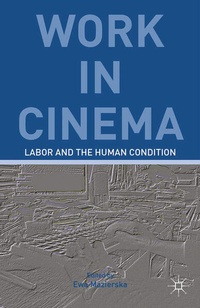
Work in Cinema
Labor and the Human Condition
Published on 18. December 2013
Book
Paperback/Softback
VI, 296 pages
978-1-349-47544-5 (ISBN)
Description
Cinema frequently depicts various types of work, but this representation is never straightforward. It depends on and reflects many factors, especially the place and time the film is made and the type of audience it addresses. Here, the contributors employ transnational and transhistorical perspectives to compare filmic depictions of work.
Reviews / Votes
"This is a timely and stimulating book. It shows, convincingly and compellingly, that far from simply ignoring work, cinema has probed and investigated it in original and important ways. The book explores cinematic history but is, above all, of the current moment. At its most productive when it brings together contemporary theories of work with careful close analysis of films, it is required reading for anyone interested in the representation of work and associated subjectivities." - Martin O'Shaughnessy, Professor of Film Studies, Nottingham Trent University, UK
More details
Edition
1st ed. 2013
Language
English
Place of publication
New York
United States
Target group
Professional and scholarly
Illustrations
VI, 296 p.
Dimensions
Height: 216 mm
Width: 140 mm
Thickness: 17 mm
Weight
385 gr
ISBN-13
978-1-349-47544-5 (9781349475445)
DOI
10.1057/9781137370860
Schweitzer Classification
Other editions
Additional editions
Book
12/2013
Palgrave MacMillan
€53.49
Shipment within 10-20 days
Person
Alice Bardan, University of Southern California, USA
Ib Bondebjerg, University of Copenhagen, Denmark
William Brown, Roehampton University, UK
Ian Fraser, Loughborough University, UK
?aneta Jamrozik, Jagiellonian University, Poland
Lars Kristensen, University of Skövde, Sweden
Alexandar Mihailovic, Hofstra University, USA
Eva Näripea, Estonian Academy of Arts, Estonia
Jonathan L. Owen, Exeter University, UK
David Sorfa, Liverpool John Moores University, UK
Christina Stojanova, University of Regina, Canada
Alfredo Suppia, Federal University of Juiz de Fora, Brazil
Glyn White, University of Salford, UK
Content
Introduction: Work, Struggle and Cinema; Ewa Mazierska PART I: NEO-LIBERAL WORK 1. Affective Labor and Alienation in Up in the Air; Ian Fraser 2. Becoming Cinema: The Social Network, Exploitation in the Digital Age, and the Film Industry; William Brown 3. The New European Cinema of Precarity: A Transnational Perspective; Alice Bardan 4. Acting as Value in the Age of Neoliberalism: Juliette Binoche in Michael Haneke's Code Unknown; ?aneta Jamrozik PART II: NATIONAL AND TRANSNATIONAL CINEMAS 5. The Trauma of Daedalus: The Labyrinth of Labour in Brazilian Cinema; Alfredo Suppia 6. Beyond Work and Sex in Czech Cinema; David Sorfa 7. Desensitised Migrants: Organised Crime Workers in David Cronenberg's Eastern Promises and Aleksei Balabanov's Stoker; Alexandar Mihailovic 8. The Damnation of Labour in the Films of Bela Tarr; Christina Stojanova PART III: GENRE 9. You Don't Have to be Crazy to Work, But it Helps: Work in Comedies of the 1930s; Glyn White 10. The Migrations of Factory Style: Work, Play and Work-as-Play in Andy Warhol, Chantal Akerman and Apichatpong Weerasethakul; Jonathan L. Owen 11. Work in Outer Space: Notes on Eastern European Science Fiction Cinema; Eva Näripea 12. Work in Bicycle Cinema: From Race Rider to City Courier; Lars Kristensen 13. Documentaries, Work and Global Challenges; Ib Bondebjerg