

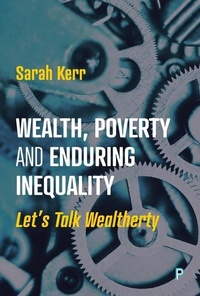
Wealth, Poverty and Enduring Inequality
Let's Talk Wealtherty
1st Edition
Published on 27. September 2024
Book
Paperback/Softback
256 pages
978-1-4473-7056-7 (ISBN)
Description
The rich and the poor in the UK are subject to radically different legislative approaches. While the behaviours of the poor are relentlessly scrutinised, those of the rich are ignored or enabled.
In this book, Sarah Kerr suggests that we live in a state of 'wealtherty', characterised by the hyper-concentration of wealth and a stark distinction between the rich and the rest. Drawing on evidence from the 1500s onwards, she reveals a long history of government scrutiny of the poor and ignorance of the rich. She contests contemporary policy and practice which disregards the enduring role of the rich in the production of poverty and poverty in the production of the rich.
In pursuit of social and economic justice, this radical book challenges policy makers and researchers to stop talking about poverty and to start addressing the problems caused by wealtherty.
In this book, Sarah Kerr suggests that we live in a state of 'wealtherty', characterised by the hyper-concentration of wealth and a stark distinction between the rich and the rest. Drawing on evidence from the 1500s onwards, she reveals a long history of government scrutiny of the poor and ignorance of the rich. She contests contemporary policy and practice which disregards the enduring role of the rich in the production of poverty and poverty in the production of the rich.
In pursuit of social and economic justice, this radical book challenges policy makers and researchers to stop talking about poverty and to start addressing the problems caused by wealtherty.
Reviews / Votes
"Sarah Kerr has written an angry, compelling book about how we need to see wealth as a social problem, and end our stigmatising perspectives on poverty. This book will make you see the world quite differently!" Mike Savage, London School of Economics and Political Science "A vital critique of the idea, conveniently promoted by generations of political leaders, that today's mass impoverishment is independent of extreme inequality." Stewart Lansley, author of The Richer The Poorer: How Britain Enriched the Few and Failed the PoorMore details
Edition
First Edition
Language
English
Place of publication
Bristol
United Kingdom
Publishing group
Bristol University Press
Target group
Professional and scholarly
Illustrations
10 s/w Tabellen, 20 s/w Abbildungen
10 Tables, black and white; 20 Illustrations, black and white
Dimensions
Height: 233 mm
Width: 153 mm
Thickness: 15 mm
Weight
366 gr
ISBN-13
978-1-4473-7056-7 (9781447370567)
Copyright in bibliographic data and cover images is held by Nielsen Book Services Limited or by the publishers or by their respective licensors: all rights reserved.
Schweitzer Classification
Other editions
Additional editions
E-Book
09/2024
1st Edition
Policy Press
€40.99
Available for download
Book
09/2024
1st Edition
Policy Press
€129.50
Shipment within 15-20 days
Person
Sarah Kerr is Research Fellow at LSE International Inequalities Institute. Her research interests are in the broad area of justice-making.
Content
Part I: What have we become?
1. Why wealtherty and why now?
2. The state of wealth and the state and wealth
Part II: how have we become what we are?
3. Knowing: how the state came to know richer and poorer people differently
4. Governing: how the state came to govern richer and poorer people differently
5. Being: how ways of governing enabled different forms of self for richer and poorer people
Part III: What sustains the problem?
6. Producing knowledge: think tanks and policy networks
7. Shaping behaviours: Space and the visual as tools of government
8. Shaping selves: wealth and identity
Part IV: In conclusion
9. Ways out
1. Why wealtherty and why now?
2. The state of wealth and the state and wealth
Part II: how have we become what we are?
3. Knowing: how the state came to know richer and poorer people differently
4. Governing: how the state came to govern richer and poorer people differently
5. Being: how ways of governing enabled different forms of self for richer and poorer people
Part III: What sustains the problem?
6. Producing knowledge: think tanks and policy networks
7. Shaping behaviours: Space and the visual as tools of government
8. Shaping selves: wealth and identity
Part IV: In conclusion
9. Ways out