

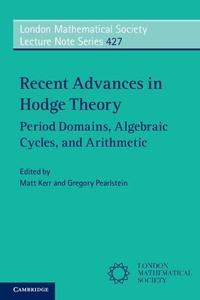
Recent Advances in Hodge Theory
Period Domains, Algebraic Cycles, and Arithmetic
Published on 4. February 2016
Book
Paperback/Softback
521 pages
978-1-107-54629-5 (ISBN)
Description
In its simplest form, Hodge theory is the study of periods - integrals of algebraic differential forms which arise in the study of complex geometry and moduli, number theory and physics. Organized around the basic concepts of variations of Hodge structure and period maps, this volume draws together new developments in deformation theory, mirror symmetry, Galois representations, iterated integrals, algebraic cycles and the Hodge conjecture. Its mixture of high-quality expository and research articles make it a useful resource for graduate students and seasoned researchers alike.
More details
Series
Language
English
Place of publication
Cambridge
United Kingdom
Target group
Professional and scholarly
Product notice
Paperback (trade)
Illustrations
Worked examples or Exercises; 7 Tables, black and white; 3 Halftones, black and white; 7 Line drawings, black and white
Dimensions
Height: 229 mm
Width: 152 mm
Thickness: 29 mm
Weight
764 gr
ISBN-13
978-1-107-54629-5 (9781107546295)
Copyright in bibliographic data and cover images is held by Nielsen Book Services Limited or by the publishers or by their respective licensors: all rights reserved.
Schweitzer Classification
Other editions
Additional editions
E-Book
02/2016
Cambridge University Press
€65.49
Available for download
Matt Kerr | Gregory Pearlstein
Recent Advances in Hodge Theory
Period Domains, Algebraic Cycles, and Arithmetic
E-Book
01/2016
Cambridge University Press
€78.49
Available for download
Persons
Matt Kerr is an Associate Professor of Mathematics at Washington University, St Louis, and an established researcher in Hodge theory and algebraic geometry. His work is supported by an FRG grant from the National Science Foundation. He is also co-author (with M. Green and P. Griffiths) of Mumford-Tate Groups and Domains: Their Geometry and Arithmetic and Hodge Theory, Complex Geometry, and Representation Theory. Gregory Pearlstein is an Associate Professor of Mathematics at Texas A&M University. He is an established researcher in Hodge theory and algebraic geometry and his work is supported by an FRG grant from the National Science Foundation.
Content
Preface Matt Kerr and Gregory Pearlstein; Introduction Matt Kerr and Gregory Pearlstein; List of conference participants; Part I. Hodge Theory at the Boundary: Part I(A). Period Domains and Their Compactifications: Classical period domains R. Laza and Z. Zhang; The singularities of the invariant metric on the Jacobi line bundle J. Burgos Gil, J. Kramer and U. Kuhn; Symmetries of graded polarized mixed Hodge structures A. Kaplan; Part I(B). Period Maps and Algebraic Geometry: Deformation theory and limiting mixed Hodge structures M. Green and P. Griffiths; Studies of closed/open mirror symmetry for quintic threefolds through log mixed Hodge theory S. Usui; The 14th case VHS via K3 fibrations A. Clingher, C. Doran, A. Harder, A. Novoseltsev and A. Thompson; Part II. Algebraic Cycles and Normal Functions: A simple construction of regulator indecomposable higher Chow cycles in elliptic surfaces M. Asakura; A relative version of the Beilinson-Hodge conjecture R. de Jeu, J. D. Lewis and D. Patel; Normal functions and spread of zero locus M. Saito; Fields of definition of Hodge loci M. Saito and C. Schnell; Tate twists of Hodge structures arising from abelian varieties S. Abdulali; Some surfaces of general type for which Bloch's conjecture holds C. Pedrini and C. Weibel; Part III. The Arithmetic of Periods: Part III(A). Motives, Galois Representations, and Automorphic Forms: An introduction to the Langlands correspondence W. Goldring; Generalized Kuga-Satake theory and rigid local systems I - the middle convolution S. Patrikis; On the fundamental periods of a motive H. Yoshida; Part III(B). Modular Forms and Iterated Integrals: Geometric Hodge structures with prescribed Hodge numbers D. Arapura; The Hodge-de Rham theory of modular groups R. Hain.