

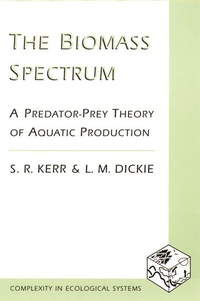
The Biomass Spectrum
A Predator-Prey Theory of Aquatic Production
Published on 29. August 2001
Book
Hardback
352 pages
978-0-231-08458-1 (ISBN)
Description
Kerr and Dickie propose the development of a new ecological theory, one that can lead to a more effective remedy for the drastic effects of heavy fishing on natural communities of organisms in both marine and freshwater environments. By plotting the densities of the biomass of all organisms in a given community by body-size classes, the authors provide empirical evidence of what they term "the biomass body-size spectrum" in the world's oceans. After examining this evidence, they propose an underlying theory of predator-prey energy transfer: larger species eat smaller species, providing energy exchange across all species within an ecosystem. Providing the first comprehensive synthesis of the energy flow within the biomass spectrum, this book demonstrates not only a new understanding of the self-organizing properties of ecological production systems but also the potential of the biomass spectrum methodology for offering practical remedies when these natural systems are exploited by humans.
More details
Series
Language
English
Place of publication
New York
United States
Target group
Professional and scholarly
Product notice
Trade binding
Illustrations
25 line art
Weight
638 gr
ISBN-13
978-0-231-08458-1 (9780231084581)
Copyright in bibliographic data and cover images is held by Nielsen Book Services Limited or by the publishers or by their respective licensors: all rights reserved.
Schweitzer Classification
Other editions
Additional editions
Book
08/2001
Columbia University Press
€47.04
Article not available at the moment
Persons
Stephen R. Kerr is Cox Fisheries Scientist-in-Residence in the Department of Biology at Dalhousie University. Lloyd M. Dickie is a scientist emeritus at the Bedford Oceanographic Institute and a fellow of the Royal Society of Canada.
Content
Choosing and Organizing Observations and Experiences The Empirical Evidence The Detailed Structure of the Spectrum Toward a Mathematical Model Feeding Relationships in the Spectrum Physiological Bases for Spectra System Properties of Biomass Spectra Alternative Views of the System Underlying Fisheries Levels of Ecological System Output Implications for Fisheries Management Final Observations