

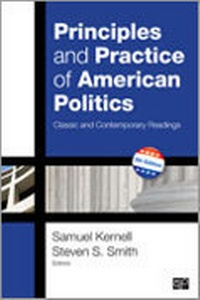
Principles and Practice of American Politics
Classic and Contemporary Readings
5th Edition
Published on 5. September 2012
Book
Paperback/Softback
752 pages
978-1-4522-2628-6 (ISBN)
Description
Combining timeless readings with cutting-edge, current selections, Kernell and Smith bring judicious editing and important context for students learning the ropes of American government. This collection effectively examines the strategic behavior of key players in American politics, showing that political actors, though motivated by their own interests, are governed by the Constitution, the law, and institutional rules, as well as influenced by the strategies of others. The 5th edition features 17 new readings, including 5 pieces written specifically for this volume. True to form, each and every selection is artfully framed by Kernell and SmithAEs headnotes, providing an invaluable grounding for todayAEs students.
More details
Edition
5th Revised edition
Language
English
Place of publication
Washington
United States
Publishing group
SAGE Publications Inc
Target group
College/higher education
Edition type
Revised edition
Dimensions
Height: 229 mm
Width: 152 mm
Weight
900 gr
ISBN-13
978-1-4522-2628-6 (9781452226286)
Copyright in bibliographic data and cover images is held by Nielsen Book Services Limited or by the publishers or by their respective licensors: all rights reserved.
Schweitzer Classification
Other editions
New editions
Samuel H. Kernell | Steven Smith
Principles and Practice of American Politics
Classic and Contemporary Readings
Book
04/2015
6th Edition
SAGE Publications Inc
€65.87
Article is exhausted; no reprint
Previous edition
Samuel H. Kernell | Steven Smith
Principles and Practice of American Politics
Classic and Contemporary Readings
Book
08/2009
4th Edition
CQ Press
€68.35
Article exhausted; check for reprint
Persons
Samuel Kernell is distinguished emeritus professor of political science at the University of California, San Diego, where he has taught since 1977. Kernell's research interests focus on the presidency, political communication, and American political history. His books include Veto Rhetoric: A Leadership Strategy for Divided Government; Going Public: New Strategies of Presidential Leadership, 4th edition; Strategy and Choice in Congressional Elections, 2nd edition (with Gary C. Jacobson); and Party Ballots, Reform, and the Transformation of America's Electoral System (with Erik J. Engstrom). He has also edited Parallel Politics: Economic Policymaking in Japan and the United States; The Politics of Divided Government (with Gary W. Cox); and James Madison: The Theory and Practice of Republican Government. He is presently writing an intellectual biography of James H. Rowe.
Steven S. Smith is professor in the School of Politics and Global Studies at Arizona State University. He also is the Kate M. Gregg Emeritus Professor of Social Sciences and former Director of the Weidenbaum Center at Washington University. In addition to Wash U, he has been on the faculties of the University of Minnesota, George Washington University, and Northwestern University, and was a senior fellow at the Brookings Institution. He is the author or coauthor of Politics Over Process: Partisan Conflict and Post-Passage Processes in the U.S. Congress (2017), The American Congress (10 editions, 1995-2019), The Senate Syndrome: The Evolution of Parliamentary Warfare in the Modern U.S. Senate (2014), Party Influence in Congress (2007), The Politics of Institutional Choice: The Formation of the Russian State Duma (2001), Politics or Principle: Filibustering in the United States Senate (1997), Call to Order: Floor Politics in the House and Senate (1989), Managing Uncertainty in the House of Representatives: Adaptation and Innovation in Special Rules (1988), Committees in Congress (1984, 1990, 1997).
Steven S. Smith is professor in the School of Politics and Global Studies at Arizona State University. He also is the Kate M. Gregg Emeritus Professor of Social Sciences and former Director of the Weidenbaum Center at Washington University. In addition to Wash U, he has been on the faculties of the University of Minnesota, George Washington University, and Northwestern University, and was a senior fellow at the Brookings Institution. He is the author or coauthor of Politics Over Process: Partisan Conflict and Post-Passage Processes in the U.S. Congress (2017), The American Congress (10 editions, 1995-2019), The Senate Syndrome: The Evolution of Parliamentary Warfare in the Modern U.S. Senate (2014), Party Influence in Congress (2007), The Politics of Institutional Choice: The Formation of the Russian State Duma (2001), Politics or Principle: Filibustering in the United States Senate (1997), Call to Order: Floor Politics in the House and Senate (1989), Managing Uncertainty in the House of Representatives: Adaptation and Innovation in Special Rules (1988), Committees in Congress (1984, 1990, 1997).
Content
Chapter 1. Designing Institutions
from The Logic of Collective Action - Mancur Olson Jr.
The Tragedy of the Commons - Garrett Hardin
The Citizenship Agenda - Bruce Ackerman
Chapter 2. The Constitutional Framework
The Founding Fathers: A Reform Caucus in Action - John P. Roche Jr.
Anti-Federalist No. 3 - Brutus
Federalist No. 10 - James Madison
Federalist No. 51 - James Madison
Chapter 3. Federalism
Federalist No. 39 - James Madison
Federalism: Sorting Out Who Does What - Donald F. Kettl
A Separate Peace - Jonathan Rauch
An American History Lesson For Europe - Thomas J. Sargent
Chapter 4. Civil Rights
from The Race Card - Richard Thompson Ford
Immigrants and the Changing Categories of Race - Kenneth Prewitt
Chapter 5. Civil Liberties
from Republic.com 2.0 - Cass R. Sunstein
A Liberal Vision of U.S. Family Law in 2020 - William N. Eskridge, Jr.
Roe v. Wade - Supreme Court of the United States
The Real World of Constitutional Rights: The Supreme Court and the Implementation of the Abortion Decisions - Gerald N. Rosenberg
Chapter 6. Congress
Congress, the Troubled Institution - Steven S. Smith
The Politics of Legislative Stalemate - Sarah A. Binder
Congressional Committees in a Continuing Partisan Era - John H. Aldrich and David W. Rohde
Chapter 7. The Presidency
from Presidential Power - Richard E. Neustadt
The Institutional Presidency - John P. Burke
from Going Public - Samuel Kernell
Chapter 8. The Bureaucracy
The Politics of Bureaucratic Structure - Terry M. Moe
Bush and the Bureaucracy: A Crusade for Control - Paul Singer
from The Politics of Presidential Appointments - David E. Lewis
Administrative Procedures as Instruments of Political Control - Matthew McCubbins, Roger G. Noll, and Barry R. Weingast
Chapter 9. The Judiciary
from A Matter of Interpretation: Federal Courts and the Law - Antonin Scalia
from Active Liberty - Stephen Breyer
Federalist No. 78 - Alexander Hamilton
The Voting Behavior of Barack Obama's Judges: As Far Left as Some Opponents Say or Just Mainstream Liberals? - Robert A. Carp, Kenneth L. Manning, and Ronald Stidham
Chapter 10. Public Opinion
Analyzing and Interpreting Polls - Herbert Asher
Dynamic Representation - James A. Stimson, Michael B. MacKuen, and Robert S. Erikson
from Culture War? The Myth of a Polarized America - Morris P. Fiorina
How Divided Are We? - James Q. Wilson
Religion in American Politics - Robert D. Putnam and David E. Campbell
Chapter 11. Voting, Campaigns, and Elections
from The Reasoning Voter - Samuel L. Popkin
No Compromise: The Electoral Origins of Legislative Gridlock - Gary C. Jacobson
from Air Wars - Darrell M. West
America's Ignorant Voters - Michael Schudson
Super PACs and Secret Money - Paul Blumental
Chapter 12. Political Parties
from Why Parties? - John H. Aldrich
Partisanship and Voting Behavior, 1952-1996 - Larry M. Bartels
Parties as Problem Solvers - Morris P. Fiorina
Chapter 13. Interest Groups
The Scope and Bias of the Pressure System - E. E. Schattschneider
The Evolution of Interest Groups - John R. Wright
Buying Time: Moneyed Interests and the Mobilization of Bias in Congressional Committees - Richard L. Hall and Frank W. Wayman
Chapter 14. News Media
The Market and the Media - James T. Hamilton
from War Stories - Matthew A. Baum and Tim J. Groeling
Understanding the Participatory News Consumer - Pew Research Center
from The Logic of Collective Action - Mancur Olson Jr.
The Tragedy of the Commons - Garrett Hardin
The Citizenship Agenda - Bruce Ackerman
Chapter 2. The Constitutional Framework
The Founding Fathers: A Reform Caucus in Action - John P. Roche Jr.
Anti-Federalist No. 3 - Brutus
Federalist No. 10 - James Madison
Federalist No. 51 - James Madison
Chapter 3. Federalism
Federalist No. 39 - James Madison
Federalism: Sorting Out Who Does What - Donald F. Kettl
A Separate Peace - Jonathan Rauch
An American History Lesson For Europe - Thomas J. Sargent
Chapter 4. Civil Rights
from The Race Card - Richard Thompson Ford
Immigrants and the Changing Categories of Race - Kenneth Prewitt
Chapter 5. Civil Liberties
from Republic.com 2.0 - Cass R. Sunstein
A Liberal Vision of U.S. Family Law in 2020 - William N. Eskridge, Jr.
Roe v. Wade - Supreme Court of the United States
The Real World of Constitutional Rights: The Supreme Court and the Implementation of the Abortion Decisions - Gerald N. Rosenberg
Chapter 6. Congress
Congress, the Troubled Institution - Steven S. Smith
The Politics of Legislative Stalemate - Sarah A. Binder
Congressional Committees in a Continuing Partisan Era - John H. Aldrich and David W. Rohde
Chapter 7. The Presidency
from Presidential Power - Richard E. Neustadt
The Institutional Presidency - John P. Burke
from Going Public - Samuel Kernell
Chapter 8. The Bureaucracy
The Politics of Bureaucratic Structure - Terry M. Moe
Bush and the Bureaucracy: A Crusade for Control - Paul Singer
from The Politics of Presidential Appointments - David E. Lewis
Administrative Procedures as Instruments of Political Control - Matthew McCubbins, Roger G. Noll, and Barry R. Weingast
Chapter 9. The Judiciary
from A Matter of Interpretation: Federal Courts and the Law - Antonin Scalia
from Active Liberty - Stephen Breyer
Federalist No. 78 - Alexander Hamilton
The Voting Behavior of Barack Obama's Judges: As Far Left as Some Opponents Say or Just Mainstream Liberals? - Robert A. Carp, Kenneth L. Manning, and Ronald Stidham
Chapter 10. Public Opinion
Analyzing and Interpreting Polls - Herbert Asher
Dynamic Representation - James A. Stimson, Michael B. MacKuen, and Robert S. Erikson
from Culture War? The Myth of a Polarized America - Morris P. Fiorina
How Divided Are We? - James Q. Wilson
Religion in American Politics - Robert D. Putnam and David E. Campbell
Chapter 11. Voting, Campaigns, and Elections
from The Reasoning Voter - Samuel L. Popkin
No Compromise: The Electoral Origins of Legislative Gridlock - Gary C. Jacobson
from Air Wars - Darrell M. West
America's Ignorant Voters - Michael Schudson
Super PACs and Secret Money - Paul Blumental
Chapter 12. Political Parties
from Why Parties? - John H. Aldrich
Partisanship and Voting Behavior, 1952-1996 - Larry M. Bartels
Parties as Problem Solvers - Morris P. Fiorina
Chapter 13. Interest Groups
The Scope and Bias of the Pressure System - E. E. Schattschneider
The Evolution of Interest Groups - John R. Wright
Buying Time: Moneyed Interests and the Mobilization of Bias in Congressional Committees - Richard L. Hall and Frank W. Wayman
Chapter 14. News Media
The Market and the Media - James T. Hamilton
from War Stories - Matthew A. Baum and Tim J. Groeling
Understanding the Participatory News Consumer - Pew Research Center