

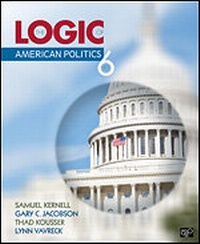
The Logic of American Politics
6th Edition
Published on 9. August 2013
Book
Paperback/Softback
816 pages
978-1-4522-7649-6 (ISBN)
Description
After observing the strains of intense partisanship and divided government, many Americans are wondering what logic, if any, can be found in politics. The new Sixth Edition of The Logic of American Politics reaffirms this best-seller's place as the most accessible "smart" book on the market.
Consistently praised for its engaging narrative, the book hooks students with great storytelling while arming them with a "toolkit" of institutional design concepts-command, veto, agenda control, voting rules, delegation.
Consistently praised for its engaging narrative, the book hooks students with great storytelling while arming them with a "toolkit" of institutional design concepts-command, veto, agenda control, voting rules, delegation.
Reviews / Votes
"[The Logic of American Politics] is simply the best American government text out there. Its clear focus on collective action theory is appealing and understandable, and the text is readable and engaging." -- Suzanne R. Robbins "Most other textbooks for the introductory American politics course leave out either the politics or the science. The Logic of American Politics is unique in providing a thorough, current introduction to the system while also giving students a way to think critically and systematically about it. Despite the fact that it is new and abstract at the outset, students seize on the book's collective action and institutional design framework and use it in class. This is an indication to me that the book pays off for them." -- Scott Meinke "The Logic of American Politics has a clear analytical focus, smart and thoughtful chapters that cover what I like in an intro. text, and a writing style that is engaging and accessible to students." -- Charles R. ShipanMore details
Series
Edition
6th Revised edition
Language
English
Place of publication
Washington
United States
Publishing group
SAGE Publications Inc
Target group
College/higher education
Edition type
Revised edition
Dimensions
Height: 232 mm
Width: 191 mm
Weight
1099 gr
ISBN-13
978-1-4522-7649-6 (9781452276496)
Copyright in bibliographic data and cover images is held by Nielsen Book Services Limited or by the publishers or by their respective licensors: all rights reserved.
Schweitzer Classification
Other editions
New editions
Samuel H. Kernell | Gary C. Jacobson | Thad Kousser
The Logic of American Politics
Book
07/2015
7th Edition
SAGE Publications Inc
€133.92
Article exhausted; check for reprint
Previous edition
Samuel H. Kernell | Gary C. Jacobson | Thad Kousser
The Logic of American Politics
Book
09/2011
5th Edition
CQ Press
€96.88
Article exhausted; check for reprint
Persons
Samuel Kernell is distinguished emeritus professor of political science at the University of California, San Diego, where he has taught since 1977. Kernell's research interests focus on the presidency, political communication, and American political history. His books include Veto Rhetoric: A Leadership Strategy for Divided Government; Going Public: New Strategies of Presidential Leadership, 4th edition; Strategy and Choice in Congressional Elections, 2nd edition (with Gary C. Jacobson); and Party Ballots, Reform, and the Transformation of America's Electoral System (with Erik J. Engstrom). He has also edited Parallel Politics: Economic Policymaking in Japan and the United States; The Politics of Divided Government (with Gary W. Cox); and James Madison: The Theory and Practice of Republican Government. He is presently writing an intellectual biography of James H. Rowe.
Gary C. Jacobson is distinguished emeritus professor of political science at the University of California, San Diego, where he taught from 1979 to 2016. He previously taught at Trinity College; the University of California, Riverside; Yale University; and Stanford University. Jacobson specializes in the study of U.S. elections, parties, interest groups, public opinion, and Congress. He is the author of Money in Congressional Elections; The Politics of Congressional Elections, 10th edition; The Electoral Origins of Divided Government; A Divider, Not a Uniter: George W. Bush and the American People, 2nd edition; and Presidents and Parties in the Public Mind; he is the coauthor of Strategy and Choice in Congressional Elections, 2nd edition. Jacobson is a fellow of the American Academy of Arts and Sciences.
Thad Kousser is professor of political science and co-director of the Yankelovich Center at the University of California, San Diego. He has served as a legislative aide in the California, New Mexico, and U.S. Senates. He is the author of Term Limits and the Dismantling of State Legislative Professionalism, coauthor of The Power of American Governors and The Logic of American Politics, and coeditor of The New Political Geography of California and recent editions of Politics in the American States. Kousser has been awarded the UCSD Academic Senate's Distinguished Teaching Award, has served as coeditor of the journals State Politics and Policy Quarterly and Legislative Studies Quarterly.
Lynn Vavreck is the Marvin Hoffenberg Professor of American Politics and Public Policy at the University of California, Los Angeles (UCLA), a member of the American Academy of Arts and Sciences, and a contributor to the New York Times. She is the author of The Bitter End: The 2020 Presidential Campaign and the Challenge to American Democracy, and the award-winning books, Identity Crisis: The 2016 Presidential Campaign and the Battle for the Meaning of America and The Gamble: Choice and Chance in the 2012 Presidential Campaign. Her research has been supported by the National Science Foundation and the Andrew F. Carnegie Fellowship, and she has served on the advisory boards of both the British and American National Election Studies. At UCLA she teaches courses on campaigns, elections, and public opinion.
Gary C. Jacobson is distinguished emeritus professor of political science at the University of California, San Diego, where he taught from 1979 to 2016. He previously taught at Trinity College; the University of California, Riverside; Yale University; and Stanford University. Jacobson specializes in the study of U.S. elections, parties, interest groups, public opinion, and Congress. He is the author of Money in Congressional Elections; The Politics of Congressional Elections, 10th edition; The Electoral Origins of Divided Government; A Divider, Not a Uniter: George W. Bush and the American People, 2nd edition; and Presidents and Parties in the Public Mind; he is the coauthor of Strategy and Choice in Congressional Elections, 2nd edition. Jacobson is a fellow of the American Academy of Arts and Sciences.
Thad Kousser is professor of political science and co-director of the Yankelovich Center at the University of California, San Diego. He has served as a legislative aide in the California, New Mexico, and U.S. Senates. He is the author of Term Limits and the Dismantling of State Legislative Professionalism, coauthor of The Power of American Governors and The Logic of American Politics, and coeditor of The New Political Geography of California and recent editions of Politics in the American States. Kousser has been awarded the UCSD Academic Senate's Distinguished Teaching Award, has served as coeditor of the journals State Politics and Policy Quarterly and Legislative Studies Quarterly.
Lynn Vavreck is the Marvin Hoffenberg Professor of American Politics and Public Policy at the University of California, Los Angeles (UCLA), a member of the American Academy of Arts and Sciences, and a contributor to the New York Times. She is the author of The Bitter End: The 2020 Presidential Campaign and the Challenge to American Democracy, and the award-winning books, Identity Crisis: The 2016 Presidential Campaign and the Battle for the Meaning of America and The Gamble: Choice and Chance in the 2012 Presidential Campaign. Her research has been supported by the National Science Foundation and the Andrew F. Carnegie Fellowship, and she has served on the advisory boards of both the British and American National Election Studies. At UCLA she teaches courses on campaigns, elections, and public opinion.
Content
1. The Logic of American Politics
I. THE NATIONALIZATION OF POLITICS
2. The Constitution
3. Federalism
4. Civil Rights
5. Civil Liberties
II. THE INSTITUTIONS OF GOVERNMENT
6. Congress
7. The Presidency
8. The Bureaucracy
9. The Federal Judiciary
III. THE PUBLIC'S INFLUENCE ON NATIONAL POLICY
10. Public Opinion
11. Voting, Campaigns, and Elections
12. Political Parties
13. Interest Groups
14. The News Media
IV. CONCLUSION
15. The Prospects for Institutional Reform
I. THE NATIONALIZATION OF POLITICS
2. The Constitution
3. Federalism
4. Civil Rights
5. Civil Liberties
II. THE INSTITUTIONS OF GOVERNMENT
6. Congress
7. The Presidency
8. The Bureaucracy
9. The Federal Judiciary
III. THE PUBLIC'S INFLUENCE ON NATIONAL POLICY
10. Public Opinion
11. Voting, Campaigns, and Elections
12. Political Parties
13. Interest Groups
14. The News Media
IV. CONCLUSION
15. The Prospects for Institutional Reform