

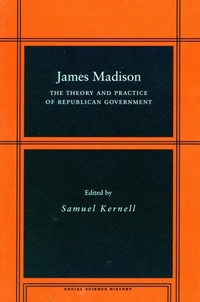
James Madison
The Theory and Practice of Republican Government
Published on 5. August 2003
Book
Hardback
400 pages
978-0-8047-4495-9 (ISBN)
Description
In recent years, the study of James Madison and his contributions to early American politics has enjoyed a growing audience among scholars and students of modern American politics. Not only did Madison establish the fundamental American concept of pluralism, his appreciation of the logic of institutional design as a key to successful democratic reform still influences modern theory and research.
This book evaluates the legacy of James Madison as the product of a scholarly politician-a politician who thought carefully about institutions in the context of action. It brings together thoughtful responses to Madison and his theory from a broad cross-section of modern political science, and views Madison not as an icon or mouthpiece of an era, but as a "modern" political scientist who was able to implement many of his theoretical ideas in a practical forum.
This book evaluates the legacy of James Madison as the product of a scholarly politician-a politician who thought carefully about institutions in the context of action. It brings together thoughtful responses to Madison and his theory from a broad cross-section of modern political science, and views Madison not as an icon or mouthpiece of an era, but as a "modern" political scientist who was able to implement many of his theoretical ideas in a practical forum.
Reviews / Votes
"Of all the Framers, James Madison arguably was closest to being a political scientist in the contemporary sense of the term. In preparing for the Philadelphia Convention, for instance, he made a thorough comparative study of ancient and modern confederacies. . . . These essays make a valuable and varied contribution to our understanding of Madison's political science and will elicit productive agreements and disagreements." - Presidential Studies Quarterly "James Madison was America's first political scientist, and is arguably still its greatest. In these essays, Madison's latter-day heirs subject his close reasoning on the major problems of federalism and republicanism to some close scrutiny of their own. The result is a volume that illuminates both the sources of Madison's continuing influence on our ideas of the Founding era and the ways in which contemporary political science differs from his. One comes away from these papers impressed not only by how deeply the contributors have thought about Madison, but also by his capacity to inspire and demand continued critical thinking about the American constitutional system." - Jack Rakove (Stanford University) "While James Madison has always received considerable scholarly attention, this book is unique in its sustained treatment of Madison in terms of concepts and theories arising from political science. Every chapter makes new and interesting arguments about James Madison's contributions to the 'theory and practice of Republican government.'" - Eric Schickler, University of California (Berkeley)More details
Series
Edition
New edition
Language
English
Place of publication
Palo Alto
United States
Target group
College/higher education
Professional and scholarly
Edition type
New edition
Product notice
Cloth
Illustrations
3 tables, 8 figures
Dimensions
Height: 237 mm
Width: 156 mm
Thickness: 27 mm
Weight
726 gr
ISBN-13
978-0-8047-4495-9 (9780804744959)
Copyright in bibliographic data and cover images is held by Nielsen Book Services Limited or by the publishers or by their respective licensors: all rights reserved.
Schweitzer Classification
Person
Samuel Kernell is Professor of Political Science at the University of California, San Diego.
Content
Contributors vii 1. Introduction 1 samuel kernell 2. Before and after Publius: The Sources and Influence of Madison's Political Thought 14 iain mclean 3. Madison's Theory of Public Goods 41 keith l. dougherty 4. Personal Motives, Constitutional Forms, and the Public Good: Madison on Political Leadership 63 randall strahan 5. "The True Principles of tRepublican Government": Reassessing James Madison's Political Science 92 samuel kernell 6. Madisonian Separation of Powers 126 john ferejohn 7. Madison's Dilemma: Revisiting the Relationship between the Senate and the "Great Compromise" at the Constitutional Convention 156 daniel widaniel wirls 8. Constituting a National Interest: Madison against the States' Autonomy 184 david brian robertson 9. The Madisonian Scheme to Control the National Government 217 jenna bednar 10. Madison at the First Congress: Institutional Design and Lessons from the Continental Congress, 1780-1783 243 rick k. wilson 11. Vote Trading in the First Federal Congress? James Madison and the Compromise of 1790 264 d. roderick kiewiet 12. Madison and the Founding of the Two-Party System 302 norman schofield appendix James Madison, "Vices of the Political System of the United States" 329 James Madison, Federalist 10, 56-65 334 James Madison, Federalist 51, 347-53 340 James Madison to Thomas Jefferson 343 Works Cited 351 Index 369 Library of Congress Subject Headings for this publication: Madison, James, 1751-1836 Political and social views, United States Politics and government 1783-1809, United States Politics and government Philosophy, Republicanism United States History 18th century, Federal government United States History 18th century, Political leadership United States History 18th century, Political science United States History 18th century