

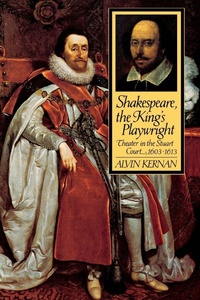
Shakespeare, the King's Playwright
Theater in the Stuart Court, 1603-1613
Will be published approx. on 1. October 1997
Book
Paperback/Softback
258 pages
978-0-300-07258-7 (ISBN)
Description
Soon after James Stuart became king of England in 1603, William Shakespeare, while still working in the public theater, became the royal playwright, and his acting troupe became the premier playing company of the realm. How did this courtly setting influence Shakespeare's work? What was it like to view, perform in, and write plays conceived for the Stuart king?
In this fascinating and lively book, one of our most eminent literary critics explores these questions by taking us back to the court performances of some of Shakespeare's most famous plays, examining them in their settings at the royal palaces of Whitehall and Hampton Court. Alvin Kernan looks at Shakespeare as a patronage playwright whose work after 1603 focused on the main concerns of his royal patron: divine-right kingship in Lear, the corruption of the court in Antony, the difficulties of the old military aristocracy in Coriolanus, and other vital matters. Kernan argues that Shakespeare was neither the royal propagandist nor the political subversive that the New Historicists have made him out to be. He was, instead, a great dramatist whose plays commented on political and social concerns of his patrons and who sought the most satisfactory way of adjusting his own art to court needs.
In this fascinating and lively book, one of our most eminent literary critics explores these questions by taking us back to the court performances of some of Shakespeare's most famous plays, examining them in their settings at the royal palaces of Whitehall and Hampton Court. Alvin Kernan looks at Shakespeare as a patronage playwright whose work after 1603 focused on the main concerns of his royal patron: divine-right kingship in Lear, the corruption of the court in Antony, the difficulties of the old military aristocracy in Coriolanus, and other vital matters. Kernan argues that Shakespeare was neither the royal propagandist nor the political subversive that the New Historicists have made him out to be. He was, instead, a great dramatist whose plays commented on political and social concerns of his patrons and who sought the most satisfactory way of adjusting his own art to court needs.
More details
Language
English
Place of publication
United States
Target group
College/higher education
Professional and scholarly
Product notice
Paperback (trade)
Illustrations
30 b-w illus.
Dimensions
Height: 234 mm
Width: 156 mm
Thickness: 17 mm
Weight
447 gr
ISBN-13
978-0-300-07258-7 (9780300072587)
Copyright in bibliographic data and cover images is held by Nielsen Book Services Limited or by the publishers or by their respective licensors: all rights reserved.
Schweitzer Classification
Person
Alvin Kernan (1923-2018) was Senior Advisor in the Humanities at the Andrew W. Mellon Foundation. He is the author of many other books, including The Death of Literature and The Playwright as Magician, both published by Yale University Press.
Content
Introduction - Shakespeare at the Stuart Court; Art and Theatre in the Service of the Leviathan State; Blood Revenge in Elsinore and in Holyrood - "Hamlet", Hampton Court, Christmas 1603; The King's Prerogative and the Law - "Measure for Measure", Whitehall, December 26th 1604; The Politics of Madness and Demonism - "Macbeth", Hampton Court, August 7th 1606; The True King - Lear, Whitehall, Christmas 1606; Sex and Favour in the Court - "Antony and Cleopatra", Whitehall, Christmas 1607; Military and the Court Aristocracies - Coriolanus, Whitehall, Christmas 1608; The King and the Poet - "The Tempest", Whitehall, Winter 1613; Shakespeare's Sonnets and Patronage Art; What the King Saw, What the Poet Wrote. Appendices: Theatrical Calendar of the King's Men, 1603-14; The Great Hall at Christ Church, Oxford, August 1605.