

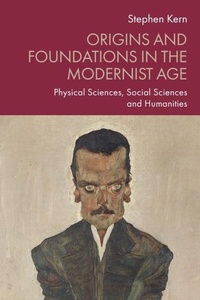
Origins and Foundations in the Modernist Age
Physical Sciences, Social Sciences and Humanities
Will be published approx. on 30. September 2026
Book
Hardback
336 pages
978-1-3995-6588-2 (ISBN)
Description
In contrast to recent modernist studies that find evidence of modernism well before and after the period from 1890 to 1930, Stephen Kern concentrates on these key forty years to examine two fundamental ideas: origins and foundations. Analysing this period of exceptional cultural achievement in a wide range of fields including physics, cosmology, geology, biology, anthropology, psychology, psychiatry, philosophy, religion, literature and art, Kern contrasts the achievements of the modernist period, from 1890 to 1930, against the background of the Victorian period. Origins and Foundations in the Modernist Age surveys historically distinctive ideas about chronological origins as well as theoretical, ontological, functional and formal foundations and argues that modernists probed deeper into origins and foundations than the Victorians, especially in the physical and social sciences, and developed distinctive new foundational techniques in literature and art.
Reviews / Votes
Yet another foundational book by Stephen Kern - this one actually about foundations: modernism's unlikely devotion to the past, which here finally gets its due, thanks to Kern's magisterial breadth of knowledge, true interdisciplinarity and timeless wisdom. Encyclopaedic and exciting, this book offers the most compelling new account of modernist culture as a whole. -- Jesse Matz, Kenyon CollegeMore details
Language
English
Place of publication
Edinburgh
United Kingdom
Target group
Professional and scholarly
Illustrations
12 colour illustrations
Dimensions
Height: 234 mm
Width: 156 mm
ISBN-13
978-1-3995-6588-2 (9781399565882)
Copyright in bibliographic data and cover images is held by Nielsen Book Services Limited or by the publishers or by their respective licensors: all rights reserved.
Schweitzer Classification
Person
Stephen Kern is a Humanities Distinguished Professor of History at Ohio State University. He is the author of The Culture of Time and Space 1880-1918 (1983); The Culture of Love: Victorians to Moderns (1992); A Cultural History of Causality: Science, Murder Novels, and Systems of Thought (2004); The Modernist Novel: A Critical Introduction (2011); and Modernism after the Death of God: Christianity, Fragmentation, and Unification (2017).
Content
Preface
Introduction
Part I: Physical Sciences
1. PHYSICS: Foundations of Matter, Energy, Light, Time, Space, Motion, Gravity, and Causality
2. COSMOLOGY: Composition, Center, and Origin of the Universe
3. GEOLOGY: Age of the Earth and Origins of the Continents and Mountains
4. BIOLOGY: Origins of Life, Species, and Human Beings
Part II: Social Sciences
5. ANTHROPOLOGY: Societal Origins and Foundations in Malinowski and Boas
6. PSYCHOLOGY: Mental Origins and Foundations in Freud and Jung
7. PSYCHIATRY: Origins of Mental Illness and Crime
PART III: Humanities
8. PHILOSOPHY: Genealogy of Morals in Nietzsche and Foundation of Being in Heidegger
9. RELIGION: Original Sin and Love in Gide, Joyce, and Lawrence
10. LITERATURE: Narrative Beginnings in Faulkner, Joyce, Proust, Woolf, Gide, Stein, Rhys, Richardson, and Hall
11. ART: Formal Foundations in Fauvism, Cubism, Futurism, Collage, Abstraction, Expressionism, Dadaism, and Surrealism
Conclusion: Cross-field Patterns
Works Cited
Introduction
Part I: Physical Sciences
1. PHYSICS: Foundations of Matter, Energy, Light, Time, Space, Motion, Gravity, and Causality
2. COSMOLOGY: Composition, Center, and Origin of the Universe
3. GEOLOGY: Age of the Earth and Origins of the Continents and Mountains
4. BIOLOGY: Origins of Life, Species, and Human Beings
Part II: Social Sciences
5. ANTHROPOLOGY: Societal Origins and Foundations in Malinowski and Boas
6. PSYCHOLOGY: Mental Origins and Foundations in Freud and Jung
7. PSYCHIATRY: Origins of Mental Illness and Crime
PART III: Humanities
8. PHILOSOPHY: Genealogy of Morals in Nietzsche and Foundation of Being in Heidegger
9. RELIGION: Original Sin and Love in Gide, Joyce, and Lawrence
10. LITERATURE: Narrative Beginnings in Faulkner, Joyce, Proust, Woolf, Gide, Stein, Rhys, Richardson, and Hall
11. ART: Formal Foundations in Fauvism, Cubism, Futurism, Collage, Abstraction, Expressionism, Dadaism, and Surrealism
Conclusion: Cross-field Patterns
Works Cited