

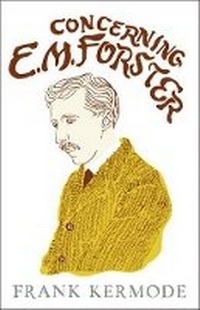
Concerning E.M. Forster
Published on 5. November 2009
Book
Hardback
192 pages
978-0-297-85116-5 (ISBN)
Description
Over the past half-century Frank Kermode has established himself as one of the finest literary critics of his generation. When he delivered the Clark Lectures at Cambridge in 2007, he chose as his subject E.M. Forster - eighty years after Forster gave the same series of lectures, which became his ASPECTS OF THE NOVEL. Kermode's lectures form the core of this book: he assesses the influence and meaning of all of Forster's novels as well as his criticism, reflects on his profound musicality (Britten thought Forster the most musical of all writers) and offers a fascinating interpretation of his greatest work, A PASSAGE TO INDIA. The second part of the book takes the form of a causerie, a brilliant and wide-ranging series of loosely organized, interweaving discussions in which Forster is reduced in size, placed in the wider context of his times, and occasionally scolded by Kermode for being not quite the author he would have preferred him to be.
Kermode reflects not only on Forster's considerable talent but on the social and personal circumstances that restricted it, on the dizzying changes in English society in the first half of the twentieth century, and the preoccupations and uncertainties of those, like Forster, who found themselves caught between two worlds. Taking Forster as his starting point, Kermode also casts a spotlight on many of his great contemporary writers - Joseph Conrad, Henry James, Virginia Woolf, Arnold Bennett, D.H. Lawrence and H.G. Wells. The product of a lifetime's reading and thinking by one of our most distinguished critics, CONCERNING E.M. FORSTER is both a stimulating and original portrait of E.M. Forster and a unique panorama of twentieth-century English letters.
Kermode reflects not only on Forster's considerable talent but on the social and personal circumstances that restricted it, on the dizzying changes in English society in the first half of the twentieth century, and the preoccupations and uncertainties of those, like Forster, who found themselves caught between two worlds. Taking Forster as his starting point, Kermode also casts a spotlight on many of his great contemporary writers - Joseph Conrad, Henry James, Virginia Woolf, Arnold Bennett, D.H. Lawrence and H.G. Wells. The product of a lifetime's reading and thinking by one of our most distinguished critics, CONCERNING E.M. FORSTER is both a stimulating and original portrait of E.M. Forster and a unique panorama of twentieth-century English letters.
Reviews / Votes
"If there is a living British critic of literature as indisputably great as the literature he criticises it's Frank Kermode... still the dominant voice in his profession." -- JOHN SUTHERLAND THE TIMES 21.11.09 "Like all good criticism, Concerning EM Forster, makes one want to read the books under discussion once more, and it ends on an appropriately affectionate note." -- PETER PARKER SUNDAY TIMES - 12.12.09 "He is as sharp a reader and as learned as ever. This is a lovely book on a novelist Kermode has lived with and thought about for many decades." -- PHILIP HENSHER THE DAILY TELEGRAPH 12.12.09 "our greatest living critic." -- FERDINAND MOUNT THE SPECTATOR - 19.12.09 "Kermode writes with real insight." -- COLM TOIBIN THE IRISH TIMES 12.12.09More details
Language
English
Place of publication
London
United Kingdom
Publishing group
Orion Publishing Co
Dimensions
Height: 204 mm
Width: 135 mm
Thickness: 23 mm
Weight
330 gr
ISBN-13
978-0-297-85116-5 (9780297851165)
Copyright in bibliographic data and cover images is held by Nielsen Book Services Limited or by the publishers or by their respective licensors: all rights reserved.
Schweitzer Classification
Other editions
Additional editions
Frank Kermode
Concerning E.M. Forster
E-Book
11/2009
Weidenfeld & Nicolson
€3.99
Available for download
Person
Sir Frank Kermode was the author and editor of over forty books, including Romantic Image (1957), The Sense of an Ending (1967) and Shakespeare's Language (2000). He was the Lord Northcliffe Professor of Modern English Literature at University College London and the King Edward VII Professor of English Literature at Cambridge University.