

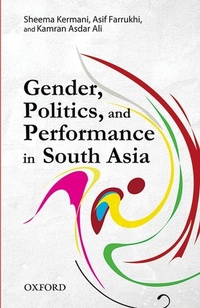
Gender, Politics, and Performance in South Asia
Published on 23. April 2015
Book
Hardback
470 pages
978-0-19-940192-5 (ISBN)
Description
There have not been many studies conducted focusing on womenas issues in this region specifically. The essays by various contributors in this book make for a very interesting read for the general reader as well as scholars as it gives a variety of different looks at women in performing arts and the politics around them. The book will be a useful resource for libraries as well.
Tehrik-e-Niswan, founded in 1979 by Sheema Kermani, strives to empower women in Pakistan and improve their lot through the use of drama and the performing arts. The Tehrik held a Conference in Karachi in December 2010, aimed at rethinking issues of gender, performance, and politics in South Asia. The present volume is the outcome of the Conference and is based on papers presented by scholars therein.
In Pakistan today, the scholarly challenge exists to represent the multiple layers of Pakistanas history in order to bring the country out of the security studies/Islamic threat model that has become the paradigm within which Pakistan Studies are constantly placed.
Pakistan today stands at a critical juncture in its short history of existence. The bigger picture consisting of increasing Islamist radicalism, domestic insurgencies, social and economic crisis, the destabilizing of the democratic experiment, the perpetual threat of military take over, and the countryas place in the international security paradigm in most cases informs how the rest of the world views and imagines the country. But very little attention is paid to the smaller picture and
the other histories that could update us about how people a with all the uncertainties in their lives a struggle to retain a modicum of dignity and create opportunities to live decent and meaningful lives. The scholarly challenge remains to represent the multiple layers of Pakistanas history in order to
bring it out of the security studies/Islamic threat model that has become the paradigm within which Pakistan studies is constantly placed. It is within this context that all the essays of the book have been written.
The book has attempted to express various aspects of the social impact of the arts: It is through the arts that people express themselves; attain a sense of collective identity; and are able to reflect on their problems. Moreover, the arts elevate the mind and soul to a higher level and eradicate pettiness and coarseness. Culture brings people together and leads to harmony and cohesion. It counters violence and aggressive attitudes and urges people to reflect and think, thus, unleashing their
creative energies. Through this exercise the contributors of this book have sought to address an important gap in the study of South Asia in general and Pakistan in particular. They explore the interconnections between performance arts and the politics of gender and class in South Asia within an
historical framework and sociological research. The book demonstrates, how, within the South Asian milieu, the cultural forms such as theatre, dance, music, film, or the fine arts have been used to advocate for gender and class equity, womenas rights, and the rights of the marginalised. It explores how cultural forms and performances interrogate the constructions of identity, class, or religious affiliation in the South Asian context and provokes the reader to think beyond stereotypical
representations of gendered experiences.
Tehrik-e-Niswan, founded in 1979 by Sheema Kermani, strives to empower women in Pakistan and improve their lot through the use of drama and the performing arts. The Tehrik held a Conference in Karachi in December 2010, aimed at rethinking issues of gender, performance, and politics in South Asia. The present volume is the outcome of the Conference and is based on papers presented by scholars therein.
In Pakistan today, the scholarly challenge exists to represent the multiple layers of Pakistanas history in order to bring the country out of the security studies/Islamic threat model that has become the paradigm within which Pakistan Studies are constantly placed.
Pakistan today stands at a critical juncture in its short history of existence. The bigger picture consisting of increasing Islamist radicalism, domestic insurgencies, social and economic crisis, the destabilizing of the democratic experiment, the perpetual threat of military take over, and the countryas place in the international security paradigm in most cases informs how the rest of the world views and imagines the country. But very little attention is paid to the smaller picture and
the other histories that could update us about how people a with all the uncertainties in their lives a struggle to retain a modicum of dignity and create opportunities to live decent and meaningful lives. The scholarly challenge remains to represent the multiple layers of Pakistanas history in order to
bring it out of the security studies/Islamic threat model that has become the paradigm within which Pakistan studies is constantly placed. It is within this context that all the essays of the book have been written.
The book has attempted to express various aspects of the social impact of the arts: It is through the arts that people express themselves; attain a sense of collective identity; and are able to reflect on their problems. Moreover, the arts elevate the mind and soul to a higher level and eradicate pettiness and coarseness. Culture brings people together and leads to harmony and cohesion. It counters violence and aggressive attitudes and urges people to reflect and think, thus, unleashing their
creative energies. Through this exercise the contributors of this book have sought to address an important gap in the study of South Asia in general and Pakistan in particular. They explore the interconnections between performance arts and the politics of gender and class in South Asia within an
historical framework and sociological research. The book demonstrates, how, within the South Asian milieu, the cultural forms such as theatre, dance, music, film, or the fine arts have been used to advocate for gender and class equity, womenas rights, and the rights of the marginalised. It explores how cultural forms and performances interrogate the constructions of identity, class, or religious affiliation in the South Asian context and provokes the reader to think beyond stereotypical
representations of gendered experiences.
More details
Language
English
Place of publication
Oxford
Pakistan
Illustrations
33 b/w photographs
Dimensions
Height: 226 mm
Width: 148 mm
Thickness: 33 mm
Weight
766 gr
ISBN-13
978-0-19-940192-5 (9780199401925)
Copyright in bibliographic data and cover images is held by Nielsen Book Services Limited or by the publishers or by their respective licensors: all rights reserved.
Schweitzer Classification
Persons
Sheema Kermani is a classical dancer, teacher, drama artist, and womenas rights activist. She is founder and head of Tehrik-e-Niswan, an organization dedicated to improving womenas rights in Pakistan by raising awareness through the use of dance and the performing arts.
Asif Farrukhi is an author, critic, and translator. He was educated at the Dow Medical College, Karachi, and the Harvard University, USA. He is known for his short stories and essays, seven collections of short fiction and two collections of critical essays that have been published. He contributes regularly to the English language press. Two of his adaptations have been staged in Karachi. He is editor of Duniyazad, a literary journal of new writings and contemporary issues in
Urdu. Asif Farrukhi has presented papers and participated in literary events at home as well as abroad. For his distinguished work, he was awarded the Prime Ministeras Literary Award by the Pakistan Academy of Letters in 1997 and the Tamgha-i-Imtiaz by the Government of Pakistan.
Kamran Asdar Ali is Associate Professor of Anthropology and Director of the South Asia Institute at the University of Texas, Austin, USA. He has conducted ethnographic research in Mexico, Egypt, and Pakistan. Based on these studies, his publications are on topics relating to health, gender, sexuality, urban issues, popular culture, and labour history. He is the author of Planning the Family in Egypt: New Bodies, New Selves. Along with Martina Rieker he guest-edited, Urban
Margins: Envisioning the Contemporary Global South, and has also co-edited Gendering Urban Space and Comparing Cities: Middle East and South Asia.
Asif Farrukhi is an author, critic, and translator. He was educated at the Dow Medical College, Karachi, and the Harvard University, USA. He is known for his short stories and essays, seven collections of short fiction and two collections of critical essays that have been published. He contributes regularly to the English language press. Two of his adaptations have been staged in Karachi. He is editor of Duniyazad, a literary journal of new writings and contemporary issues in
Urdu. Asif Farrukhi has presented papers and participated in literary events at home as well as abroad. For his distinguished work, he was awarded the Prime Ministeras Literary Award by the Pakistan Academy of Letters in 1997 and the Tamgha-i-Imtiaz by the Government of Pakistan.
Kamran Asdar Ali is Associate Professor of Anthropology and Director of the South Asia Institute at the University of Texas, Austin, USA. He has conducted ethnographic research in Mexico, Egypt, and Pakistan. Based on these studies, his publications are on topics relating to health, gender, sexuality, urban issues, popular culture, and labour history. He is the author of Planning the Family in Egypt: New Bodies, New Selves. Along with Martina Rieker he guest-edited, Urban
Margins: Envisioning the Contemporary Global South, and has also co-edited Gendering Urban Space and Comparing Cities: Middle East and South Asia.
Content
PART 1: POLITICAL THEATRE; SHEEMA KERMANI; JAMIL AHMED; JAMIL AHMED; PART 2: TEHRIK-E-NISWANAS POLITICS OF CLASS AND GENDER; ASMA MUNDRAWALA; JULIE HOLLEDGE; JAMIL AHMED; PART 3: CELEBRATING WOMEN; CLAIRE PAMMENT; RUMANA HUSSAIN; ZAHIDA HINA; RAKHSHANDA JALIL; ASIF FARRUKHI; PART 4: DANCE, MUSIC AND FILM; ZULFIQAR ALI KALHORO; SAKUNTALA NARASIMHAN; RAZA KAZIM; MADHU PURNIMA KISHWAR; KAMRAN ASDAR ALI; FAHMIDA RIAZ