

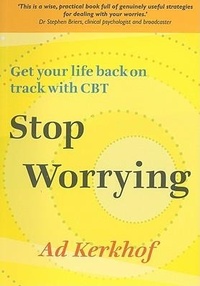
Stop Worrying: Get Your Life Back on Track with CBT
Get Your Life Back on Track with CBT
2nd Edition
Published on 16. August 2010
Book
Paperback/Softback
200 pages
978-0-335-24252-8 (ISBN)
Description
"It's a book which sets realistic goals, has a down-to-earth approach and is genuinely useful."
Claudia Hammond, broadcaster, writer and academic psychologist
"Very simple and practical"
Professor Geoff Beattie, University of Manchester and resident Big Brother psychologist
"The method described is really excellent! Besides having a sound basis in CBT (Cognitive Behavioural Therapy) it instils hope and motivates intentions to change."
Bela BUDA, M.D - Psychiatrist, Budapest, Hungary"This book is a well thought-out combination of cognitive therapy and mindful techniques. It is a practical book with useful step-by-step exercises. It contains an excellent analysis of the common causes of worry and methods for overcoming it."
Dr Steven Melemis, author of I Want To Change My LifeWe all worry about things - some of us even worry about the fact that we are worrying. This practical book will help you to put your fears into perspective and teach you to cope with stressful situations.Supporting and offering advice to worriers, as well as their family and friends, this book also provides guidance for professionals who work in mental health, especially those who recommend self-help to their clients. Other contributors: Saida Akhnikh, Anneke Koopman, Maarten van der Linde, Marleen Stam and Elvan Tutkun were doctoral students in clinical psychology at the VU University of Amsterdam where they carried out research on the Stop Worrying Project, which formed the basis of this book.
Claudia Hammond, broadcaster, writer and academic psychologist
"Very simple and practical"
Professor Geoff Beattie, University of Manchester and resident Big Brother psychologist
"The method described is really excellent! Besides having a sound basis in CBT (Cognitive Behavioural Therapy) it instils hope and motivates intentions to change."
Bela BUDA, M.D - Psychiatrist, Budapest, Hungary"This book is a well thought-out combination of cognitive therapy and mindful techniques. It is a practical book with useful step-by-step exercises. It contains an excellent analysis of the common causes of worry and methods for overcoming it."
Dr Steven Melemis, author of I Want To Change My LifeWe all worry about things - some of us even worry about the fact that we are worrying. This practical book will help you to put your fears into perspective and teach you to cope with stressful situations.Supporting and offering advice to worriers, as well as their family and friends, this book also provides guidance for professionals who work in mental health, especially those who recommend self-help to their clients. Other contributors: Saida Akhnikh, Anneke Koopman, Maarten van der Linde, Marleen Stam and Elvan Tutkun were doctoral students in clinical psychology at the VU University of Amsterdam where they carried out research on the Stop Worrying Project, which formed the basis of this book.
More details
Edition
2nd Revised edition
Language
English
Place of publication
Milton Keynes
United Kingdom
Edition type
Revised edition
Product notice
Paperback (trade)
Unsewn / adhesive bound
Dimensions
Height: 211 mm
Width: 151 mm
Thickness: 14 mm
Weight
295 gr
ISBN-13
978-0-335-24252-8 (9780335242528)
Schweitzer Classification
Person
Ad Kerkhof is Professor of Clinical Psychology at the VU University, Amsterdam, The Netherlands. He specializes in worry, depression and suicide. He also has a psychotherapy practice, where he treats clients for persistent forms of worrying, depression and burn-out.
Content
Preface
For guidancePart One: Stop worrying in four weeks
Week One: To begin with: How much have you worried over the past week?
Week Two: Worrying and writing worries down
Week Three: Writing exercise
Week Four: Three column exercise
Part Two: Worrying for advanced students
Favourite worries
Worrying in metaphors and with exaggeration
Worrying as self-protection and self-torture
Final exercises
Conclusion
More information about worrying
For guidancePart One: Stop worrying in four weeks
Week One: To begin with: How much have you worried over the past week?
Week Two: Worrying and writing worries down
Week Three: Writing exercise
Week Four: Three column exercise
Part Two: Worrying for advanced students
Favourite worries
Worrying in metaphors and with exaggeration
Worrying as self-protection and self-torture
Final exercises
Conclusion
More information about worrying