

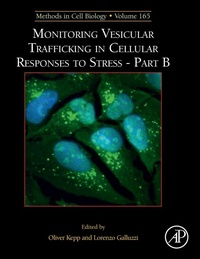
Monitoring Vesicular Trafficking in Cellular Responses to Stress - Part B: Volume 165
Published on 27. July 2021
Book
Hardback
232 pages
978-0-12-824487-6 (ISBN)
Description
Monitoring Vesicular Trafficking in Cellular Responses to Stress - Part B, Volume 165 in the Methods in Cell Biology series, highlights new advances in the field, with this new release presenting coverage of different topics, including A novel tool for detecting lysosomal membrane permeabilization by high-throughput fluorescence microscopy, Exploring selective autophagy in Drosophila, Assessment of EGFP-Q74 degradation for the measurement of autophagic flux, Multimodal assessment of autophagy in mammalian cells with a novel, LC3-based tandem reporter, Multiplex quantification of autophagic flux by imaging flow cytometry, Monitoring autophagic flux in Caenorhabditis elegans using p62/SQST-1 reporters, High throughput screening for autophagy, and much more.
More details
Series
Language
English
Place of publication
San Diego
United States
Publishing group
Elsevier Science Publishing Co Inc
Target group
Professional and scholarly
Product notice
Laminated cover
Dimensions
Height: 235 mm
Width: 191 mm
Thickness: 14 mm
Weight
620 gr
ISBN-13
978-0-12-824487-6 (9780128244876)
Copyright in bibliographic data and cover images is held by Nielsen Book Services Limited or by the publishers or by their respective licensors: all rights reserved.
Schweitzer Classification
Other editions
Additional editions
E-Book
07/2021
Academic Press
€160.00
Available for download
Persons
Dr. Oliver Kepp graduated from Humboldt University Berlin and obtained a PhD degree in Molecular Biology. Today he is a tenured researcher at INSERM and a Co-director of the BioCell automation platform at GRCC. Oliver and his team investigate several aspects of tumor immunogenicity, focusing on systems cell biology approaches. He is also a co-founder of Samsara therapeutics and was appointed associate director of the European academy of tumor immunology in 2019. Oliver received the prestigious Clarivate Highly Cited Researcher Award four years in a row since 2018 and has recently been ranked among the top biology and biochemistry scientists in France (#5; www.research.com) Lorenzo Galluzzi is Assistant Professor of Cell Biology in Radiation Oncology at the Department of Radiation Oncology of the Weill Cornell Medical College, Honorary Assistant Professor Adjunct with the Department of Dermatology of the Yale School of Medicine, Honorary Associate Professor with the Faculty of Medicine of the University of Paris, and Faculty Member with the Graduate School of Biomedical Sciences and Biotechnology of the University of Ferrara, the Graduate School of Pharmacological Sciences of the University of Padova, and the Graduate School of Network Oncology and Precision Medicine of the University of Rome "La Sapienza?. Moreover, he is Associate Director of the European Academy for Tumor Immunology and Founding Member of the European Research Institute for Integrated Cellular Pathology.
Galluzzi is best known for major experimental and conceptual contributions to the fields of cell death, autophagy, tumor metabolism and tumor immunology. He has published over 450 articles in international peer-reviewed journals and is the Editor-in-Chief of four journals:
OncoImmunology (which he co-founded in 2011), International Review of Cell and Molecular Biology, Methods in Cell biology, and Molecular and Cellular Oncology (which he co-founded in 2013). Additionally, he serves as Founding Editor for Microbial Cell and Cell Stress, and Associate Editor for Cell Death and Disease, Pharmacological Research and iScience.
Galluzzi is best known for major experimental and conceptual contributions to the fields of cell death, autophagy, tumor metabolism and tumor immunology. He has published over 450 articles in international peer-reviewed journals and is the Editor-in-Chief of four journals:
OncoImmunology (which he co-founded in 2011), International Review of Cell and Molecular Biology, Methods in Cell biology, and Molecular and Cellular Oncology (which he co-founded in 2013). Additionally, he serves as Founding Editor for Microbial Cell and Cell Stress, and Associate Editor for Cell Death and Disease, Pharmacological Research and iScience.
Content
1. A novel tool for detecting lysosomal membrane permeabilization by high-throughput fluorescence microscopy
Karla Alvarez-Valadez, Allan Sauvat, Helene Fohrer-Ting, Christophe Klein, Oliver Kepp, Guido Kroemer, Mojgan Djavaheri-Mergny
2. Exploring selective autophagy in Drosophila
Stavroula Petridi, Anne-Claire Jacomin, Zambarlal Bhujabal, Terje Johansen and Ioannis P. Nezis
3. Assessment of EGFP-Q74 degradation for the measurement of autophagic fluxYan Wang, Jiao Meng, Qi Wu, Guo Chen, Wei Xie, Zhen Zhang, Guido Kroemer and Oliver Kepp
4. Multimodal assessment of autophagy in mammalian cells with a novel, LC3-based tandem reporter
Dan F. Lazar, Amani A. Gillette, Samantha R. Lewis, and Braeden L. Butler
5. Multiplex quantification of autophagic flux by imaging flow cytometry
Lea Montegut, Hui Chen, Gerasimos Anagnostopoulos, Sabrina Spaggiari, Oliver Kepp, Maria Chiara Maiuri, Guido Kroemer, and Isabelle Martins
6. Monitoring autophagic flux in Caenorhabditis elegans using p62/SQST-1 reporters
Christina Ploumi, Aggeliki Sotiriou and Nektarios Tavernarakis
7. High throughput screening for autophagy
Sabrina Forveille, Marion Leduc, Allan Sauvat, Giulia Cerrato, Guido Kroemer and Oliver Kepp
8. Determination of mitophagy by electron microscope
Zhiyu Li, Qi Wu, Le Liu, Si Sun, Shengrong Sun,Zhong Wang, Juanjuan Li
9. Quantification of intracellular ACBP/DBI levels
Valentina Sica, Isabelle Martins, Federico Pietrocola and Jose Manuel Bravo-San Pedro
10. Immunoblot-based assays for assessing autophagy in the turquoise killifish Nothobranchius furzeri
Gerasimos Anagnostopoulos, Leia Montegut, Hui Chen, Vincent Carbonnier, Isabelle Martins, Khady Mangane, Abdelkrim Mannioui, Alex Bois, Elisa Elena Baracco, Maria Chiara Maiuri, and Guido Kroemer
11. Monitoring autophagy using super-resolution structured illumination and direct stochastic optical reconstruction microscopy
Dumisile Lumkwana, Lize Engelbrecht and Ben Loos
12. Monitoring selective autophagy of mitochondria using super-resolution microscopy
Ziyue Li and Nicholas T. Ktistakis
13. Monitoring autophagy-dependent ferroptosis
Jingbo Li, Rui Kang, and Daolin Tang
14. Quantitative analysis of autophagy-related protein LC3B by quantum-dot-based molecular imaging
Xin Yu, Juan Wu, Qi Wu, Shengrong Sun
15. Isolation of microRNA from exosomes
Sheila Spada
16. Simultaneous determination of intraluminal lysosomal calcium and pH by dextran-conjugated fluorescence dyes
Philippe Pihan, Paula Nunes-Hasler, Nicolas Demaurex and Claudio Hetz
Karla Alvarez-Valadez, Allan Sauvat, Helene Fohrer-Ting, Christophe Klein, Oliver Kepp, Guido Kroemer, Mojgan Djavaheri-Mergny
2. Exploring selective autophagy in Drosophila
Stavroula Petridi, Anne-Claire Jacomin, Zambarlal Bhujabal, Terje Johansen and Ioannis P. Nezis
3. Assessment of EGFP-Q74 degradation for the measurement of autophagic fluxYan Wang, Jiao Meng, Qi Wu, Guo Chen, Wei Xie, Zhen Zhang, Guido Kroemer and Oliver Kepp
4. Multimodal assessment of autophagy in mammalian cells with a novel, LC3-based tandem reporter
Dan F. Lazar, Amani A. Gillette, Samantha R. Lewis, and Braeden L. Butler
5. Multiplex quantification of autophagic flux by imaging flow cytometry
Lea Montegut, Hui Chen, Gerasimos Anagnostopoulos, Sabrina Spaggiari, Oliver Kepp, Maria Chiara Maiuri, Guido Kroemer, and Isabelle Martins
6. Monitoring autophagic flux in Caenorhabditis elegans using p62/SQST-1 reporters
Christina Ploumi, Aggeliki Sotiriou and Nektarios Tavernarakis
7. High throughput screening for autophagy
Sabrina Forveille, Marion Leduc, Allan Sauvat, Giulia Cerrato, Guido Kroemer and Oliver Kepp
8. Determination of mitophagy by electron microscope
Zhiyu Li, Qi Wu, Le Liu, Si Sun, Shengrong Sun,Zhong Wang, Juanjuan Li
9. Quantification of intracellular ACBP/DBI levels
Valentina Sica, Isabelle Martins, Federico Pietrocola and Jose Manuel Bravo-San Pedro
10. Immunoblot-based assays for assessing autophagy in the turquoise killifish Nothobranchius furzeri
Gerasimos Anagnostopoulos, Leia Montegut, Hui Chen, Vincent Carbonnier, Isabelle Martins, Khady Mangane, Abdelkrim Mannioui, Alex Bois, Elisa Elena Baracco, Maria Chiara Maiuri, and Guido Kroemer
11. Monitoring autophagy using super-resolution structured illumination and direct stochastic optical reconstruction microscopy
Dumisile Lumkwana, Lize Engelbrecht and Ben Loos
12. Monitoring selective autophagy of mitochondria using super-resolution microscopy
Ziyue Li and Nicholas T. Ktistakis
13. Monitoring autophagy-dependent ferroptosis
Jingbo Li, Rui Kang, and Daolin Tang
14. Quantitative analysis of autophagy-related protein LC3B by quantum-dot-based molecular imaging
Xin Yu, Juan Wu, Qi Wu, Shengrong Sun
15. Isolation of microRNA from exosomes
Sheila Spada
16. Simultaneous determination of intraluminal lysosomal calcium and pH by dextran-conjugated fluorescence dyes
Philippe Pihan, Paula Nunes-Hasler, Nicolas Demaurex and Claudio Hetz