

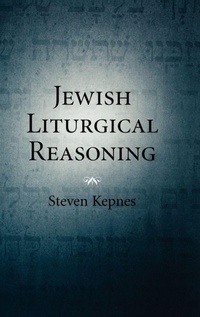
Jewish Liturgical Reasoning
Published on 8. November 2007
Book
Hardback
248 pages
978-0-19-531381-9 (ISBN)
Description
Liturgy, a complex interweaving of word, text, song, and behavior is a central fixture of religious life in the Jewish tradition. It is unique in that it is performed and not merely thought. Because liturgy is performed by a specific group at a specific time and place it is mutable. Thus, liturgical reasoning is always new and understandings of liturgical practices are always evolving. Liturgy is neither preexisting nor static; it is discovered and revealed in every liturgical performance.
Jewish Liturgical Reasoning is an attempt to articulate the internal patterns of philosophical, ethical, and theological reasoning that are at work in synagogue liturgies. This book discusses the relationship between internal Jewish liturgical reasoning and the variety of external philosophical and theological forms of reasoning that have been developed in modern and post liberal Jewish philosophy. Steven Kepnes argues that liturgical reasoning can reorient Jewish philosophy and provide it with new tools, new terms of discourse and analysis, and a new sensibility for the twenty-first century.
The formal philosophical study of Jewish liturgy began with Moses Mendelssohn and the modern Jewish philosophers. Thus the book focuses, in its first chapters, on the liturgical reasoning of Moses Mendelssohn, Hermann Cohen, and Franz Rosenzweig. However, it attempts to augment and further develop the liturgical reasoning of these figures with methods of study from Hermeneutics, Semiotic theory, post liberal theology, anthropology and performance theory. These newer theories are enlisted to help form a contemporary liturgical reasoning that can respond to such events as the Holocaust, the establishment of the State of Israel, and interfaith dialogue between Jews, Christians, and Muslims.
Jewish Liturgical Reasoning is an attempt to articulate the internal patterns of philosophical, ethical, and theological reasoning that are at work in synagogue liturgies. This book discusses the relationship between internal Jewish liturgical reasoning and the variety of external philosophical and theological forms of reasoning that have been developed in modern and post liberal Jewish philosophy. Steven Kepnes argues that liturgical reasoning can reorient Jewish philosophy and provide it with new tools, new terms of discourse and analysis, and a new sensibility for the twenty-first century.
The formal philosophical study of Jewish liturgy began with Moses Mendelssohn and the modern Jewish philosophers. Thus the book focuses, in its first chapters, on the liturgical reasoning of Moses Mendelssohn, Hermann Cohen, and Franz Rosenzweig. However, it attempts to augment and further develop the liturgical reasoning of these figures with methods of study from Hermeneutics, Semiotic theory, post liberal theology, anthropology and performance theory. These newer theories are enlisted to help form a contemporary liturgical reasoning that can respond to such events as the Holocaust, the establishment of the State of Israel, and interfaith dialogue between Jews, Christians, and Muslims.
Reviews / Votes
"Liturgical Reasoning represents a new sub-discipline of Jewish philosophy. Steven Kepnes re-reads the practices of Jewish prayer as sources of instruction in how to reason Jewishly. And he re-reads the great modern Jewish philosophers - Mendelssohn, Cohen, and Rosenzweig - as sources of instruction in how to read prayer philosophically. The result is extraordinary: a systematic theology of modern Judaism and, with it, a unifying vision for modern and contemporary Judaism. Liturgical Reasoning is a required reading for all scholars and students of modern Jewish thought. A stunning achievement." --Peter W. Ochs is Edgar Bronfman Professor of Modern Jewish Thought at the University of VirginiaMore details
Language
English
Place of publication
New York
United States
Target group
College/higher education
Dimensions
Height: 240 mm
Width: 161 mm
Thickness: 18 mm
Weight
540 gr
ISBN-13
978-0-19-531381-9 (9780195313819)
Copyright in bibliographic data and cover images is held by Nielsen Book Services Limited or by the publishers or by their respective licensors: all rights reserved.
Schweitzer Classification
Other editions
Additional editions
Steven Kepnes
Jewish Liturgical Reasoning
E-Book
11/2007
1st Edition
OUP eBook
€24.99
Available for download
Steven Kepnes
Jewish Liturgical Reasoning
E-Book
11/2007
1st Edition
OUP eBook
€31.49
Available for download
Person
Steven Kepnes is the Murray and Mildred Finard Professor of Jewish Studies at Colgate University. He is the author of Reasoning After Revelation: Dialogues in Postmodern Jewish Philosophy (with Peter Ochs and Robert Gibbs), Interpreting Judaism in a Postmodern Age, and The Text as Thou: Martin Buber's Dialogical Hermeneutics and Narrative Theology. He is also a co-director of the Society for Scriptural Reasoning.
Content
1.: Introduction: After Postmodernism To Liturgical Reasoning
2.: Liturgical Semiotics: Moses Mendelssohn's Jerusalem
3.: Liturgical Selfhood: Hermann Cohen's Religion of Reason
4.: Liturgical Time: Franz Rosenzweig's Star of Redemption
5.: Liturgical Space: In the Post-Shoah and Zionist Era
6.: Liturgical Theology: The Semiotics of the Preliminary Morning Service
7.: Epilogue: Liturgical Truth
2.: Liturgical Semiotics: Moses Mendelssohn's Jerusalem
3.: Liturgical Selfhood: Hermann Cohen's Religion of Reason
4.: Liturgical Time: Franz Rosenzweig's Star of Redemption
5.: Liturgical Space: In the Post-Shoah and Zionist Era
6.: Liturgical Theology: The Semiotics of the Preliminary Morning Service
7.: Epilogue: Liturgical Truth