

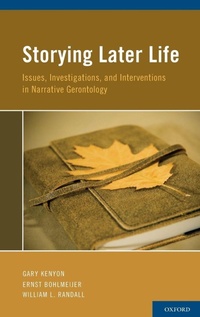
Storying Later Life
Issues, Investigations, and Interventions in Narrative Gerontology
Published on 13. January 2011
Book
Hardback
424 pages
978-0-19-539795-6 (ISBN)
Description
In its brief but vigorous history, gerontology has spawned a broadening range of specializations. One of the newest of such specializations is narrative gerontology, so named for its emphasis on the biographical, or inside, dimensions of the experience of aging.
Telling stories about our world, our relationships, and ourselves is fundamental to how we make meaning. Everything from our history to our religion and our memories to our emotions is linked to the tales we tell ourselves, and others, about where we have come from and where we are going. They are central to who we are.
The biographical side of human life is every bit as critical to fathom as the biological side, if we seek a more balanced, positive, and optimistic perspective on what aging is about; if we would honor the dignity and complexity, the humanity and uniqueness of the lives of older persons, no matter what their health or economic standing. In this respect, a narrative approach is particularly suited to the exploration of such topics as meaning, spirituality, and wisdom, and the connections they share.
This volume reflects a selection of new directions and insights, and constitutes a general broadening and deepening of narrative gerontology, exploring its implications for theory and research in the field of aging, and for the quality of life of older adults themselves. Such deepening indicates a greater refinement of thought, method, and intervention. The evolution of narrative gerontology is also evidenced by a significant increase in the number of faculty and graduate students engaged in research in this area, as well as by increasing collaboration among researchers, practitioners, and administrators in applying narrative insights to contexts such as long term care - indeed, healthcare in general. These initiatives have given rise to the phrase, "narrative care as core care".
Telling stories about our world, our relationships, and ourselves is fundamental to how we make meaning. Everything from our history to our religion and our memories to our emotions is linked to the tales we tell ourselves, and others, about where we have come from and where we are going. They are central to who we are.
The biographical side of human life is every bit as critical to fathom as the biological side, if we seek a more balanced, positive, and optimistic perspective on what aging is about; if we would honor the dignity and complexity, the humanity and uniqueness of the lives of older persons, no matter what their health or economic standing. In this respect, a narrative approach is particularly suited to the exploration of such topics as meaning, spirituality, and wisdom, and the connections they share.
This volume reflects a selection of new directions and insights, and constitutes a general broadening and deepening of narrative gerontology, exploring its implications for theory and research in the field of aging, and for the quality of life of older adults themselves. Such deepening indicates a greater refinement of thought, method, and intervention. The evolution of narrative gerontology is also evidenced by a significant increase in the number of faculty and graduate students engaged in research in this area, as well as by increasing collaboration among researchers, practitioners, and administrators in applying narrative insights to contexts such as long term care - indeed, healthcare in general. These initiatives have given rise to the phrase, "narrative care as core care".
Reviews / Votes
Storying Later Life is an intriguing, challenging and complex read... This book is unique in its exploration of the theoretical underpinning, the evidence base and the practical applications that this narrative 'take' on the ageing process can bring to individuals, groups and services for older people... The chapters are diverse and thought provoking and bring many related and varied themes of narrative gerontology together as a coherent approach to new and positive ways of working with older people in health and social care. * Ageing & Society *More details
Language
English
Place of publication
New York
United States
Target group
College/higher education
This volume will appeal to a broad range of professors, graduate students, and practitioners in a variety of disciplines and contexts concerned with aging and older adults. It will also be of interest to a general reader interested in human development from a lifestory perspective. The audience includes social workers, psychotherapists, counselors, spiritual directors, palliative care directors, caregivers and managers, nurses and physicians, as well as faculty in gerontology, psychology and sociology, in both universities and professional training institutions. The volume will be appropriate as a primary or secondary textbook for both graduate and undergraduate courses.
Dimensions
Height: 240 mm
Width: 161 mm
Thickness: 27 mm
Weight
793 gr
ISBN-13
978-0-19-539795-6 (9780195397956)
Copyright in bibliographic data and cover images is held by Nielsen Book Services Limited or by the publishers or by their respective licensors: all rights reserved.
Schweitzer Classification
Other editions
Additional editions
Gary Kenyon | Ernst Bohlmeijer | William L. Randall
Storying Later Life
Issues, Investigations, and Interventions in Narrative Gerontology
E-Book
12/2010
OUP eBook
€52.49
Available for download
Persons
Gary Kenyon, Ph.D. is founding Chair and Professor, Gerontology Department, St. Thomas University, New Brunswick, Canada. He is listed in Who's Who in Canada and the United States and is a frequent visiting scholar in Europe. Dr. Kenyon is a co-creator of Narrative Gerontology and the concept of Narrative Care.
William L. Randall, EdD, is Associate Professor in the Department of Gerontology at St. Thomas University, where he also serves as Director of the Centre for Interdisciplinary Research on Narrative. He is author or co-author of numerous publications on narrative gerontology and biographical aging. He is also principal organizer of the 2002, 2004, and 2010 international-interdisciplinary conferences entitled Narrative Matters.
Ernst Bohlmeijer, Ph.D. is Associate Professor Mental Health Promotion at the University of Twente. He is one of the leading international researchers on reminiscence and life-review. He has a special interest in narrative-based and acceptance-based care. He
published over 70 articles and book chapters on these topics.
William L. Randall, EdD, is Associate Professor in the Department of Gerontology at St. Thomas University, where he also serves as Director of the Centre for Interdisciplinary Research on Narrative. He is author or co-author of numerous publications on narrative gerontology and biographical aging. He is also principal organizer of the 2002, 2004, and 2010 international-interdisciplinary conferences entitled Narrative Matters.
Ernst Bohlmeijer, Ph.D. is Associate Professor Mental Health Promotion at the University of Twente. He is one of the leading international researchers on reminiscence and life-review. He has a special interest in narrative-based and acceptance-based care. He
published over 70 articles and book chapters on these topics.
Editor
Professor and Chair, Gerontology DepartmentProfessor and Chair, Gerontology Department, St. Thomas University, Fredericton, NB
Associate Professor, Mental Health PromotionAssociate Professor, Mental Health Promotion, Universiteit Twente, Enschede, Netherlands
Professor of Gerontology, Director of Centre for Interdisciplinary Research on NarrativeProfessor of Gerontology, Director of Centre for Interdisciplinary Research on Narrative, St. Thomas University, Fredericton, NB
Content
Preface Gary Kenyon, William Randall, and Ernst Bohlmeijer
Acknowledgements
Contributors
Foreword James E. Birren
Part 1: Issues
1. Narrative Foreclosure in Later Life: Possibilities and Limits
Mark Freeman
2. Memory, Metaphor, and Meaning: Reading for Wisdom in the Stories of Our Lives
William L. Randall
3. Narrative Events and Biographical Construction in Old Age
Jaber F. Gubrium
4. Inventing Yourself: How Older Adults Deal with the Pressure of Late-Modern Identity Construction
Frits de Lange
5. Minding the Wisdom of the Ages: Narrative Approaches in Pastoral Care with Older Adults
R. Ruard Ganzevoort
6. In Waves of Time, Space, and Self: The Dwelling-Place of Age in Virginia Woolf's The Waves
Rishi Goyal and Rita Charon
7. The Narrative Frame in Discourse on Aging: Understanding Facts and Values Behind Public Policy
Phillip G. Clark
Part 2: Investigations
8. The Power of Stories Left Untold: Narratives of Nazi Followers
Stephan Marks
9. Young Bodies, Old Bodies, and Stories of the Athletic Self
Cassandra Phoenix
10. The Raging Grannies: Narrative Construction of Gender and Aging
Linda Caissie
11. Narrative and Gender Differences: How Men and Women Interpret Their Lives
Patricia O'Neill, James E. Birren, and Cheryl Svensson
12. Telling Stories: How Do Expressions of Self Differ in a Writing Group Versus a Reminiscence Group?
Kate de Medeiros
13. Mneme and Anamnesis: The Contribution of Involuntary Reminiscences to the Construction of a Narrative Self in Older Age
Philippe Cappeliez and Jeffrey Dean Webster
14. Achieving Narrative Coherence Following Traumatic War Experience: The Role of Social Support
Karen Burnell, Peter Coleman, and Nigel Hunt
15. Using Self-Defining Memories in Couples Therapy with Older Adults
Jefferson A. Singer and Beata Labunko Messier
Part 3: Interventions
16. On Suffering, Loss, and The Journey To Life: Tai Chi as Narrative Care
Gary M. Kenyon
17. Older Adults in Search of New Stories: Measuring the Effects of Life Review on Coherence and Integration in Autobiographical Narratives
Thijs Tromp
18. Reminiscence Interventions: Bringing Narrative Gerontology into Practice
Ernst Bohlmeijer and Gerben Westerhof
19. Life Review Using Autobiographical Retrieval: A Protocol for Training Depressed Residential Home Inhabitants in Recalling Specific Personal Memories
Bas Steunenberg & Ernst Bohlmeijer
20. "Green and Grey": an Educational Program to Enhance Contact Between Younger and Older Adults by Means of Lifestories
Gerben J. Westerhof
21. Implementation of Narrative Care in the Netherlands: Coordinating Management, Institutional, and Personal Narratives
Gerdienke M. Ubels
22. Asking the Right Questions: Enabling Dementing Persons to Speak for Themselves
Marie-Elise van den Brandt
23. The Ripple Effect: A Story of the Transformational Nature of Narrative Care
Daphne Noonan
Afterword
24. Towards a Narrative Turn in Health Care
Ernst Bohlmeijer, Gary Kenyon, William Randall
Acknowledgements
Contributors
Foreword James E. Birren
Part 1: Issues
1. Narrative Foreclosure in Later Life: Possibilities and Limits
Mark Freeman
2. Memory, Metaphor, and Meaning: Reading for Wisdom in the Stories of Our Lives
William L. Randall
3. Narrative Events and Biographical Construction in Old Age
Jaber F. Gubrium
4. Inventing Yourself: How Older Adults Deal with the Pressure of Late-Modern Identity Construction
Frits de Lange
5. Minding the Wisdom of the Ages: Narrative Approaches in Pastoral Care with Older Adults
R. Ruard Ganzevoort
6. In Waves of Time, Space, and Self: The Dwelling-Place of Age in Virginia Woolf's The Waves
Rishi Goyal and Rita Charon
7. The Narrative Frame in Discourse on Aging: Understanding Facts and Values Behind Public Policy
Phillip G. Clark
Part 2: Investigations
8. The Power of Stories Left Untold: Narratives of Nazi Followers
Stephan Marks
9. Young Bodies, Old Bodies, and Stories of the Athletic Self
Cassandra Phoenix
10. The Raging Grannies: Narrative Construction of Gender and Aging
Linda Caissie
11. Narrative and Gender Differences: How Men and Women Interpret Their Lives
Patricia O'Neill, James E. Birren, and Cheryl Svensson
12. Telling Stories: How Do Expressions of Self Differ in a Writing Group Versus a Reminiscence Group?
Kate de Medeiros
13. Mneme and Anamnesis: The Contribution of Involuntary Reminiscences to the Construction of a Narrative Self in Older Age
Philippe Cappeliez and Jeffrey Dean Webster
14. Achieving Narrative Coherence Following Traumatic War Experience: The Role of Social Support
Karen Burnell, Peter Coleman, and Nigel Hunt
15. Using Self-Defining Memories in Couples Therapy with Older Adults
Jefferson A. Singer and Beata Labunko Messier
Part 3: Interventions
16. On Suffering, Loss, and The Journey To Life: Tai Chi as Narrative Care
Gary M. Kenyon
17. Older Adults in Search of New Stories: Measuring the Effects of Life Review on Coherence and Integration in Autobiographical Narratives
Thijs Tromp
18. Reminiscence Interventions: Bringing Narrative Gerontology into Practice
Ernst Bohlmeijer and Gerben Westerhof
19. Life Review Using Autobiographical Retrieval: A Protocol for Training Depressed Residential Home Inhabitants in Recalling Specific Personal Memories
Bas Steunenberg & Ernst Bohlmeijer
20. "Green and Grey": an Educational Program to Enhance Contact Between Younger and Older Adults by Means of Lifestories
Gerben J. Westerhof
21. Implementation of Narrative Care in the Netherlands: Coordinating Management, Institutional, and Personal Narratives
Gerdienke M. Ubels
22. Asking the Right Questions: Enabling Dementing Persons to Speak for Themselves
Marie-Elise van den Brandt
23. The Ripple Effect: A Story of the Transformational Nature of Narrative Care
Daphne Noonan
Afterword
24. Towards a Narrative Turn in Health Care
Ernst Bohlmeijer, Gary Kenyon, William Randall