

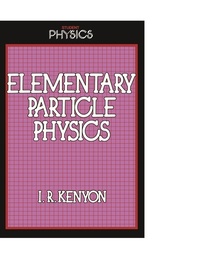
Elementary Particle Physics
Published on 31. October 1987
Book
Paperback/Softback
XII, 312 pages
978-0-7102-1234-4 (ISBN)
Description
The last few years have seen particular excitement in particle physics, culminating in the experimental confirmation of the W and Z particles. Ian Kenyon, who was involved in the UA1 experiment at CERN that searched for the particles, provides an introduction to particle physics and takes a refreshingly non-historical approach. The aim of the book has been to concentrate on the 'standard model' and the gauge symmetries because these form the core of the subject. Leptons, quarks and forces are introduced at the beginning. After this introduction the gauge theories are dealt with in order of increasing complexity. Attention is then focussed on the hadrons - deep inelastic scattering of hadrons, then hadron spectroscopy and finally hadron interactions. Current developments beyond the standard model appear in the last chapter. This book should be of interest to third year undergraduate students; postgraduates in particle physics, nuclear physics; researchers in nuclear physics.
More details
Series
Edition
1988 ed.
Language
English
Place of publication
Dordrecht
Netherlands
Publishing group
Kluwer Academic Publishers Group
Target group
Professional and scholarly
Research
Illustrations
XII, 312 p.
Dimensions
Height: 279 mm
Width: 216 mm
Thickness: 19 mm
Weight
835 gr
ISBN-13
978-0-7102-1234-4 (9780710212344)
Schweitzer Classification
Content
Preface. Acknowledgments. Introduction. Leptons, quarks and forces. Experimental techniques. QED and the gauge principle. Symmetries and conservation laws. Colour and quantum chromodynamics. The V-A theory of weak interactions. Electroweak unification. Electroweak probes of hadron structure. Hadronic flavour. Hadron-hadron interactions. Ways forward. Appendix A: two-body kinematics, cross sections and decay rates. Appendix B: Breit-Wigner formula. Appendix C: Clebsch-Gordan coefficients for SU(2). Appendix D: Dirac equation and its solutions. Appendix E: the electromagnetic cross-section for 1/2+1/2+ - 1/2+1/2+. Appendix F: problems and solutions. Appendix G: tables of particle properties. Index.