

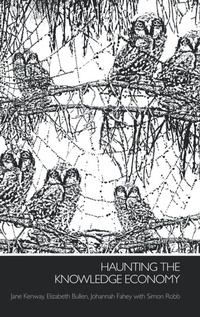
Haunting the Knowledge Economy
1st Edition
Published on 28. September 2006
Book
Hardback
160 pages
978-0-415-37067-7 (ISBN)
Description
This highly original book provides an engaging and critical introduction to the knowledge economy. The knowledge economy is a potent force pervading global and national policy circles. Yet few people outside the field of economics understand its central ideas and practices. This book makes these accessible. But it does much more.
It provokes 'conversations' between the knowledge economy and those marginalized economies that haunt it: the risk, gift, libidinal and survival economies. These illuminate the knowledge economy's shortcomings and point to alternative possible systems of exchange and sets of values. This multi-disciplinary study takes the knowledge economy out of the hands of the economists and brings it into creative tension with the ideas of key thinkers from sociology, anthropology, philosophy and ecology.
Illustrating the benefits of conversing with the ghosts of alternative economies, this provocative book will unsettle the way in which the knowledge economy is understood.
Groundbreaking and globally applicable, it has been authored by internationally respected authors and its conceptual breadth pertains to a range of disciplines and gives it its wide appeal.
It provokes 'conversations' between the knowledge economy and those marginalized economies that haunt it: the risk, gift, libidinal and survival economies. These illuminate the knowledge economy's shortcomings and point to alternative possible systems of exchange and sets of values. This multi-disciplinary study takes the knowledge economy out of the hands of the economists and brings it into creative tension with the ideas of key thinkers from sociology, anthropology, philosophy and ecology.
Illustrating the benefits of conversing with the ghosts of alternative economies, this provocative book will unsettle the way in which the knowledge economy is understood.
Groundbreaking and globally applicable, it has been authored by internationally respected authors and its conceptual breadth pertains to a range of disciplines and gives it its wide appeal.
More details
Series
Language
English
Place of publication
London
United Kingdom
Publishing group
Taylor & Francis Ltd
Target group
College/higher education
Illustrations
2 s/w Abbildungen, 2 s/w Photographien bzw. Rasterbilder
2 Halftones, black and white; 2 Illustrations, black and white
Dimensions
Height: 240 mm
Width: 161 mm
Thickness: 14 mm
Weight
417 gr
ISBN-13
978-0-415-37067-7 (9780415370677)
Copyright in bibliographic data and cover images is held by Nielsen Book Services Limited or by the publishers or by their respective licensors: all rights reserved.
Schweitzer Classification
Other editions
Additional editions
Jane Kenway | Elizabeth Bullen | Johannah Fahey
Haunting the Knowledge Economy
Book
08/2010
1st Edition
Routledge
€70.80
Shipment within 15-20 days
Jane Kenway | Elizabeth Bullen | Johannah Fahey
Haunting the Knowledge Economy
E-Book
11/2006
Routledge
€64.49
Available for download
Jane Kenway | Elizabeth Bullen | Johannah Fahey
Haunting the Knowledge Economy
E-Book
11/2006
Routledge
€64.49
Available for download
Persons
Jane Kenway holds a Chair in Global Education Studies in the Education Faculty, Monash University, Australia. Her latest books include her co-authored Masculinity Beyond the Metropolis, (2006) and Consuming Children: Entertainment-Advertising-Education, (2002). She has also co-edited Innovation and Tradition: the Arts, Humanities and the Knowledge Economy, (2004) and Globalizing Education: Policies, Pedagogies, and Politics,(2005).
Elizabeth Bullen is a Lecturer in the School of Communication and Creative Arts, Arts Faculty, Deakin University, Australia. Her research interests include gender, globalization and consumption practices. She is co-author of Consuming Children: Entertainment-Advertising-Education, (2002) and co-editor of Innovation and Tradition: The Arts, Humanities and the Knowledge Economy, (2004).
Johannah Fahey is a writer and academic. She is a Research Fellow in the Education Faculty, Monash University, Australia. Her research interests include poststructuralism, postcolonialism, globalization and contemporary Australian visual arts. Her latest book is Before and Now: David Noonan, (2005). Her forthcoming co-authored book with Jane Kenway is Globalising the Research Imagination, (Routledge).
Simon Robb is Research Fellow at the Hawke Institute, University of South Australia. His research interests include literary theory and social sustainability. He is co-editor of Innovation and Tradition: The Arts, Humanities and the Knowledge Economy (2004) and author of the experimental history The Hulk (2003).
Elizabeth Bullen is a Lecturer in the School of Communication and Creative Arts, Arts Faculty, Deakin University, Australia. Her research interests include gender, globalization and consumption practices. She is co-author of Consuming Children: Entertainment-Advertising-Education, (2002) and co-editor of Innovation and Tradition: The Arts, Humanities and the Knowledge Economy, (2004).
Johannah Fahey is a writer and academic. She is a Research Fellow in the Education Faculty, Monash University, Australia. Her research interests include poststructuralism, postcolonialism, globalization and contemporary Australian visual arts. Her latest book is Before and Now: David Noonan, (2005). Her forthcoming co-authored book with Jane Kenway is Globalising the Research Imagination, (Routledge).
Simon Robb is Research Fellow at the Hawke Institute, University of South Australia. His research interests include literary theory and social sustainability. He is co-editor of Innovation and Tradition: The Arts, Humanities and the Knowledge Economy (2004) and author of the experimental history The Hulk (2003).
Content
Foreshadowing 1. The Knowledge Economy 2. The Risk Economy 3. The Gift Economy 4. The Libidinal Economy 5. The Survival Economy. Foreboding?