

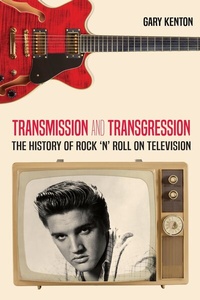
Transmission and Transgression
The History of Rock 'n' Roll on Television
Published on 28. February 2020
Book
Hardback
344 pages
978-1-4331-5304-4 (ISBN)
Description
When MTV (Music Television channel) was established in 1981, an executive claimed that they had "integrated the most powerful forces in our two decades, TV and rock 'n' roll." In fact, this problematic relationship began in the mid-1950s, when the advent of rock 'n' roll represented a musical and cultural revolution. The backlash against the music and the youth culture from which it emanated, described here as "rockaphobia," was reflected in a process of adulteration, racism, and co-optation by television programmers, spearheaded by American Bandstand. This interplay between rock 'n' roll and television played a significant role in alienating baby boomers from the mainstream, motivating them to create their own countercultural identity. This social migration helped to delineate the boundaries that would be identified in the 1960s as the generation gap.
Transmission and Transgression uses an interdisciplinary approach informed by media ecology, the theoretical framework which recognizes that each communication technology, or medium, creates its own unique environment, independent of content. This analysis allows the author to identify inherent technological and sensory incompatibilities between the medium of television and the cultural practice of rock 'n' roll, and to place these tensions within the broader shift of physiological emphasis from the traditional, tribal world dominated by the ear to the modern world which privileges the eye. Even in its remediated, diluted form, rock music has occupied a significant niche on television, and this book is the most comprehensive summary, celebration, and analysis of that history.
Reviews / Votes
"Jean Baudrillard rubs shoulders with Soupy Sales in Gary Kenton's encyclopedic history and indictment of television's emasculation of rock 'n' roll. Anyone who rushed home from school to watch American Bandstand, stayed up late to catch Midnight Special, or glommed onto MTV will revisit old memories in Transmission and Transgression, find new food for thought, and discover the missing link between Alan Freed and Andy Warhol." -Ken Emerson, author of Always Magic in the Air "This book is a superb, welcomed examination of the interrelationship between these two defining media of the boomer generation, but with emphasis on how popular music has impacted the boomers in a more pronounced and profound way than television ever did." -Thom Gencarelli, co-editor of Baby Boomers and Popular Culture "Gary Kenton combines a rock journalist's know-how with scholarly erudition in this engrossing study of the intersection of television and rock 'n' roll. ... Transmission and Transgression is a pioneering work of media ecology for anyone wanting to understand rock 'n' roll through the lens of the often-disapproving television camera." -Parke Puterbaugh, author of Phish: The BiographyMore details
Series
Edition
New edition
Language
English
Place of publication
New York
United States
Edition type
New edition
Illustrations
31 Illustrations
Dimensions
Height: 231 mm
Width: 155 mm
Thickness: 24 mm
Weight
648 gr
ISBN-13
978-1-4331-5304-4 (9781433153044)
DOI
10.3726/b14573
Schweitzer Classification
Other editions
Additional editions
E-Book
03/2020
1st Edition
Peter Lang Verlag
€49.49
Available for download
E-Book
03/2020
1st Edition
Peter Lang Verlag
€49.49
Available for download
Book
02/2020
Peter Lang Verlag
€47.10
Shipment within 7-9 days
Person
Gary Kenton began his career as a rock journalist with Fusion and Creem magazines. He subsequently worked in public relations for Warner Bros., Island, and CBS Records, and would later teach students with disabilities. After receiving a master's degree from Fordham University, he has taught communications at several universities. Some of his recent publications include "Insolent Networks: The Auto-Mated Social Life" in Confronting Technopoly and "'Come See About Me': Why the Baby Boomers Liked Stax but Loved Motown" in Baby Boomers and Popular Culture.
Content
List of Illustrations - Acknowledgments - Introduction - The Music and the Audience - Rockaphobia - The Mediums and the Messages - Technologies - Reception and Perception - The Non-Recognition Era - The Ridicule Era - The Regulation Era, Part 1 - The Regulation Era, Part 2 - The Regulation Era, Part 3 - The Respect Era, Part 1 - The Respect Era, Part 2 - The Respect Era, Part 3 - Conclusion - Appendix of TV Shows Featuring Rock 'n' Roll - Videography - Selected Discography - Index.