

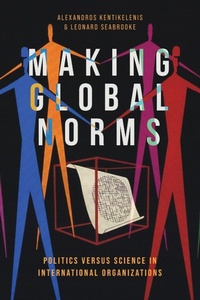
Making Global Norms
Politics versus Science in International Organizations
Published on 18. November 2025
Book
Paperback/Softback
280 pages
978-0-19-782862-5 (ISBN)
Description
Global norms form the core infrastructure of economic and political globalization. To be influential, these norms need to be codified into policy scripts that spell out how they are to be applied in practice. This process of developing scripts is a key job of international organizations, which act as venues where states can collectively make major decisions. When forging policy prescriptions, these organizations draw on scientific knowledge but are also highly attune to political pressures.
Making Global Norms provides a theoretical account and advanced methodological toolkit to study how variation in the intensity of scientific consensus and political contestation produces policy scripts that modify global norms. This book shows that the policymakers involved in scriptwriting processes within international organizations wear two hats: they are both political representatives of the states that appoint them and experts in their own right with worldviews that correspond to their expertise. They have to negotiate with each other, as well as with their organization's technocratic staff, to shape the ultimate content of global policy scripts. The implication of the authors' findings is that diversity within IOs matters: changes in the kinds of expertise that are present in deliberations can yield significant differences in how norms are modified. Their empirical focus is on the International Monetary Fund's scripts for capital controls, sovereign debt management, and taxation. Drawing on a novel mixed-method methodological approach, Making Global Norms opens the black box on how some of the most important norms underpinning globalization were made.
This is an open access title available under the terms of a [CC BY-NC-ND 4.0 International] licence. It is free to read at Oxford Scholarship Online and offered as a free PDF download from OUP and selected open access locations.
Making Global Norms provides a theoretical account and advanced methodological toolkit to study how variation in the intensity of scientific consensus and political contestation produces policy scripts that modify global norms. This book shows that the policymakers involved in scriptwriting processes within international organizations wear two hats: they are both political representatives of the states that appoint them and experts in their own right with worldviews that correspond to their expertise. They have to negotiate with each other, as well as with their organization's technocratic staff, to shape the ultimate content of global policy scripts. The implication of the authors' findings is that diversity within IOs matters: changes in the kinds of expertise that are present in deliberations can yield significant differences in how norms are modified. Their empirical focus is on the International Monetary Fund's scripts for capital controls, sovereign debt management, and taxation. Drawing on a novel mixed-method methodological approach, Making Global Norms opens the black box on how some of the most important norms underpinning globalization were made.
This is an open access title available under the terms of a [CC BY-NC-ND 4.0 International] licence. It is free to read at Oxford Scholarship Online and offered as a free PDF download from OUP and selected open access locations.
Reviews / Votes
The book stands out for its ability to combine an interest in broad questions about norm change, international organizations and the role of expertise in international politics with in-depth empirical work that brings out the particular norm dynamics, the actors involved in norm-making processes as well as their approaches and worldviews. Making Global Norms makes a significant contribution to our understanding of the dynamics of international law and norms by drawing on historical, sociological and political science methods and literatures with a rare sophistication.More details
Language
English
Place of publication
New York
United States
Target group
Professional and scholarly
College/higher education
Dimensions
Height: 234 mm
Width: 156 mm
Thickness: 17 mm
Weight
481 gr
ISBN-13
978-0-19-782862-5 (9780197828625)
Copyright in bibliographic data and cover images is held by Nielsen Book Services Limited or by the publishers or by their respective licensors: all rights reserved.
Schweitzer Classification
Other editions
Additional editions
Alexandros Kentikelenis | Leonard Seabrooke
Making Global Norms
Politics versus Science in International Organizations
Book
11/2025
Oxford University Press Inc
€101.80
Shipment within 15-20 days
Persons
Alexandros Kentikelenis is an Associate Professor of Political Economy and Sociology at Bocconi University in Milan.
Leonard Seabrooke is Professor of International Political Economy and Economic Sociology in the Department of Organization at the Copenhagen Business School and Research Professor at the Norwegian Institute of International Affairs.
Leonard Seabrooke is Professor of International Political Economy and Economic Sociology in the Department of Organization at the Copenhagen Business School and Research Professor at the Norwegian Institute of International Affairs.
Content
1: Politics Versus Science in International Organizations Part I. Processes 2: Global Norms as Contestation 3: How to Study Policy Scripts in International Organizations Part II. Scriptwriters 4: The Board 5: Technocrats Part III. Negotiations 6: Sovereign Debt 7: Capital Controls 8: Taxation Part IV. Extensions 9: Politics Versus Science Across Global Organizations