

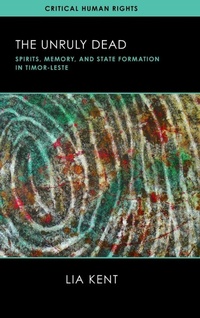
The Unruly Dead
Spirits, Memory, and State Formation in Timor-Leste
Published on 20. August 2024
Book
Hardback
210 pages
978-0-299-34930-1 (ISBN)
Description
"What might it mean to take the dead seriously?" asks Lia Kent in this exciting new contribution to critical human rights scholarship. In Timor-Leste, a new nation-state that experienced centuries of European colonialism before a violent occupation by Indonesia from 1975 to 1999, the dead are active participants in social and political life who continue to operate within familial structures of obligation and commitment. On individual, local, and national levels, Timor-Leste is invested in various forms of memory work, including memorialization, exhumation, reburial, and commemoration of the occupation's victims. Such practices enliven the dead, allowing them to forge new relationships with the living and unsettling the state-building logics that seek to contain and control them.
With generous, careful ethnography and incisive analysis, Kent challenges comfortable, linear narratives of transitional justice and argues that this memory work is reshaping the East Timorese social and political order-a process in which the dead are active, and sometimes disruptive, participants. Community ties and even the landscape itself are imbued with their presence and demands, and the horrific scale of mass death in recent times-at least a third of the population perished during the Indonesian occupation-means Timor-Leste's dead have real, significant power in the country's efforts to remember, recover, and reestablish itself.
With generous, careful ethnography and incisive analysis, Kent challenges comfortable, linear narratives of transitional justice and argues that this memory work is reshaping the East Timorese social and political order-a process in which the dead are active, and sometimes disruptive, participants. Community ties and even the landscape itself are imbued with their presence and demands, and the horrific scale of mass death in recent times-at least a third of the population perished during the Indonesian occupation-means Timor-Leste's dead have real, significant power in the country's efforts to remember, recover, and reestablish itself.
Reviews / Votes
"An important intervention into transitional justice scholarship. Kent interrupts established narratives and problematizes assumptions about victims and their temporal location in the past. Convincing, persuasive, and eminently readable."-Caroline Bennett, University of Sussex "Paying close attention to how the dead make claims on life and the political community in the aftermath of devastating violence, Kent offers a profound and compelling ethnography of how, in responding, Timorese survivors escape official necro-governmental projects and attempt on their own to re-member their dead through everyday technologies of truth and self."-Isaias Rojas-Perez, author of Mourning Remains: State Atrocity, Exhumations, and Governing the Disappeared in Peru's Postwar AndesMore details
Series
Language
English
Place of publication
Wisconsin
United States
Target group
College/higher education
Illustrations
18 b&w illus., 1 map
Dimensions
Height: 235 mm
Width: 157 mm
Thickness: 16 mm
Weight
462 gr
ISBN-13
978-0-299-34930-1 (9780299349301)
Copyright in bibliographic data and cover images is held by Nielsen Book Services Limited or by the publishers or by their respective licensors: all rights reserved.
Schweitzer Classification
Person
Lia Kent is a peace and conflict studies scholar and a senior fellow at the School of Regulation and Global Governance at the Australian National University. She is the author of The Dynamics of Transitional Justice: International Models and Local Realities in East Timor.
Content
List of Illustrations
Acknowledgments
Introduction: Memory Work in Timor-Leste: The Affective Force of the Dead
1 From Necropower to Necrogovernmentality: State Responses to Massive Bad Death
2 The Martyred Youth of the Metropole: Re-membering Santa Cruz
3 Civilian Sacrifices in the Town: Re-membering the LiquiCA Church Dead
4 The "Participating Population" of the Hinterlands: Gathering the Dispersed Dead
5 The Treacherous Dead of the Badlands: Re-membering Those Killed by the Resistance
Conclusion: Remembering Timor-Leste's Unruly Dead
Glossary
Notes
Bibliography
Index
Acknowledgments
Introduction: Memory Work in Timor-Leste: The Affective Force of the Dead
1 From Necropower to Necrogovernmentality: State Responses to Massive Bad Death
2 The Martyred Youth of the Metropole: Re-membering Santa Cruz
3 Civilian Sacrifices in the Town: Re-membering the LiquiCA Church Dead
4 The "Participating Population" of the Hinterlands: Gathering the Dispersed Dead
5 The Treacherous Dead of the Badlands: Re-membering Those Killed by the Resistance
Conclusion: Remembering Timor-Leste's Unruly Dead
Glossary
Notes
Bibliography
Index