

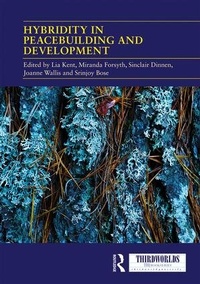
Hybridity in Peacebuilding and Development
A Critical and Reflexive Approach
1st Edition
Published on 11. December 2018
Book
Hardback
178 pages
978-0-367-08648-0 (ISBN)
Description
The concept of hybridity highlights complex processes of interaction and transformation between different institutional and social forms, and normative systems. It has been used in numerous ways to generate important analytical and methodological insights into peacebuilding and development. Its most recent application in the social sciences has also attracted powerful critiques that have highlighted its limitations and challenged its continuing usage.
This book examines whether the value of hybridity as a concept can continue to be harnessed, and how its shortcomings might be mitigated or overcome. It does so in an interdisciplinary way, as hybridity has been used as a benchmark across multiple disciplines and areas of practical engagement over the past decade - including peacebuilding, state-building, justice reform, security, development studies, anthropology, and economics. This book encourages a dialogue about the uses and critiques of hybridity from a variety of perspectives and vantage points, including deeply ethnographic works, high-level theory, and applied policy work. The authors conclude that there is continued value in the concept of hybridity, but argue that this value can only be realised if the concept is engaged with in a reflexive and critical way.
This book was originally published as a special issue of the online journal Third World Thematics.
This book examines whether the value of hybridity as a concept can continue to be harnessed, and how its shortcomings might be mitigated or overcome. It does so in an interdisciplinary way, as hybridity has been used as a benchmark across multiple disciplines and areas of practical engagement over the past decade - including peacebuilding, state-building, justice reform, security, development studies, anthropology, and economics. This book encourages a dialogue about the uses and critiques of hybridity from a variety of perspectives and vantage points, including deeply ethnographic works, high-level theory, and applied policy work. The authors conclude that there is continued value in the concept of hybridity, but argue that this value can only be realised if the concept is engaged with in a reflexive and critical way.
This book was originally published as a special issue of the online journal Third World Thematics.
More details
Series
Language
English
Place of publication
London
United Kingdom
Publishing group
Taylor & Francis Ltd
Target group
College/higher education
Dimensions
Height: 246 mm
Width: 174 mm
Weight
453 gr
ISBN-13
978-0-367-08648-0 (9780367086480)
Copyright in bibliographic data and cover images is held by Nielsen Book Services Limited or by the publishers or by their respective licensors: all rights reserved.
Schweitzer Classification
Other editions
Additional editions
Lia Kent | Miranda Forsyth | Sinclair Dinnen
Hybridity in Peacebuilding and Development
A Critical and Reflexive Approach
Book
09/2020
1st Edition
Routledge
€51.98
Shipment within 15-20 days
Lia Kent | Miranda Forsyth | Sinclair Dinnen
Hybridity in Peacebuilding and Development
A Critical and Reflexive Approach
E-Book
06/2020
1st Edition
Routledge
€59.49
Available for download
Lia Kent | Miranda Forsyth | Sinclair Dinnen
Hybridity in Peacebuilding and Development
A Critical and Reflexive Approach
E-Book
06/2020
1st Edition
Routledge
€59.49
Available for download
Persons
Lia Kent is a Fellow in the School of Regulation and Global Governance at The Australian National University. Her research is concerned with questions of peacebuilding, transitional justice, memory and reconciliation, with a geographic focus on Timor-Leste and Aceh.
Miranda Forsyth is an Associate Professor in the School of Regulation and Global Governance at The Australian National University. She formerly lectured in criminal law at the University of the South Pacific. Her research focuses on the possibilities and challenges of the interoperation of state and non-state justice and regulatory systems.
Sinclair Dinnen is an Associate Professor with the Department of Pacific Affairs at The Australian National University. He has a background in socio-legal studies and criminology. His research examines issues of regulatory pluralism, security governance, and politics and state formation in postcolonial societies, with a particular focus on the independent Melanesian countries in the southwest Pacific.
Joanne Wallis is a Senior Lecturer in the Strategic and Defence Studies Centre, Coral Bell School of Asia Pacific Affairs, at The Australian National University. Her research focuses on peacebuilding and security in the Pacific islands, with a special focus on Timor-Leste and Bougainville, Papua New Guinea.
Srinjoy Bose is a Lecturer in the School of Social Sciences at the University of New South Wales, Australia. He was formerly European Union COFUND (Marie Sklodowska-Curie Action) Fellow in the School of Government and International Affairs at Durham University, UK. His research is at the intersection of peace/security/conflict and development.
Miranda Forsyth is an Associate Professor in the School of Regulation and Global Governance at The Australian National University. She formerly lectured in criminal law at the University of the South Pacific. Her research focuses on the possibilities and challenges of the interoperation of state and non-state justice and regulatory systems.
Sinclair Dinnen is an Associate Professor with the Department of Pacific Affairs at The Australian National University. He has a background in socio-legal studies and criminology. His research examines issues of regulatory pluralism, security governance, and politics and state formation in postcolonial societies, with a particular focus on the independent Melanesian countries in the southwest Pacific.
Joanne Wallis is a Senior Lecturer in the Strategic and Defence Studies Centre, Coral Bell School of Asia Pacific Affairs, at The Australian National University. Her research focuses on peacebuilding and security in the Pacific islands, with a special focus on Timor-Leste and Bougainville, Papua New Guinea.
Srinjoy Bose is a Lecturer in the School of Social Sciences at the University of New South Wales, Australia. He was formerly European Union COFUND (Marie Sklodowska-Curie Action) Fellow in the School of Government and International Affairs at Durham University, UK. His research is at the intersection of peace/security/conflict and development.
Content
1. Hybridity in peacebuilding and development: a critical approach Miranda Forsyth, Lia Kent, Sinclair Dinnen, Joanne Wallis and Srinjoy Bose 2. From constructivist to critical engagements with peacebuilding: implications for hybrid peace Joanne Wallis and Oliver Richmond 3. Hybridity and dialogue - approaches to the hybrid turn M. Anne Brown 4. Hybridity and boundary-making: exploring the politics of hybridisation Helene Maria Kyed 5. Using the concept of hybridity to guide social change through legal means Miranda Forsyth 6. Is the 'hybrid turn' a 'spatial turn'? A geographical perspective on hybridity and state-formation in the Western Pacific Matthew G. Allen and Sinclair Dinnen 7. Sexual violence and hybrid peacebuilding: how does silence 'speak'? Nicole George and Lia Kent 8. The Afghan Local Police: unpacking a hybrid security arrangement Susanna Schmeidl and Nick Miszak 9. Separation and positive accommodation: police reform in Sierra Leone Peter Albrecht