

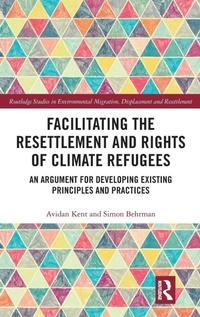
Facilitating the Resettlement and Rights of Climate Refugees
An Argument for Developing Existing Principles and Practices
1st Edition
Published on 5. April 2018
Book
Hardback
190 pages
978-0-8153-8631-5 (ISBN)
Description
One of the most significant impacts of climate change is migration. Yet, to date, climate-induced migrants are falling within what has been defined by some as a 'protection gap'. This book addresses this issue, first by identifying precisely where the gap exists, by reviewing the relevant legal tools that are available for those who are currently, and who will in the future be displaced because of climate change. The authors then address the relevant actors; the identity of those deserving protection (displaced individuals), as well as other bearers of rights (migration-hosting states) and obligations (polluting states). The authors also address head-on the contentious topic of definitions, concluding with the provocative assertion that the term 'climate refugees' is indeed correct and should be relied upon.
The second part of the book looks to the future by advocating specific legal and institutional pathways. Notably, the authors support the use of international environmental law as the most adequate and suitable regime for the regulation of climate refugees. With respect to the role of institutions, the authors propose a model of 'cross-governance', through which a more inclusive and multi-faceted protection regime could be achieved.
Addressing the regulation of climate refugees through a unique collaboration between a refugee lawyer and an environmental lawyer, this book will be of great interest to scholars and professionals in fields including international law, environmental studies, refugee studies and international relations.
The second part of the book looks to the future by advocating specific legal and institutional pathways. Notably, the authors support the use of international environmental law as the most adequate and suitable regime for the regulation of climate refugees. With respect to the role of institutions, the authors propose a model of 'cross-governance', through which a more inclusive and multi-faceted protection regime could be achieved.
Addressing the regulation of climate refugees through a unique collaboration between a refugee lawyer and an environmental lawyer, this book will be of great interest to scholars and professionals in fields including international law, environmental studies, refugee studies and international relations.
More details
Series
Language
English
Place of publication
New York
United States
Publishing group
Taylor & Francis Inc
Target group
College/higher education
Dimensions
Height: 240 mm
Width: 161 mm
Thickness: 15 mm
Weight
458 gr
ISBN-13
978-0-8153-8631-5 (9780815386315)
Copyright in bibliographic data and cover images is held by Nielsen Book Services Limited or by the publishers or by their respective licensors: all rights reserved.
Schweitzer Classification
Other editions
Additional editions
Avidan Kent | Simon Behrman
Facilitating the Resettlement and Rights of Climate Refugees
An Argument for Developing Existing Principles and Practices
Book
12/2019
1st Edition
Routledge
€68.00
Shipment within 15-20 days
Avidan Kent | Simon Behrman
Facilitating the Resettlement and Rights of Climate Refugees
An Argument for Developing Existing Principles and Practices
E-Book
03/2018
1st Edition
Routledge
€61.99
Available for download
Persons
Avidan Kent is a lecturer at the University of East Anglia, UK, and a Fellow of the Centre for International Sustainable Development Law.
Simon Behrman is a lecturer in the Law School at Royal Holloway, University of London, UK.
Simon Behrman is a lecturer in the Law School at Royal Holloway, University of London, UK.
Content
Contents
Acknowledgements
List of Acronyms
Introduction
Chapter 1: Defining the 'legal hole'
Chapter 2: Why 'Climate Refugees'?
Chapter 3: Climate-Induced Migration and International Environmental Law
Chapter 4: Filling the Institutional Gap
Conclusion: Cautious Optimism?
Acknowledgements
List of Acronyms
Introduction
Chapter 1: Defining the 'legal hole'
Chapter 2: Why 'Climate Refugees'?
Chapter 3: Climate-Induced Migration and International Environmental Law
Chapter 4: Filling the Institutional Gap
Conclusion: Cautious Optimism?