

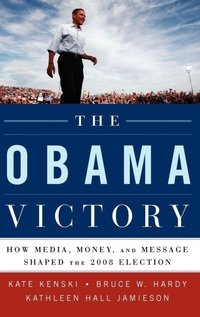
The Obama Victory
How Media, Money, and Message Shaped the 2008 Election
Published on 26. August 2010
Book
Hardback
392 pages
978-0-19-539955-4 (ISBN)
Description
Barack Obama's stunning victory in the 2008 presidential election will go down as one of the more pivotal in American history. Given America's legacy of racism, how could a relatively untested first-term senator with an African father defeat some of the giants of American politics?
In The Obama Victory, Kate Kenski, Bruce Hardy, and Kathleen Hall Jamieson draw upon the best voter data available, The National Annenberg Election Survey, as well as interviews with key advisors to each campaign, to illuminate how media, money, and messages shaped the 2008 election. In a crisp, incisive narrative, the authors identify the candidates' major themes--Maverick versus Mc-Same; Change versus Tax and Spend Liberal, etc.--and then apply them to the five main periods of the campaign: the early summer; the period from the vice presidential nominations through the conventions; the financial meltdown from mid-September to mid-October; the two weeks after the final debate; and the final week. Throughout, they explain how both sides worked the media to reinforce or combat images of McCain as too old and Obama as not ready; how Obama used a very effective rough-and-tumble radio and cable campaign that was largely unnoticed by the mainstream media; how the Vice Presidential nominees impacted the campaign; how McCain's age and Obama's race affected the final vote, and much more. Analyzing each nominee's broadcast, cable, and radio spending, the authors conclude that Obama's media campaign was more savvy than McCain's, and that early voting and the complete collapse of campaign finance reform will change elections for years to come.
Briskly written and filled with surprising insights, The Obama Victory goes beyond opinion to offer the most authoritative account available of precisely how and why Obama won the presidency.
In The Obama Victory, Kate Kenski, Bruce Hardy, and Kathleen Hall Jamieson draw upon the best voter data available, The National Annenberg Election Survey, as well as interviews with key advisors to each campaign, to illuminate how media, money, and messages shaped the 2008 election. In a crisp, incisive narrative, the authors identify the candidates' major themes--Maverick versus Mc-Same; Change versus Tax and Spend Liberal, etc.--and then apply them to the five main periods of the campaign: the early summer; the period from the vice presidential nominations through the conventions; the financial meltdown from mid-September to mid-October; the two weeks after the final debate; and the final week. Throughout, they explain how both sides worked the media to reinforce or combat images of McCain as too old and Obama as not ready; how Obama used a very effective rough-and-tumble radio and cable campaign that was largely unnoticed by the mainstream media; how the Vice Presidential nominees impacted the campaign; how McCain's age and Obama's race affected the final vote, and much more. Analyzing each nominee's broadcast, cable, and radio spending, the authors conclude that Obama's media campaign was more savvy than McCain's, and that early voting and the complete collapse of campaign finance reform will change elections for years to come.
Briskly written and filled with surprising insights, The Obama Victory goes beyond opinion to offer the most authoritative account available of precisely how and why Obama won the presidency.
Reviews / Votes
A dense account of the Obama victory, replete with charts and graphs. * The Times Literary Supplement * The Obama Victory is an incisive academic study of how the 2008 presidential election campaign, and Barack Obama's historic victory in November, was not just a triumph of hope but of organisation, money and media. * Keith Richmond, TribuneGeofrey kabaservice, The Journal of American Studies *More details
Language
English
Place of publication
New York
United States
Dimensions
Height: 240 mm
Width: 161 mm
Thickness: 25 mm
Weight
749 gr
ISBN-13
978-0-19-539955-4 (9780195399554)
Copyright in bibliographic data and cover images is held by Nielsen Book Services Limited or by the publishers or by their respective licensors: all rights reserved.
Schweitzer Classification
Other editions
Additional editions
Kate Kenski | Bruce W. Hardy | Kathleen Hall Jamieson
The Obama Victory
How Media, Money, and Message Shaped the 2008 Election
Book
08/2010
Oxford University Press Inc
€42.70
Shipment within 15-20 days
Kate Kenski | Bruce W. Hardy | Kathleen Hall Jamieson
The Obama Victory
How Media, Money, and Message Shaped the 2008 Election
E-Book
07/2010
1st Edition
OUP eBook
€16.49
Available for download
Kate Kenski | Bruce W. Hardy | Kathleen Hall Jamieson
The Obama Victory
How Media, Money, and Message Shaped the 2008 Election
E-Book
07/2010
1st Edition
OUP eBook
€15.49
Available for download
Persons
Kate Kenski is an Assistant Professor in the Department of Communication at the University of Arizona and was a member of the National Annenberg Election Survey team in 2000, 2004, and 2008. She has published over twenty articles in political communication and is co-author of Capturing Campaign Dynamics (OUP, 2004). Bruce Hardy is a doctoral candidate in the Annenberg School of Communication, a Senior Research Analyst in the Annenberg Public Policy Center, and a member of the 2008 National Annenberg Election Survey team. Kathleen Hall Jamieson is the Elizabeth Ware Packard Professor of Communication at the Annenberg School for Communication at the University of Pennsylvania and director of its Annenberg Public Policy Center. She has published many books, including Echo Chamber: Rush Limbaugh and the Conservative Media Establishment (OUP, 2008) and the award-winning Spiral of Cynicism: The Press and the Public Good (OUP, 1997), both co-authored with Joseph N. Cappella.
Author
Assistant Professor of CommunicationAssistant Professor of Communication, University of Arizona
Senior Research AnalystSenior Research Analyst, Annenberg Public Policy Center, University of Pennsylvania
Elizabeth Ware Packard Professor of CommunicationElizabeth Ware Packard Professor of Communication, Annenberg School for Communication, University of Pennsylvania
Content
1. Maverick versus Mc-Same; Change versus Tax and Spend Liberal
2. Too Old versus Not Ready to Lead
3. What a Difference a Party Makes: Playing to and against Party Assumptions
4. The Issues that Mattered to Specific Groups? Stem Cells, Abortion, Immigration
5. Period One
6. Period Two
7. Period Three
8. Period Four
9. Period Five
10. Was the Election over Before it was over
11. Will Presidential Campaigns ever be the Same Again? Implications for the Future
2. Too Old versus Not Ready to Lead
3. What a Difference a Party Makes: Playing to and against Party Assumptions
4. The Issues that Mattered to Specific Groups? Stem Cells, Abortion, Immigration
5. Period One
6. Period Two
7. Period Three
8. Period Four
9. Period Five
10. Was the Election over Before it was over
11. Will Presidential Campaigns ever be the Same Again? Implications for the Future