

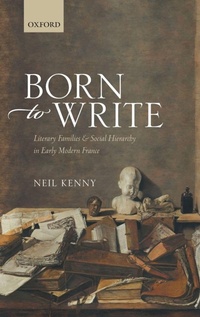
Born to Write
Literary Families and Social Hierarchy in Early Modern France
Published on 3. March 2020
Book
Hardback
424 pages
978-0-19-885239-1 (ISBN)
Description
It is easy to forget how deeply embedded in social hierarchy was the literature and learning that has come down to us from the early modern European world. From fiction to philosophy, from poetry to history, works of all kinds emerged from and through the social hierarchy that was a fundamental fact of everyday life. Paying attention to it changes how we might understand and interpret the works themselves, whether canonical and familiar or largely forgotten. But a second, related fact is much overlooked too: works also often emanated from families, not just from individuals.
Families were driving forces in the production--that is, in the composing, editing, translating, or publishing--of countless works. Relatives collaborated with each other, edited each other, or continued the unfinished works of deceased family members; some imitated or were inspired by the works of long-dead relatives. The reason why this second fact (about families) is connected to the first (about social hierarchy) is that families were in the period a basic social medium through which social status was claimed, maintained, threatened, or lost. So producing literary works was one of the many ways in which families claimed their place in the social world. The process was however often fraught, difficult, or disappointing. If families created works as a form of socio-cultural legacy that might continue to benefit their future members, not all members benefited equally; women sometimes produced or claimed the legacy for themselves, but they were often sidelined from it. Relatives sometimes disagreed bitterly about family history, identity (not least religious), and so about the picture of themselves and their family that they wished to project more widely in society through their written works, whether printed or manuscript. So although family was a fundamental social medium out of which so many works emerged, that process could be conflictual as well as harmonious. The intertwined role of family and social hierarchy within literary production is explored in this book through the case of France, from the late fifteenth to the mid-seventeenth century. Some families are studied here in detail, such as that of the most widely read French poet of the age, Clement Marot. But the extent of this phenomenon is quantified too: some two hundred families are identified as each containing more than one literary producer, and in the case of one family an extraordinary twenty-seven.
Families were driving forces in the production--that is, in the composing, editing, translating, or publishing--of countless works. Relatives collaborated with each other, edited each other, or continued the unfinished works of deceased family members; some imitated or were inspired by the works of long-dead relatives. The reason why this second fact (about families) is connected to the first (about social hierarchy) is that families were in the period a basic social medium through which social status was claimed, maintained, threatened, or lost. So producing literary works was one of the many ways in which families claimed their place in the social world. The process was however often fraught, difficult, or disappointing. If families created works as a form of socio-cultural legacy that might continue to benefit their future members, not all members benefited equally; women sometimes produced or claimed the legacy for themselves, but they were often sidelined from it. Relatives sometimes disagreed bitterly about family history, identity (not least religious), and so about the picture of themselves and their family that they wished to project more widely in society through their written works, whether printed or manuscript. So although family was a fundamental social medium out of which so many works emerged, that process could be conflictual as well as harmonious. The intertwined role of family and social hierarchy within literary production is explored in this book through the case of France, from the late fifteenth to the mid-seventeenth century. Some families are studied here in detail, such as that of the most widely read French poet of the age, Clement Marot. But the extent of this phenomenon is quantified too: some two hundred families are identified as each containing more than one literary producer, and in the case of one family an extraordinary twenty-seven.
Reviews / Votes
In this well-written study of 'literary families' in sixteenth-century France, Neil Kenny (University of Oxford) examines the relationship between 'family literature' and the family members' position on the social ladder....A must-read for literary, historical, and sociological interested readers. * Dick Wursten, Independent Scholar, Antwerp, Belgium, Church History and Religious Culture * ...the wealth of examples that Kenny presents makes a case far more compelling than what arguments from social history alone could have accomplished. With measured prose and in understated tones, Kenny has introduced to literary study a revolution of seismic proportions whose importance and consequences are difficult to overstate. * George Hoffmann, Renaissance and Reformation *More details
Language
English
Place of publication
Oxford
United Kingdom
Target group
College/higher education
Illustrations
15 Illustrations
Dimensions
Height: 240 mm
Width: 161 mm
Thickness: 27 mm
Weight
798 gr
ISBN-13
978-0-19-885239-1 (9780198852391)
Copyright in bibliographic data and cover images is held by Nielsen Book Services Limited or by the publishers or by their respective licensors: all rights reserved.
Schweitzer Classification
Other editions
Additional editions
E-Book
02/2020
1st Edition
OUP eBook
€66.49
Available for download
E-Book
02/2020
1st Edition
OUP eBook
€57.99
Available for download
Person
Neil Kenny is Senior Research Fellow at All Souls College, Oxford and Professor of French at the University of Oxford, having previously taught at the University of Cambridge and Queen Mary University of London. His work has long focused on early modern French literature, culture, and thought, within a wider European context. More recently, the focus has been on the relation of literate culture to social hierarchy. He is also interested in language policy in the UK and is Lead Fellow for Languages at the British Academy.
Content
Preface Part I. Introduction 1: Hierarchy and heredity 2: Why this time and place? 3: Inheritance under the law 4: Transmission beyond legal inheritance: socio-cultural legacy 5: Other collectivities 6: Family literature 7: The family function Part II. Family Literature: A Social Survey 8: Family literature: extent and social profile 9: Works shaped by family 10: Not going to plan 11: Conclusions Part III. Promoting Family Literature 12: Families and the emergence of literary history 13: La Croix du Maine's Bibliotheque (1584) 14: Scevole de Sainte-Marthe's Elogia (1598-1630) 15: Conclusions Part IV. The Marot Family 16: Introducing the Marots 17: The extent and the limits of a family's ascent through poetry 18: Moulding social hierarchy by communicating experience of it: Clement Marot's poetry 19: Conclusions Part V. The Brouart-Vatable-Beroald-Verville Family 20: Two deaths in the family: 1526, 1626 21: From barber-surgeon's son to professor: Matthieu Beroald 22: From professor's son to 'Francois Beroalde, escuyer, sieur de Verville, docteur en medicine' 23: Conclusions Conclusions Appendix: Families with more than one literary producer