

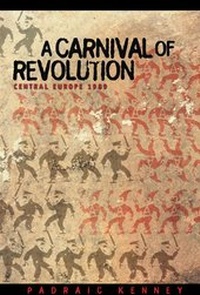
A Carnival of Revolution
Central Europe 1989
Published on 7. April 2002
Book
Hardback
352 pages
978-0-691-05028-7 (ISBN)
Description
This is the first history of the revolutions that toppled communism in Europe to look behind the scenes at the grassroots movements that made those revolutions happen. It looks for answers not in the salons of power brokers and famed intellectuals, not in decrepit economies - but in the whirlwind of activity that stirred so crucially, unstoppably, on the street. Melding his experience in Solidarity-era Poland with the sensibility of a historian, Padraic Kenney takes us into the hearts and minds of those revolutionaries across much of Central Europe who have since faded namelessly back into everyday life. This is a riveting story of musicians, artists, and guerrilla theater collectives subverting traditions and state power; a story of youthful social movements emerging in the 1980s in Poland, East Germany, Czechoslovakia, Hungary, and parts of Yugoslavia and the Soviet Union. Kenney argues that these movements were active well before glasnost. Some protested military or environmental policy. Others sought to revive national traditions or to help those at the margins of society. Many crossed forbidden borders to meet their counterparts in neighboring countries.
They all conquered fear and apathy to bring people out into the streets. The result was a revolution unlike any other before: nonviolent, exuberant, even light-hearted, but also with a relentless political focus - a revolution that leapt from country to country in the exciting events of 1988 and 1989. "A Carnival of Revolution" resounds with the atmosphere of those turbulent years: the daring of new movements, the unpredictability of street demonstrations, and the hopes and regrets of the young participants. A vivid photo-essay complements engaging prose to fully capture the drama. Based on over two hundred interviews in twelve countries, and drawing on samizdat and other writings in six languages, this is among the most insightful and compelling accounts ever published of the historical milestone that ushered in our age.
They all conquered fear and apathy to bring people out into the streets. The result was a revolution unlike any other before: nonviolent, exuberant, even light-hearted, but also with a relentless political focus - a revolution that leapt from country to country in the exciting events of 1988 and 1989. "A Carnival of Revolution" resounds with the atmosphere of those turbulent years: the daring of new movements, the unpredictability of street demonstrations, and the hopes and regrets of the young participants. A vivid photo-essay complements engaging prose to fully capture the drama. Based on over two hundred interviews in twelve countries, and drawing on samizdat and other writings in six languages, this is among the most insightful and compelling accounts ever published of the historical milestone that ushered in our age.
Reviews / Votes
Seminal and indispensable. Using his first-hand acquaintance with many of the key participants in the movements ... Kenney has given us a pioneering oral history... Strikingly well written, A Carnival of Revolution weaves personal narratives of protest into an illuminating historical analysis of the changing environment in which a new kind of politics developed. -- John Gray Times Literary Supplement In wondering at the overnight collapse of communism in Eastern Europe, Western observers have often focused on Gorbachev, Vaclav Havel, the storied opposition in Poland, and the measures of regime failure. These accounts have missed something. Kenney goes back and uncovers the more complex bubbling of events--that helped prepare the way for democracy. Foreign Affairs Using oral history techniques and underground literature, Kenney has woven together stories of many individuals... This new approach is a valuable contribution to the topic and will appeal to both historians and political scientists. Library Journal A Carnival of Revolution acts as a potent corrective to the simplistic and often self-serving accounts of the fall of the Iron Curtain currently in vogue... Padraic Kenney's careful account returns history to its rightful owners, the thousands who risked what little security they had to sneak a little joy into their lives. Mother Jones Assiduous in searching out sources in several countries and languages ... [Kenney] has gathered together information that no one else has or will. As a result, he has written an account that is essential reading for a full understanding of the revolutions of 1989 and of the younger generations that haunted the last days of Communism. -- John J. Kulczycki International History Review I know of no other book telling of so many lesser-known groups and activists involved in a social movement wave across so many countries (not to mention languages). Kenney cobbles their stories together like a master sleuth writing a whodunit, culminating with a series of sketches putting the pieces together as 1989 approaches. It ... will be a crucial reference for a long time to come. -- David Ost American Historical Review Essential reading for a full understanding of the revolution of 1989 and of the younger generation that haunted the last days on Communism. -- John J. Kulczycki International History ReviewMore details
Language
English
Place of publication
New Jersey
United States
Target group
Professional and scholarly
College/higher education
Product notice
Trade binding
Illustrations
22 Fotos bzw. Rasterbilder, 4 Abbildungen
22 halftones, 4 line illus.
Dimensions
Height: 229 mm
Width: 152 mm
Weight
652 gr
ISBN-13
978-0-691-05028-7 (9780691050287)
Copyright in bibliographic data and cover images is held by Nielsen Book Services Limited or by the publishers or by their respective licensors: all rights reserved.
Schweitzer Classification
Other editions
Additional editions
E-Book
02/2021
1st Edition
Princeton University Press
€53.49
Available for download
Person
Padraic Kenney is Associate Professor of European History at the University of Colorado, He is the author of Rebuilding Poland: Workers and Communists, 1945-1950.
Content
INTRODUCTION: Street Theater, Concrete Poetry 1 PART ONE: ACTORS, STAGES, REPERTOIRES 21 CHAPTER ONE: Eating the Crocodile with a Spoon, or, A Career Guide to the Underground 23 The Amnesty Trap Political Charity Church and Opposition The Workers' Dilemma Vents or Accumulators? CHAPTER TWO: Come With Us! They Aren't Beating Today! The Art of the Blizzard 57 The Ballad of Marek Adamkiewicz Conservative Pacism, Anarchist Nationalism Ideals and Instruments "Radiators" across the Bloc Zarnobyl The Blue and the Green Bratislava Speaks Up "I'd Rather Live" In the Future Tense CHAPTER THREE: As If in Europe: The International World of Peace and Human Rights 91 Reticence and Revolutionary Tourism Dialogue for an Endangered Continent Helsinki from Below On the Friendship Trail Borders Fall in East Germany Coventry Cathedral and the Church on Zytnia Street CHAPTER FOUR: The New Politics of the Konkretny Generation 121 A Shy Little Wave for Gorbachev The Lion Cubs of Western Ukraine Slovenia's People for Peace Culture Hungarian Orange Appeal Towards an Opposition in Prague Workers of the Last Hour CHAPTER FIVE: How the Smurfs Captured Gargamel, or, A Revolution of Style 157 The Elfn Rebellion Hippies in the Holy Garden The Young Subversive's Handbook Gloom in Krakow Pietia's Crusade Pornoslavia God, King, and Country in Bohemia To Become a Smurf PHOTOESSAY: PHOTOGRAPHING THE CARNIVAL 195 PART TWO: A REVOLUTION IN SIXTEEN SCENES 213 Scene One: "Blink, and I See Another World": The Candlelight March 215 Scene Two: A Tale of Two Lenins 217 Scene Three: Slovene Spring 225 Scene Four: Days That Shook Lviv 229 Scene Five: Strikes in Shades of Orange 233 Scene Six: An Invasion Remembered 238 Scene Seven: WaterDam/ned: Hungary Defends the Danube 241 Scene Eight: Independence Day and Palach Week 244 Scene Nine: Encircling the Round Table 249 Scene Ten: Mothers and Children 254 Scene Eleven: On the Fourth of June 257 Scene Twelve: Hungarians Bury the Communists 261 Scene Thirteen: Korzos and Road Races 265 Scene Fourteen: Lviv Passes the Baton 269 Scene Fifteen: The Mosquito and the Messedemos 274 Scene Sixteen: Bring a Flower with You! The Velvet Revolution 280 EPILOGUE: No More Picnics, After the Revolution 293 Jacob's Retreat Remembering 1989 ACKNOWLEDGMENTS 307 NOTES 311 SOURCES 323 INDEX 331