

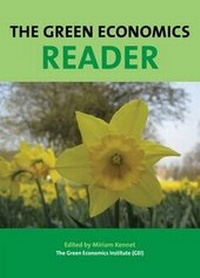
Green Economics Reader 2012
2nd Edition
Published on 1. February 2012
Book
Paperback/Softback
350 pages
978-1-907543-26-5 (ISBN)
Description
The Green Economics Reader is a collection of essays, speeches and articles from leading green economists Green Economists, and also green professionals, and philosophers on environmental change, scientific theory and philosophy in Green Economics. Green Economics as a discipline is outlined and described, and provides the reader with well-thought out practical answers to existing and future problems by incorporating knowledge and complex interactions into an exciting and up to the minute understanding of the issues that the world is facing. The work of the Green Economics Institute (GEI) has given rise to the global movement known as Green Economics and the Green Economy. It was the aim and the achievement of The Green Economics Institute to turn the vision of a few campaigners and innovators into a massive global movement for change, one which has been taken up by almost all global transnational institutions and governments. This book is the first volume to bring these core ideas to the general reader and to provide an insight into the development, theory and features of Green Economics.Green Economics is based on a completely innovative assessment of the problems, options and solutions available to society, which is needed to deal with the challenges of the rapidly changing fragile and vulnerable physical and social environments, which we face.
It is a beacon of hope for addressing the related crises of climate, biodiversity loss, species extinction and the global economic downturn. Green Economics also highlights the need for a progressive approach, involving the complex mesh of both social and environmental justice, as the key to solving the economic problems of the Age of Austerity. Table of Contents: Part One - Concepts: establishing the Green Economics discipline: what is green economics and how it can make a difference Part Two - Developments in Green Economics: essays on the development and background of green economics as a discipline, issues and philosophy in green economics, and the green economics response to environmental and economic crises. Part Three - Green Economics in Context: solutions to problems today, perspectives, and on the financial crises.Part Four - Green Economics and Education: pedagogy and the importance of teaching young people Part Five - Case Studies: Green economics in action in Ethiopia, women's unequal pay, green jobs and green careers, Galapagos and China.
Authors of this the first book in the series include: Naomi Baster (Scotland -Orkney), Katie Black (UK), Sophie Billington, (UK), Rosita Bujkaite, (Lithuania) Michele Gale D'Oliviera (USA and Brazil),Volker Heinemann (Uk and Germany),Kristina Jociute (Lithuania), Miriam Kennet,(UK), Mahalet Alemayehu Mekonnen, (Ethiopia), Jack Reardon, (USA) Oliver Tickell,(UK) Miriam Prasse (Germany) Sandra Ries, |(Denmark and New Zealand), Grit Silberstein (Galapagos, Ee and Storage. Volker Heinemann is an economist who studied at the Universities of Goettingen, Kiel and Nottingham. He is a specialist in international and developing economics, monetary economics and macroeconomic theory and policy. He is author of the book "Die Oekonomie der Zukunft," "The Economy of the Future," a book outlining the principal structure for a modern economy that accepts the pressing changes that are required to the outdated current economic thinking.He is co-founder and Director and CFO of the Green Economics Institute, a member of the Institute of Chartered Accountants in England and Wales, trained at PWC and other major Institutions and Deputy Editor of the International Journal of Green Economics.
Michelle Gale de Oliveira is on the board of the Green Economics Institute, UK, and is in the International Relations Department at Richmond, the American International University in London (RAIUL) and lives in the remote rainforest in Brazil. She is currently editor of the Green Economics Institute's members' magazine, The Green Economist, as well as the Editor of this current climate change special issue of the International Journal of Green Economics. Her writing has been featured in Europe's World, one of the foremost European policy magazines. She lectures and speaks on Environmental and Social Justice, Gender Equity, and International Development from a Green Economics perspective. She is founder and chair of the Gender Equity Forum at RAIUL.Recently, she recently organised a Green Economics conference on women's unequal pay and poverty in Reading, UK, and lectured on green economics in Berlin, Germany, at retreats in Glastonbury, UK, and is a regular speaker at international conferences. She researches women's unequal pay and poverty in Brazil. cuador and Germany), Enrico Tezza (Italy), Jeff Turk (Belgium and Slovenia) Professor Lu Wei (China). Rights:
It is a beacon of hope for addressing the related crises of climate, biodiversity loss, species extinction and the global economic downturn. Green Economics also highlights the need for a progressive approach, involving the complex mesh of both social and environmental justice, as the key to solving the economic problems of the Age of Austerity. Table of Contents: Part One - Concepts: establishing the Green Economics discipline: what is green economics and how it can make a difference Part Two - Developments in Green Economics: essays on the development and background of green economics as a discipline, issues and philosophy in green economics, and the green economics response to environmental and economic crises. Part Three - Green Economics in Context: solutions to problems today, perspectives, and on the financial crises.Part Four - Green Economics and Education: pedagogy and the importance of teaching young people Part Five - Case Studies: Green economics in action in Ethiopia, women's unequal pay, green jobs and green careers, Galapagos and China.
Authors of this the first book in the series include: Naomi Baster (Scotland -Orkney), Katie Black (UK), Sophie Billington, (UK), Rosita Bujkaite, (Lithuania) Michele Gale D'Oliviera (USA and Brazil),Volker Heinemann (Uk and Germany),Kristina Jociute (Lithuania), Miriam Kennet,(UK), Mahalet Alemayehu Mekonnen, (Ethiopia), Jack Reardon, (USA) Oliver Tickell,(UK) Miriam Prasse (Germany) Sandra Ries, |(Denmark and New Zealand), Grit Silberstein (Galapagos, Ee and Storage. Volker Heinemann is an economist who studied at the Universities of Goettingen, Kiel and Nottingham. He is a specialist in international and developing economics, monetary economics and macroeconomic theory and policy. He is author of the book "Die Oekonomie der Zukunft," "The Economy of the Future," a book outlining the principal structure for a modern economy that accepts the pressing changes that are required to the outdated current economic thinking.He is co-founder and Director and CFO of the Green Economics Institute, a member of the Institute of Chartered Accountants in England and Wales, trained at PWC and other major Institutions and Deputy Editor of the International Journal of Green Economics.
Michelle Gale de Oliveira is on the board of the Green Economics Institute, UK, and is in the International Relations Department at Richmond, the American International University in London (RAIUL) and lives in the remote rainforest in Brazil. She is currently editor of the Green Economics Institute's members' magazine, The Green Economist, as well as the Editor of this current climate change special issue of the International Journal of Green Economics. Her writing has been featured in Europe's World, one of the foremost European policy magazines. She lectures and speaks on Environmental and Social Justice, Gender Equity, and International Development from a Green Economics perspective. She is founder and chair of the Gender Equity Forum at RAIUL.Recently, she recently organised a Green Economics conference on women's unequal pay and poverty in Reading, UK, and lectured on green economics in Berlin, Germany, at retreats in Glastonbury, UK, and is a regular speaker at international conferences. She researches women's unequal pay and poverty in Brazil. cuador and Germany), Enrico Tezza (Italy), Jeff Turk (Belgium and Slovenia) Professor Lu Wei (China). Rights:
Reviews / Votes
A review by Pauline Mouret, AgroParisTech, France. This books introduces Green economics and provides practical answers to existing and future problems. Green economics brings to economics the core drivers of ecology, equity, social and environmental justice and therefore its approach is a beacon of hope for addressing the related crises of climate, biodiversity loss, species extinction and the global economic downturn. To my mind, this book is really worth reading, especially because it brings these core ideas to anyone who is interested in global issues and provides an insight into the development, theory and the key ideas and features of Green Economics which are clearly explained in this book. The age of Green Economics which teaches us firstly how to share with others. In my view, this book is also well suited for innovators, campaigners and policy makers an its aims is to turn their vision into a global movement to reform mainstream economics into a discipline which no longer supports or accepts that only a minority can be wealthy, but which works towards a fair and equitable society which lives within its means. Further Green Economics seeks to re-examine broader versions of reality, beyond the views of the rich and powerful, rejecting the idea of rational economic man "homoeconomicus". It is divided into five parts which could be sumed up thus : Part One - Concepts: establishing the Green Economics discipline: what is green economics and how it can make a difference Part two - Developments in Green Economics: essays on the development and background of green economics as a discipline, issues and philosophy in green economics, and the green economics response to environmental and economic crises in 2010 Part three - Green Economics in Context: solutions to problems today, perspectives, and on the financial crises. Part four - Green Economics and Education: pedagogy and the importance of teaching young people Part five - Case Studies: Green economics in action in Ethiopia, women's unequal pay, green jobs and green careers, Galapagos and China. ------------ A review of'The Green Economics Reader' Title: The Green Economics Reader Author / Editor: Miriam Kennet, Katie Black, Michelle S. Gale de Oliveira and Volker Heinemann First copyright date: February 2012 Type of book: A compilation of essays on global movement known as Green Economics and Green Economy. General subject matter: Economics Theme: Green economics and Green economy. Description: The author uses explanation and analysis to present a subject or to clarify an idea. Exposition presents the facts about a subject or an issue as clearly and impartially as possible. Its primary purpose is to explain. The author uses the techniques of persuasion to establish the truth of a statement or to convince the reader of its falsity. The purpose is to persuade the reader to believe something and perhaps to act on that belief. Argument takes sides on an issue. Its primary purpose is to convince. Green economics is an entirely new discipline. It is based on innovative assessment of the problems, and providing realistic solutions to society in dealing with today's complex challenges. It has been written from the point of view of campaigners and innovators in Green Economics Institute, which intent to turn a vision into a global movement. The book explains the core ideas of green economics particularly in its development, theory and features. It addresses today's world challenges in managing resources which becoming scarcer. This book is targeted to general reader who wants to understand what green economics is all about. The book has been written in an interesting and informal manner. The topics were arranged in a holistic approach. The ideas were original and clearly explained. It suits the intended readers. The book has 6 sections. It starts with Part 1- Introduction, contains two sub topics; which (i) explains the core idea of green economics and the role of Green Economics Institute and (ii) highlights the 10 key values of green economics. Part 2 - Concepts, including three sub topics; (i) describe Green Economics (GE) as global movement, (ii) introducing GE as progressive economics, (iii) explains GE research, instruments and tools. Part 3 - Developments in GE contains 4 sub topics; (i) describe recent development in environmental and GE, (ii) express ideas on the framework of welfare economics, sustainable development and ecological economics in the GE development context, (iii) explains how GE response to current economic and environmental crises, (iv) illustrates GE ideas in Critical Realist perspective. Part 4 - GE in context have 6 sub topics which are; (i) explains the usefulness of econometrics for GE, (ii) describe socio ecological transformation through GE, (iii) discuss the prosperity without growth, (iv) express ideas on global green human being, (v) explains the importance of COP Kyoto Climate Summit Conference Processes, and finally (vi) discuss the new welfare approaches for today's financial crisis. Part 5 - GE and Education comprises two sub topics, (i) explains the importance of GE to young people, and (ii) discussing on the GE and Pedagogy. In the final section, Part 6 - Case studies contains five cases, (i) Case on Ethiopia, (ii) case on women's unequal pay, (iii) green jobs, (iv) Case on Galapagos Island, and finally (v) case on China. Before I read this book, there are many questions lies in my head especially on the new concept and theory. After I finish reading the book, I am clearly understood the concept of GE and the explanations of the theories. It makes my desire burning to pursue PhD in the GE discipline. I would agree with the GE concept as today we could still locate poor countries - with unequal opportunities given to women, youngsters and disabled individual. The concept of progressive economics and inclusivity are arriving at the right time. Now, it's the time to develop effective economics instruments which contains these two basic elements. The book has achieved its goal in explaining and discussing ideas of GE to general readers. I would rate it 5 stars for anyone wanting to know more about green economics or who want an introduction to Green Economics and how it has spread around the world. Norferanti Kamarudin 2012 MalaysiaMore details
Edition
2nd edition
Language
English
Place of publication
Reading
United Kingdom
Illustrations
20 photos
ISBN-13
978-1-907543-26-5 (9781907543265)
Copyright in bibliographic data and cover images is held by Nielsen Book Services Limited or by the publishers or by their respective licensors: all rights reserved.
Schweitzer Classification
Other editions
Previous edition
Miriam Kennet | Katie Black | Michelle Gale D'Oliveira
The Green Economics Reader
The Economics of Doing, Sharing and Supporting Each Other
Book
12/2011
The Green Economics Institute
€51.00
Shipment within 3-4 weeks
Person
Author Biography: Miriam Kennet is CEO, director and co-founder of the Green Economics Institute and the founder and editor of the International Journal of Green Economics. She is a member of Mansfield College, Oxford University and the Environmental Change Institute, Oxford University. She is co-editor of one of the few books on Green Economics; "Green Economics, beyond Supply and Demand to Meeting People's Needs", and author of over 100 articles on green economics and stakeholder theory, corporate social responsibility and economics transformation, green jobs, geo engineering and women's unequal pay and poverty, climate change, poverty prevention and biodiversity economics. She is a regular trainer, speaker, lecturer and adviser to governments on the international stage and also universities, as well as running a very lively international interns college and regular influential and international green economics conferences. She is also a member of the Chartered Institute of Purchasing and Supply (MCIPS). Volker Heinemann is an economist who studied at the Universities of Goettingen, Kiel and Nottingham. He is a specialist in international and developing economics, monetary economics and macroeconomic theory and policy. He is author of the book "Die Oekonomie der Zukunft," "The Economy of the Future," a book outlining the principal structure for a modern economy that accepts the pressing changes that are required to the outdated current economic thinking. He is co-founder and Director and CFO of the Green Economics Institute, a member of the Institute of Chartered Accountants in England and Wales, trained at PWC and other major Institutions and Deputy Editor of the International Journal of Green Economics. Michelle Gale de Oliveira is on the board of the Green Economics Institute, UK, and is in the International Relations Department at Richmond, the American International University in London (RAIUL) and lives in the remote rainforest in Brazil. She is currently editor of the Green Economics Institute's members' magazine, The Green Economist, as well as the Editor of this current climate change special issue of the International Journal of Green Economics. Her writing has been featured in Europe's World, one of the foremost European policy magazines. She lectures and speaks on Environmental and Social Justice, Gender Equity, and International Development from a Green Economics perspective. She is founder and chair of the Gender Equity Forum at RAIUL. Recently, she recently organised a Green Economics conference on women's unequal pay and poverty in Reading, UK, and lectured on green economics in Berlin, Germany, at retreats in Glastonbury, UK, and is a regular speaker at international conferences. She researches women's unequal pay and poverty in Brazil
Content
Preface The Green Economics Institute Contents Publications of the Green Economics Institute List of Contributors Chapter 1: Introducing Green Economics Renaissance, Reform and Methodology 1.1 Green Economics: A Global Movement for Change By Miriam Kennet 1.2 A short introduction to Green Economics Miriam Kennet 1.3 Green Economics is developing into an academic discipline. Miriam Kennet 1.4 The Ten Key Values of Green Economics By Miriam Kennet, Jeffrey Turk, Michelle S. Gale de Oliveira 1.5 10 Key values for campaigning Ben Armstrong Haworth, Jeff Turk, Miriam Kennet, Michele Gale D'Oliviera, Sophie Henstridge 1.6 Why it is important to change the current system Bente Madeira 1.7 Rebalancing the Economy: Gender, The Shadow Market and Sovereign Wealth By Miriam Kennet Chapter 2 : Finance 2.1 The Green Investment Bank Winston Mark 2.2. Finance and instability: re-focusing the economic policy agenda By Maria Alejandra Caporale Madi 2.3 New trends in energy finance in Brazil Maria Madi Chapter 3: Green Economics Development 3.1 Green Economics: recent developments By Miriam Kennet and Michelle S. Gale de Oliveira Chapter 4: Methodology 4.1 What is green economics: a new discipline Volker Heinemann 4.2 Methods, Tools and instruments Volker Heinemann, Miriam Kennet, Michele Gale Chapter 5 Climate change 5.1 Green Economics: Ten Key Points for avoiding further catastrophic runaway Climate Change By Miriam Kennet 5.2 Tackling poverty and climate change in China Sandra Ries and Lu Wei 5, 3 The economics of the anthropocene Sir Crispin Tickell 5. 4 Environmental risk Max Marioni 5.5 Responses to climate change and their implications for Lifestyle change or technofixes Katie black 5. 6 Smart Grid Winston Mak King 5.7 European Super Smart Grid Winston Mak King Chapter 6: Green Economics in Government 6.1 Green Economics in Government Meredith Hunter MP 6.2 China is getting greener Lu Wei Chapter 7 Managing the Economy 7.1 The formal and informal economy Miriam Kennet Chapter 8 Social justice 8.1. Social-ecological transformation and Green Economics: New perspectives for solutions to the most pressing problems of today By Miriam Kennet 8.2 Social justice Miriam Kennet Chapter 9 : Young people and education 9.1 Pedagogy Miriam Kennet 9.2 Green Economics for Young People By Miriam Kennet 9.3 Revolution Eleni Courea Chapter 10: Green Jobs and Green IT 10. 1 Beyond Green Jobs By Enrico Tezza 10.2 Decent work: Green Jobs: Edmundo Werna and Abdul Saboor Atrafi Chapter 11: Green IT, energy and Technology 11.1 Green IT Rakesh Kumar 11.2 Application of Green Economics in Business and Rural India: methods and tools Natalie West Kharkongor Chapter 12 : Biodiversity and Species Extinction 12.1 Human vs. Nature: Finding the controversial balance between economic survival and ecological preservation on the Galapagos Islands By Grit Silberstein 12.2 How do you conserve elephants in an area suffering from poverty- the case of Mali elephants Susan Canney 12.3 EU Fisheries Policy and Estonia By Maret Merisaar 12.4 Conservation in Africa Russel Seymour 12.5Forests in China Professors Zhang and Weiming 12.6 Green Economics in Africa Isavanye Naicker