

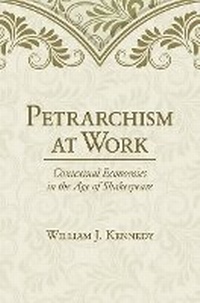
Petrarchism at Work
Contextual Economies in the Age of Shakespeare
Published on 19. April 2016
Book
Hardback
352 pages
978-1-5017-0001-9 (ISBN)
Description
The Italian scholar and poet Francesco Petrarch (1304-1374) is best remembered today for vibrant and impassioned love poetry that helped to establish Italian as a literary language. Petrarch inspired later Renaissance writers, who produced an extraordinary body of work regarded today as perhaps the high-water mark of poetic productivity in the European West. These "Petrarchan" poets were self-consciously aware of themselves as poets-as craftsmen, revisers, and professionals. As William J. Kennedy shows in Petrarchism at Work, this commitment to professionalism and the mastery of poetic craft is essential to understanding Petrarch's legacy.
Petrarchism at Work contributes to recent scholarship that explores relationships between poetics and economic history in early-modern European literature. Kennedy traces the development of a Renaissance aesthetics from one based upon Platonic intuition and visionary furor to one grounded in Aristotelian craftsmanship and technique. Their polarities harbor economic consequences, the first privileging the poet's divinely endowed talent, rewarded by the autocratic largess of patrons, the other emphasizing the poet's acquired skill and hard work. Petrarch was the first to exploit the tensions between these polarities, followed by his poetic successors. These include Gaspara Stampa in the emergent salon society of Venice, Michelangelo Buonarroti in the "gift" economy of Medici Florence and papal Rome, Pierre de Ronsard and the poets of his Pleiade brigade in the fluctuant Valois court, and William Shakespeare and his contemporaries in the commercial world of Elizabethan and early Stuart London. As Kennedy shows, the poetic practices of revision and redaction by Petrarch and his successors exemplify the transition from a premodern economy of patronage to an early modern economy dominated by unstable market forces.
Petrarchism at Work contributes to recent scholarship that explores relationships between poetics and economic history in early-modern European literature. Kennedy traces the development of a Renaissance aesthetics from one based upon Platonic intuition and visionary furor to one grounded in Aristotelian craftsmanship and technique. Their polarities harbor economic consequences, the first privileging the poet's divinely endowed talent, rewarded by the autocratic largess of patrons, the other emphasizing the poet's acquired skill and hard work. Petrarch was the first to exploit the tensions between these polarities, followed by his poetic successors. These include Gaspara Stampa in the emergent salon society of Venice, Michelangelo Buonarroti in the "gift" economy of Medici Florence and papal Rome, Pierre de Ronsard and the poets of his Pleiade brigade in the fluctuant Valois court, and William Shakespeare and his contemporaries in the commercial world of Elizabethan and early Stuart London. As Kennedy shows, the poetic practices of revision and redaction by Petrarch and his successors exemplify the transition from a premodern economy of patronage to an early modern economy dominated by unstable market forces.
Reviews / Votes
Kennedy's command of the source materials and close readings of poetic variants are exceptional. With Petrarchism at Work he has written another authoritative and original study of Petrarch's legacy that will greatly impact theeld.(Renaissance Quarterly) Invites debate, reflection, and further contributions on a widening variety of textual corpora. This fine book has much to recommend it, especially to English-language students of Renaissance literature and history who seek to weigh the importance of one of Renaissance Europe's principal literary idioms as its distinctive forms appear in a representative variety of national contexts.
(Renaissance and Reformation)
More details
Language
English
Place of publication
Ithaca
United States
Target group
College/higher education
Professional and scholarly
Product notice
Paper over boards
Dimensions
Height: 229 mm
Width: 152 mm
Weight
907 gr
ISBN-13
978-1-5017-0001-9 (9781501700019)
Copyright in bibliographic data and cover images is held by Nielsen Book Services Limited or by the publishers or by their respective licensors: all rights reserved.
Schweitzer Classification
Other editions
Additional editions
E-Book
04/2016
Cornell University Press
€44.99
Available for download
Person
William J. Kennedy is Avalon Foundation Professor in the Humanities in the Department of Comparative Literature at Cornell University. He is the author of several books, including The Site of Petrarchism: Early Modern National Sentiment in Italy, France, and England and Authorizing Petrarch.
Content
Introduction: The Marketplace of Mercury
Part One: Petrarch and Italian Poetry
1. Petrarch as Homo Economicus
2. Making Petrarch Matter: The Parts and Labor of Textual Revision
3. Jeweler's Daughter Sings for Doge: Gaspara Stampa's Entrepreneurial Poetics
4. Incommensurate Gifts: Michelangelo and the Economy of Revision
Part Two: Pierre De Ronsard and Pleiade Aesthetics
1. Polished to Perfection: Ronsard's Investment in Les Amours
2. Ronsard Furieux: Interest in Ariosto
3. Passions and Privations: Writing Sonnets like a Pro in Les Amours de Marie
4. The Smirched Muse: Commercializing Sonnets pour Helene
Part Three: Shakespeare's Sonnets and the Economy of Petrarchan Aesthetics
1. To Possess Is Not to Own: The Cost of the Dark Lady and the Young Man
2. Polish and Skill: Will's Interest and Self-Interest in Sonnets 61-99
3. Owning Up to Furor: The "Poets' War" and Its Aftermath in Sonnets 100-126
4. Shakespeare as Professional: The Economy of Revision in Sonnets 1-60
Conclusion: Mercurial Economies
Part One: Petrarch and Italian Poetry
1. Petrarch as Homo Economicus
2. Making Petrarch Matter: The Parts and Labor of Textual Revision
3. Jeweler's Daughter Sings for Doge: Gaspara Stampa's Entrepreneurial Poetics
4. Incommensurate Gifts: Michelangelo and the Economy of Revision
Part Two: Pierre De Ronsard and Pleiade Aesthetics
1. Polished to Perfection: Ronsard's Investment in Les Amours
2. Ronsard Furieux: Interest in Ariosto
3. Passions and Privations: Writing Sonnets like a Pro in Les Amours de Marie
4. The Smirched Muse: Commercializing Sonnets pour Helene
Part Three: Shakespeare's Sonnets and the Economy of Petrarchan Aesthetics
1. To Possess Is Not to Own: The Cost of the Dark Lady and the Young Man
2. Polish and Skill: Will's Interest and Self-Interest in Sonnets 61-99
3. Owning Up to Furor: The "Poets' War" and Its Aftermath in Sonnets 100-126
4. Shakespeare as Professional: The Economy of Revision in Sonnets 1-60
Conclusion: Mercurial Economies