

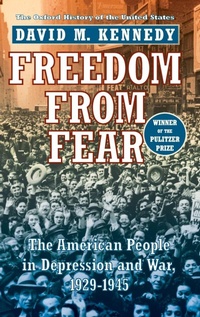
Freedom from Fear
The American People in Depression and War, 1929-1945
Published on 1. July 1999
Book
Hardback
960 pages
978-0-19-503834-7 (ISBN)
Description
Between 1929 and 1945, two great travails were visited upon the American people: the Great Depression and World War II. Freedom From Fear tells the story of how Americans endured, and eventually prevailed, in the face of those unprecedented calamities.
The Depression was both a disaster and an opportunity. As David Kennedy vividly demonstrates, the economic crisis of the 1930s was far more than a simple reaction to the alleged excesses of the 1920s. For more than a century before 1929, America's unbridled industrial revolution had gyrated through repeated boom and bust cycles, wastefully consuming capital and inflicting untold misery on city and countryside alike. Nor was the fabled prosperity of the 1920s as uniformly shared as legend portrays. Countless Americans, especially if they were farmers, African Americans, or recent immigrants, eked out thread bare lives on the margins of national life. For them, the Depression was but another of the ordeals of fear and insecurity with which they were sadly familiar.
Franklin Roosevelt's New Deal wrung from the trauma of the 1930s a lasting legacy of economic and social reform, including the Social Security Act, new banking and financial laws, regulatory legislation, and new opportunities for organized labor. Taken together, those reforms gave a measure of security to millions of Americans who had never had much of it, and with it a fresh sense of having a stake in their country.
Freedom From Fear tells the story of the New Deal's achievements, without slighting its shortcomings, contradictions, and failures. It is a story rich in drama and peopled with unforgettable personalities, including the incandescent but enigmatic figure of Roosevelt himself.
Even as the New Deal was coping with the Depression, a still more fearsome menace was developing abroad--Hitler's thirst for war in Europe, coupled with the imperial ambitions of Japan in Asia. The same generation of Americans who battled the Depression eventually had to shoulder arms in another conflict that wreaked world wide destruction, ushered in the nuclear age, and forever changed their own way of life and their country's relationship to the rest of the world. Freedom From Fear explains how the nation agonized over its role in World War II, how it fought the war, why the United States won, and why the consequences of victory were sometimes sweet, sometimes ironic. In a compelling narrative, Kennedy analyzes the determinants of American strategy, the painful choices faced by commanders and statesmen, and the agonies inflicted on the millions of ordinary Americans who were compelled to swallow their fears and face battle as best they could.
Freedom From Fear is a comprehensive and colorful account of the most convulsive period in American history, excepting only the Civil War--a period that formed the crucible in which modern America was formed.
The Oxford History of the United States
The Atlantic Monthly has praised The Oxford History of the United States as "the most distinguished series in American historical scholarship," a series that "synthesizes a generation's worth of historical inquiry and knowledge into one literally state-of-the-art book. Who touches these books touches a profession."
Conceived under the general editorship of one of the leading American historians of our time, C. Vann Woodward, The Oxford History of the United States blends social, political, economic, cultural, diplomatic, and military history into coherent and vividly written narrative. Previous volumes are Robert Middlekauff's The Glorious Cause: The American Revolution; James M. McPherson's Battle Cry of Freedom: The Civil War Era (which won a Pulitzer Prize and was a New York Times Best Seller); and James T. Patterson's Grand Expectations: The United States 1945-1974 (which won a Bancroft Prize).
The Depression was both a disaster and an opportunity. As David Kennedy vividly demonstrates, the economic crisis of the 1930s was far more than a simple reaction to the alleged excesses of the 1920s. For more than a century before 1929, America's unbridled industrial revolution had gyrated through repeated boom and bust cycles, wastefully consuming capital and inflicting untold misery on city and countryside alike. Nor was the fabled prosperity of the 1920s as uniformly shared as legend portrays. Countless Americans, especially if they were farmers, African Americans, or recent immigrants, eked out thread bare lives on the margins of national life. For them, the Depression was but another of the ordeals of fear and insecurity with which they were sadly familiar.
Franklin Roosevelt's New Deal wrung from the trauma of the 1930s a lasting legacy of economic and social reform, including the Social Security Act, new banking and financial laws, regulatory legislation, and new opportunities for organized labor. Taken together, those reforms gave a measure of security to millions of Americans who had never had much of it, and with it a fresh sense of having a stake in their country.
Freedom From Fear tells the story of the New Deal's achievements, without slighting its shortcomings, contradictions, and failures. It is a story rich in drama and peopled with unforgettable personalities, including the incandescent but enigmatic figure of Roosevelt himself.
Even as the New Deal was coping with the Depression, a still more fearsome menace was developing abroad--Hitler's thirst for war in Europe, coupled with the imperial ambitions of Japan in Asia. The same generation of Americans who battled the Depression eventually had to shoulder arms in another conflict that wreaked world wide destruction, ushered in the nuclear age, and forever changed their own way of life and their country's relationship to the rest of the world. Freedom From Fear explains how the nation agonized over its role in World War II, how it fought the war, why the United States won, and why the consequences of victory were sometimes sweet, sometimes ironic. In a compelling narrative, Kennedy analyzes the determinants of American strategy, the painful choices faced by commanders and statesmen, and the agonies inflicted on the millions of ordinary Americans who were compelled to swallow their fears and face battle as best they could.
Freedom From Fear is a comprehensive and colorful account of the most convulsive period in American history, excepting only the Civil War--a period that formed the crucible in which modern America was formed.
The Oxford History of the United States
The Atlantic Monthly has praised The Oxford History of the United States as "the most distinguished series in American historical scholarship," a series that "synthesizes a generation's worth of historical inquiry and knowledge into one literally state-of-the-art book. Who touches these books touches a profession."
Conceived under the general editorship of one of the leading American historians of our time, C. Vann Woodward, The Oxford History of the United States blends social, political, economic, cultural, diplomatic, and military history into coherent and vividly written narrative. Previous volumes are Robert Middlekauff's The Glorious Cause: The American Revolution; James M. McPherson's Battle Cry of Freedom: The Civil War Era (which won a Pulitzer Prize and was a New York Times Best Seller); and James T. Patterson's Grand Expectations: The United States 1945-1974 (which won a Bancroft Prize).
Reviews / Votes
From its dramatic prelude depicting Franklin Roosevelt, Winston Churchill, Adolf Hitler, and Joseph Stalin hearing the news of the end of World War I on November 11, 1918, to its moving climax on board the USS Missouri in Tokyo Bay on September 2, 1945, this panoramic narrative pulses with life, color, incident, and action. We know how it all comes out, yet the fate of the nation seems to hang in the balance as Kennedy captures history's throat-catching contingency. * Jack Beatty, author of The Rascal King: The Life and Times of James Michael Curley and The World According to Peter Drucker * We expect the best from David Kennedy and he will not disappoint anybody with this competent, complete and literate volume. Covering a time of large and intense change, it is all here. A major and thoroughly fine piece of work. * John Kenneth Galbraith * Freedom from Fear brings together in one place the epic story of how America faced the greatest challenges in its history. At a time when we tend to bemoan our selfish preoccupations, it is bracing to read David Kennedy's moving account of our better selves. This is history the way it ought to be. * Alan Wolfe, Boston College, author of One Nation After All * Displaying a literary craft uncommon in survey works, he has woven together narrative, sketches of character, and critical judgment to record and analyze the economic, political, social, and military events of these epic years.... This account of the crucial struggles and events of the Depression and war years will lend perspective like few others. * Library Journal * David Kennedy is one of America's most distinguished historians, and Freedom from Fear is a remarkable achievement: deeply researched, insightful, and beautifully written. Fast-paced, it presents vivid portraits of major actors such as Roosevelt, Churchill, and Hitler, as well as of the hopes and fears of millions of lesser-known people caught up in the tumultuous years of the Great Depression and of World War II. * James T. Patterson, Bancroft Prize-winning author of Grand Expectations * This is an enormous book, heavy to carry and light and very agreeable to read.... Kennedy holds firmly the attention of the reader, conveying a sense of both serious care and competence, all in good, unassuming English.... The book...has my strong approval. As it will have, I cannot doubt, that of the many readers it deserves. * John Kenneth Galbraith, The Washington Monthly * David Kennedy's panoramic history of America and the world between 1929 and 1945 is a superb reconstruction of the era that formed our times. Simply put, it is a brilliant narrative and analysis. Anyone who wants to understand our century needs to read Kennedy's book. * Robert Dallek, Boston University, author of Flawed Giant: Lyndon Johnson and his Times, 1961-1973 * It's hard to think of a more interesting time in American history than the years of the Great Depression and the Second World War * or an historian better able to bring it to life than David Kennedy.Evan Thomas, author of The Very Best and co-author of The Wise Men:Five Friends and the World They Made * In Freedom from Fear, David Kennedy combines the synthetic talents of a brilliant historian with the literary gifts of a great storyteller. The result is engrossing history, with all the complex characters and suspense of high drama put impressively to the task of demonstrating how a decade and a half of Great Depression and World War have shaped the rest of our century. * Lizabeth Cohen, Harvard University * Kennedy combines the best aspects of narrative and history. His wonderful single-volume history of the era is comprehensive and well researched, and scholars will find much that is new and informative.... It is a smoothly flowing and easily digestible account of great events, and well-informed lay readers will have little difficulty in following and appreciating this saga.... This is a work replete with revealing subtexts, and Roosevelt's relations and struggles with African American leaders are especially fascinating. It is a worthy addition to an outstanding series and an essential component to a U.S. history collection for both public and college libraries. * Booklist * David Kennedy's Freedom from Fear is a masterful work of history covering the American people and their government through the eventful years 1929-1945, it rests on an extraordinary command of the historical literature about that period. Kennedy's sprightly and lucid prose adds force to his careful judgements, all of them informed, some of them controversial. The book will appeal to all generations of Americans, perhaps especially to those who remember the Great Depression and World War II, but also to their children and grandchildren. For all Americans still live with the persisting influence of those experiences. * John Morton Blum, Sterling Professor of History Emeritus, Yale University * Rarely does a work of historical synthesis combine such trenchant analysis and elegant writing as does Kennedy's spectacular contribution to the Oxford History of the United States. Kennedy uses a wide canvas to depict all aspects of the American political, social and economic experience from 1929 to 1945. He also provides a stunningly original reinterpretation of the competing forces and interests that combined to shape the New Deal under FDR's direction. The book's final 400 pages admirably demonstrate exactly how the U.S. emerged victorious in WWII.... Because of its scope, its insight and its purring narrative engine, Kennedy's book will stand for years to come as the definitive history of the most important decades of the American Century. * Publishers Weekly * A major achievement in objective historical writing that should be a legacy to generations of students seeking authoritative reference material on the period. * Kirkus Reviews * This is modern America's story * modern America's most thrilling, most irresistible, and most significant storyand in this massive volume, David M. Kennedy makes it his story in a way that no one has before. Freedom From Fear, the fourth installment of the new Oxford History of the United States to appear, is as much a triumph as its predecessors, providing every indication that the series, once completed, will stand as the most comprehensive and most compelling narrative history of the nation.David M. Shribman, Boston Globe * A brilliant narrative history of broad scope and complexity. * BookPage * Kennedy's grasp of deep-rooted social problems and his enlightening, analytical style are very much in evidence.... [he] brilliantly explores the conflicting nuances of [Roosevelt's] character and program.... Kennedy has achieved a judicious balance in his treatment of the Depression and the military operations and diplomatic maneuvers of World War II. His narrative style is in the grand tradition of American historical writing, an unfaltering display of clarity and detail. * Ed Voves, Philadephia Inquirer * By linking the Depression and World War II...David Kennedy has undertaken an original approach to modern history.... [he] provides a grand historical synthesis in Freedom From Fear.... this is the kind of book prizes are made for. * Herbert Mitgang, Chicago Tribune * A brilliant achievement. * Philip Seib, Dallas Morning News * A sophisticated and complete one-volume history of a traumatic period such as the Great Depression or World War II.... Kennedy gives a seamless account of the war. * Mark Gamin, Cleveland Plain Dealer * Kennedy has performed an amazing feat in fitting so many varied themes into a single book.... The story is replete with cameo histories of the leading figures of the era.... [He] has done a superb job not only in retelling the main outlines of the story but in giving readres a sense of the breathless onrush of events that closed this short era. * Richard A. Nenneman, The Christian Science Monitor * Splendid.... It is a worthy addition to the multi-volume 'Oxford History of the United States' and deserves to become the standard work of introduction to its three subjects * the Depression, the New Deal, and America's part in the second world war.... Mr. Kennedy is master of his material in a double sense. He exhibits a comprehensive knowledge of events, making very few factual slips... The benefit, in terms of clarity, is immense.... This is one of the most valuable forms of scholarly originality, and it will make itself felt over a long time.The Economist * An indispensable account of the two great formative events of 20th century American history * the Great Depression and the second world war.The Economist * An elegant book, beautifully written and remarkably quick to read. In the realm of narrative history, as the saying goes, it doesn't get any better than this....The author is both a master at guiding the reader through the diplomatic thicket of that era and a first-rate chronicler of the invasions, land campaigns, sea battles, and air strikes in every theater of the War. * David M. Oshinsky, The New Leader * Kennedy's book is the most illuminating, riveting, comprehensive, and graceful one-volume history of this nation's experiences during the Great Depression, New Deal, and WWII published to date.... This is social, political, dipolmatic, and military history written magisterially with broad but nuanced strokes across a 16-year span that utterly transformed the lives of Americans and the world.... Librarians should order this book for their libraries, faculty members should assign it, and everyone should read it. * Choice * An invaluable compendium of the hyperactive period that contains the Great depression and the Second World War. * The Washington Times *More details
Series
Language
English
Place of publication
New York
United States
Target group
College/higher education
Professional and scholarly
Illustrations
65 halftones 21 maps
Dimensions
Height: 240 mm
Width: 161 mm
Thickness: 55 mm
Weight
1582 gr
ISBN-13
978-0-19-503834-7 (9780195038347)
Copyright in bibliographic data and cover images is held by Nielsen Book Services Limited or by the publishers or by their respective licensors: all rights reserved.
Schweitzer Classification
Other editions
Additional editions
Book
08/2001
Oxford University Press Inc
€27.50
Shipment within 15-20 days
E-Book
05/1999
1st Edition
OUP eBook
€10.99
Available for download
Person
David M. Kennedy is Donald J. McLachlan Professor of History at Stanford University. He is the author of Over Here: The First World War and American Society, which was nominated for a Pulitzer Prize, and Birth Control in America: The Career of Margaret Sanger, which won a Bancroft Prize. He lives in Stanford, California.