

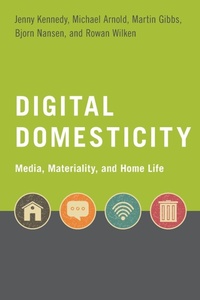
Digital Domesticity
Media, Materiality, and Home Life
Published on 29. June 2020
Book
Paperback/Softback
328 pages
978-0-19-090579-8 (ISBN)
Description
At the turn of the twenty-first century, typical households were equipped with a landline telephone, a desktop computer connected to a dial-up modem, and a shared television set. Television, radio and newspapers were the dominant mass media. Today, homes are now network hubs for all manner of digital technologies, from mobile devices littering lounge rooms to Bluetooth toothbrushes in bathrooms--and tomorrow, these too will be replaced with objects once inconceivable.
Tracing the origins of these digital developments, Jenny Kennedy, Michael Arnold, Martin Gibbs, Bjorn Nansen, and Rowan Wilken advance media domestication research through an ecology-based approach to the abundance and materiality of media in the home. The book locates digital domesticity through phases of adoption and dwelling, to management and housekeeping, to obsolescence and disposal. The authors synthesize household interviews, technology tours, remote data collection via mobile applications, and more to offer readers groundbreaking insight into domestic media consumption. Chapters use original case studies to empirically trace the adoption, use, and disposal of technology by individuals and families within their homes. The book unearths social and material accounts of media technologies, offering insight into family negotiations regarding technology usage in such a way that puts technology in the context of recent developments of digital infrastructure, devices, and software--all of which are now woven into the domestic fabric of the modern household.
Tracing the origins of these digital developments, Jenny Kennedy, Michael Arnold, Martin Gibbs, Bjorn Nansen, and Rowan Wilken advance media domestication research through an ecology-based approach to the abundance and materiality of media in the home. The book locates digital domesticity through phases of adoption and dwelling, to management and housekeeping, to obsolescence and disposal. The authors synthesize household interviews, technology tours, remote data collection via mobile applications, and more to offer readers groundbreaking insight into domestic media consumption. Chapters use original case studies to empirically trace the adoption, use, and disposal of technology by individuals and families within their homes. The book unearths social and material accounts of media technologies, offering insight into family negotiations regarding technology usage in such a way that puts technology in the context of recent developments of digital infrastructure, devices, and software--all of which are now woven into the domestic fabric of the modern household.
Reviews / Votes
Through the combination of their studies conducted over 17 years, the authors provide a novel and nuanced perspective on the changing ICTs in Australian homes. In this panoramic yet detailed account, we see the reconfiguring of domestic space, re-evaluations of technology over time, strategies to re-domesticate ICTS, and the ongoing parent-child re-negotiations of children's use of digital devices. This is a thought-provoking book with which the reader can engage. * Leslie Haddon, London School of Economics *More details
Language
English
Place of publication
New York
United States
Target group
Professional and scholarly
Dimensions
Height: 210 mm
Width: 140 mm
Thickness: 18 mm
Weight
398 gr
ISBN-13
978-0-19-090579-8 (9780190905798)
Copyright in bibliographic data and cover images is held by Nielsen Book Services Limited or by the publishers or by their respective licensors: all rights reserved.
Schweitzer Classification
Other editions
Additional editions
Book
06/2020
Oxford University Press Inc
€190.80
Shipment within 15-20 days
E-Book
05/2020
1st Edition
OUP eBook
€23.99
Available for download
E-Book
05/2020
1st Edition
OUP eBook
€23.99
Available for download
Persons
Jenny Kennedy is Research Fellow in Media and Communication and the Digital Ethnography Research Centre (DERC) at RMIT University.
Michael Arnold is Associate Professor in the History and Philosophy of Science at the University of Melbourne.
Martin Gibbs is Associate Professor in the School of Computing and Information Systems at the University of Melbourne.
Bjorn Nansen is Senior Lecturer in the School of Culture and Communication at the University of Melbourne.
Rowan Wilken is Associate Professor of Media and Communication and Principal Research Fellow in the Digital Ethnography Research Centre (DERC) at RMIT University.
Michael Arnold is Associate Professor in the History and Philosophy of Science at the University of Melbourne.
Martin Gibbs is Associate Professor in the School of Computing and Information Systems at the University of Melbourne.
Bjorn Nansen is Senior Lecturer in the School of Culture and Communication at the University of Melbourne.
Rowan Wilken is Associate Professor of Media and Communication and Principal Research Fellow in the Digital Ethnography Research Centre (DERC) at RMIT University.
Author
Postdoctoral Research FellowPostdoctoral Research Fellow, RMIT University
Associate ProfessorAssociate Professor, University of Melbourne
Senior Lecturer, Department of Computing and Information SystemsSenior Lecturer, Department of Computing and Information Systems, University of Melbourne
Senior Lecturer, Media and CommunicationsSenior Lecturer, Media and Communications, University of Melbourne
Associate Professor, Media and CommunicationAssociate Professor, Media and Communication, RMIT University
Content
List of Figures
Acknowledgments
Project Legend
1. Histories
2. Ecologies
3. Appropriations
4. Housekeepings
5. Negotiations
6. Non-uses
7. Displacements
Conclusion
References
Index
Acknowledgments
Project Legend
1. Histories
2. Ecologies
3. Appropriations
4. Housekeepings
5. Negotiations
6. Non-uses
7. Displacements
Conclusion
References
Index