

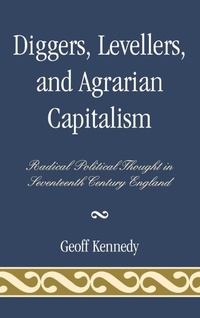
Diggers, Levellers, and Agrarian Capitalism
Radical Political Thought in 17th Century England
Published on 18. September 2008
Book
Hardback
276 pages
978-0-7391-2374-4 (ISBN)
Description
This book situates the development of radical English political thought within the context of the specific nature of agrarian capitalism and the struggles that ensued around the nature of the state during the revolutionary decade of the 1640s. In the context of the emerging conceptions of the state and property-with attendant notions of accumulation, labor, and the common good-groups such as Levellers and Diggers developed distinctive forms of radical political thought not because they were progressive, forward thinkers, but because they were the most significant challengers of the newly-constituted forms of political and economic power.
Drawing on recent re-examinations of the nature of agrarian capitalism and modernity in the early modern period, Geoff Kennedy argues that any interpretation of the political theory of this period must relate to the changing nature of social property relations and state power. The radical nature of early modern English political thought is therefore cast in terms of its oppositional relationship to these novel forms of property and state power, rather than being conceived of as a formal break from discursive conventions.
Drawing on recent re-examinations of the nature of agrarian capitalism and modernity in the early modern period, Geoff Kennedy argues that any interpretation of the political theory of this period must relate to the changing nature of social property relations and state power. The radical nature of early modern English political thought is therefore cast in terms of its oppositional relationship to these novel forms of property and state power, rather than being conceived of as a formal break from discursive conventions.
Reviews / Votes
This work makes an important contribution to the field by extending the work of other scholars in the field into a new area of debate, namely the relationship between agrarian capitalism and radical political thought. -- Colin Mooers, Ryerson University This impressive study takes on a major challenge. Geoff Kennedy not only offers a clear and persuasive account of political ideas in their historical context, but also engages in methodological debate with other historians of political thought and explores the controversies among scholars of this much contested period in English history. He manages to interweave these different strands with commendable clarity and in accessible prose, suitable to a wide audience from specialists to students and the intelligent general reader. -- Ellen Wood, York UniversityMore details
Language
English
Place of publication
United States
Publishing group
Bloomsbury Publishing Plc
Target group
Professional and scholarly
Dimensions
Height: 235 mm
Width: 157 mm
Thickness: 21 mm
Weight
603 gr
ISBN-13
978-0-7391-2374-4 (9780739123744)
Copyright in bibliographic data and cover images is held by Nielsen Book Services Limited or by the publishers or by their respective licensors: all rights reserved.
Schweitzer Classification
Person
Geoff Kennedy is visiting assistant professor at the Middle East Technical University in Cyprus.
Content
1 Table of Contents
2 Acknowledgments
Chapter 3 1. Radical Political Thought in Early Modern England
Chapter 4 2. Historical Materialism and Early Modern Radicalism
Chapter 5 3. Agrarian Capitalism and Class Formation
Chapter 6 4. The Political Economy of Improvement
Chapter 7 5. From the State as Property to Property against the State
Chapter 8 6. Unearthing the Kingly Power
Chapter 9 7. Between Monarchy and Multitude
10 Bibliography
11 Index
12 About the Author
2 Acknowledgments
Chapter 3 1. Radical Political Thought in Early Modern England
Chapter 4 2. Historical Materialism and Early Modern Radicalism
Chapter 5 3. Agrarian Capitalism and Class Formation
Chapter 6 4. The Political Economy of Improvement
Chapter 7 5. From the State as Property to Property against the State
Chapter 8 6. Unearthing the Kingly Power
Chapter 9 7. Between Monarchy and Multitude
10 Bibliography
11 Index
12 About the Author