

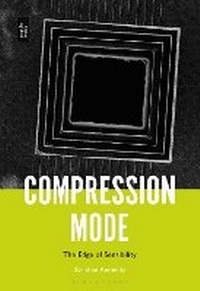
Compression Mode
The Edge of Sensibility
Published on 6. February 2025
Book
Hardback
160 pages
978-1-5013-6934-6 (ISBN)
Description
This book examines how compression can be understood not only as a digital process enacted through computing, but as a wider economic and political phenomenon that impacts on the ecology of waste, diversity and social inclusivity.
Setting out from the linguistic underpinning of visual space it proceeds to the development of the MP3 algorithm and an examination of the 'waste' it creates. As it does so it challenges the received wisdom, prevalent in western thought, that human reason and logic enacted through language is uniquely capable of bringing order to chaos. Returning to the idea of a sonic economy it seeks to reintroduce waste, error, and other discarded material back into our systems of thought, or perhaps more accurately into systems beyond our thought.
Setting out from the linguistic underpinning of visual space it proceeds to the development of the MP3 algorithm and an examination of the 'waste' it creates. As it does so it challenges the received wisdom, prevalent in western thought, that human reason and logic enacted through language is uniquely capable of bringing order to chaos. Returning to the idea of a sonic economy it seeks to reintroduce waste, error, and other discarded material back into our systems of thought, or perhaps more accurately into systems beyond our thought.
Reviews / Votes
What can music, noise, and sound teach us about the fundamental ways we make sense of the world? This question is at the heart of Stephen Kennedy's intriguing book Compression Mode. For Kennedy, 'compression' is not simply a technical operation characteristic of digital media but a process evident in all the ways we represent or comprehend the world: language, mathematics, cartography, musical notation and more. Compression, then, becomes a metaphysical and epistemological concept with which Kennedy engages key debates in contemporary philosophy and aesthetics. * Christoph Cox, Executive Dean, Eugene Lang College, The New School, USA * For years literature on sound has lacked the specificity and precision afforded to visual culture. Compression Mode by Stephen Kennedy takes on this challenge and answers this call. * Lawrence Abu Hamdan, Founder and Director of Earshot.ngo * Compression Mode explores the unruly nature of sound and noise, unearthing the treasures lost in our compressed digital worlds where the signal takes precedence. Kennedy takes us on an exhilarating ride, conjuring the spectral, the hidden and the unthought - a journey that questions our relationships with the sensual and digital worlds as they collide and coalesce. * Jane Grant, Associate Professor in Digital Arts, University of Plymouth, UK *More details
Language
English
Place of publication
New York
United States
Publishing group
Bloomsbury Publishing Plc
Target group
College/higher education
Dimensions
Height: 230 mm
Width: 158 mm
Thickness: 16 mm
Weight
780 gr
ISBN-13
978-1-5013-6934-6 (9781501369346)
Copyright in bibliographic data and cover images is held by Nielsen Book Services Limited or by the publishers or by their respective licensors: all rights reserved.
Schweitzer Classification
Other editions
Additional editions
E-Book
01/2025
1st Edition
Bloomsbury Academic USA
€90.99
Available for download
E-Book
01/2025
1st Edition
Bloomsbury Academic USA
€90.99
Available for download
Person
Stephen Kennedy is Professor of Critical Theory & Practice at the University of Greenwich, UK. He is the author of Chaos Media: A Sonic Economy of Digital Space (Bloomsbury, 2015) and Future Sounds: The Temporality of Noise (Bloomsbury, 2018). His work involves reformulating the idea of noise as a means of supporting philosophical frameworks capable of accounting for the complex nature of contemporary digital environments.
Content
Preface
Introduction
Chapter One: A Sound Argument
Chapter Two: Language as a Mode of Compression
Chapter Three: A Geometry of Listening
Introduction
Chapter One: A Sound Argument
Chapter Two: Language as a Mode of Compression
Chapter Three: A Geometry of Listening