

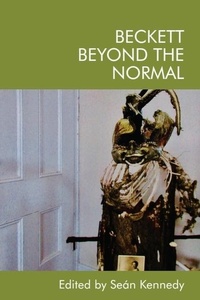
Beckett Beyond the Normal
Published on 25. August 2022
Book
Paperback/Softback
168 pages
978-1-4744-6047-7 (ISBN)
Description
Explores Beckett's artistic vision at the intersection of queer, disability and posthumanist studies
The first volume to address norms and normalcy as an enduring target of Beckettian skepticismShifts the emphasis from generic talk of 'Other Becketts' to specific accounts of the queer, the disabling, the abnormalising aspects of the mature worksAbsorbs and transcends the philosophy/history binary that has shaped the last twenty yearsBrings Beckett Studies into the twenty-first century as the first intersectional volume to address queerness, disability and biopolitics together
This book examines why Beckett's writing is so queer, so disabled and disabling. Why did Beckett write so often about mental illness, disability, perversion? Why did he take such an interest in 'abnormals' and 'degenerates'? How did he reconceive 'the human' in the wake of Hitler and Stalin? Drawing on Beckett's voluminous archive, as well as his primary texts, the authors use psychoanalysis, queer theory, disability theory and biopolitics to push Beckett studies beyond the normal.
The first volume to address norms and normalcy as an enduring target of Beckettian skepticismShifts the emphasis from generic talk of 'Other Becketts' to specific accounts of the queer, the disabling, the abnormalising aspects of the mature worksAbsorbs and transcends the philosophy/history binary that has shaped the last twenty yearsBrings Beckett Studies into the twenty-first century as the first intersectional volume to address queerness, disability and biopolitics together
This book examines why Beckett's writing is so queer, so disabled and disabling. Why did Beckett write so often about mental illness, disability, perversion? Why did he take such an interest in 'abnormals' and 'degenerates'? How did he reconceive 'the human' in the wake of Hitler and Stalin? Drawing on Beckett's voluminous archive, as well as his primary texts, the authors use psychoanalysis, queer theory, disability theory and biopolitics to push Beckett studies beyond the normal.
Reviews / Votes
These needle-sharp essays pierce the skin. They tattoo anew Beckett's utter disdain for redemptive art and liberal humanism. Torture, starvation, disability are not metaphors. More, the essays shatter pieties in contemporary criticism: from autism studies to queer studies; from historical to psychoanalytic approaches. Once again, Sean Kennedy disorders the discipline. -- James McNaughton, University of AlabamaMore details
Language
English
Place of publication
Edinburgh
United Kingdom
Target group
Professional and scholarly
Product notice
Paperback (trade)
Unsewn / adhesive bound
Dimensions
Height: 234 mm
Width: 156 mm
Thickness: 9 mm
Weight
245 gr
ISBN-13
978-1-4744-6047-7 (9781474460477)
Copyright in bibliographic data and cover images is held by Nielsen Book Services Limited or by the publishers or by their respective licensors: all rights reserved.
Schweitzer Classification
Person
Sean Kennedy is Coordinator of Irish Studies at Saint Mary's University, Halifax.
Content
Abbreviations
'Here all is strange': Beckett beyond the normal, Sean Kennedy
1 Murphy and the Tao of Autism, Joseph Valente
2 Narrating Disruption: Realist Fiction and the Politics of Form in Watt, William Davies
3 'no human shape': Unformed Life in The Unnamable, Byron Heffer
4 Beckett, Evangelicalism and the Biopolitics of Famine, Sean Kennedy
5 'He wants to know if it hurts!': Suffering beyond Redemption in Waiting for Godot, Hannah Simpson
6 'as if the sex matters': Beckett, Barthes and Endgame in Love, James Brophy
7 Beckett's Queer Time of Defaillance: Ritual and Resistance in Happy Days, Nic Barilar
8 Beckett's Safe Words: Normalising Torture in How It Is, Dominic Walker
Bibliography
Notes on Contributors
Index
'Here all is strange': Beckett beyond the normal, Sean Kennedy
1 Murphy and the Tao of Autism, Joseph Valente
2 Narrating Disruption: Realist Fiction and the Politics of Form in Watt, William Davies
3 'no human shape': Unformed Life in The Unnamable, Byron Heffer
4 Beckett, Evangelicalism and the Biopolitics of Famine, Sean Kennedy
5 'He wants to know if it hurts!': Suffering beyond Redemption in Waiting for Godot, Hannah Simpson
6 'as if the sex matters': Beckett, Barthes and Endgame in Love, James Brophy
7 Beckett's Queer Time of Defaillance: Ritual and Resistance in Happy Days, Nic Barilar
8 Beckett's Safe Words: Normalising Torture in How It Is, Dominic Walker
Bibliography
Notes on Contributors
Index