

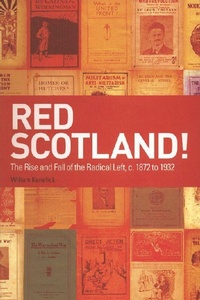
Red Scotland!
The Rise and Fall of the Radical Left, c. 1872 to 1932
Published on 16. July 2007
Book
Paperback/Softback
240 pages
978-0-7486-2518-5 (ISBN)
Description
An excellent resource for teaching and learning, this book explores the rise and decline of left radicalism in Scotland c.1872 to 1932. A journey through these turbulent times observes the response of Scottish artisans to legal restrictions on trade-union activities in the 1870s, trade union formation among the unskilled from the late 1880s, and the origins and impact of the Scottish socialist movement.The Labour movement in Scotland was to face many new challenges by the twentieth century. During the era of 'Red Scotland', 1910 to 1922, we see Scottish workers fully engaged in the labour and social unrest in the years before the Great War; monitor the incubation of workers' grievances during the war; see the growth of the anti-war movement and the influence of revolutionary politics from 1918; and witness Scottish Labour on the threshold of an extraordinary political breakthrough by 1922. The 1920s saw the rapid rise of Labour, but growing unemployment and a massive emigration of Scottish workers helped to fragment the left and set in motion the decline of left radicalism in Scotland. This book represents a major and up to date survey of the most dramatic years in the history of Scottish Labour.Key Features:* Provides comprehensive coverage of the period introducing new research sources and plugging gaps in current literature with case studies* Case studies provide detailed examination of important topics; 'new unionism'; strike and political action; quantitative method, 1910-14; new archive sources on 'revolutionary politics'* Provides case studies and regional comparative studies approach towards a better understanding of the main themes in the history of Scottish Labour* Two chapters look at the themes and issues concerned with writing Labour history
Reviews / Votes
Kenefick's examinations of socialism in Edinburgh, Aberdeen and Dundee give a far more complete picture of Scottish socialism than is typically afforded by popular culture and historiography. -- Matthew L. McDowell, University of Glasgow Kelvingrove Review Kenefick covers a critically important, turbulent and frequently highly contested 60 years of Scottish labour/ radical history in an admirably clear and concise fashion. He presents a wealth of detail and tackles highly controversial topics like 'The Myth of Red Clydeside' in an exceptionally fair, thoughtful and balanced manner. Kenefick is by no means averse to presenting his own analysis of events but he is careful to present a ranges of contrary views in a fair and respectful manner - the joys of invective, editorialising and getting even with one's political/academic enemies are forgone. Kenefick is never less than professional and the further I read into his book the more impressed I became with his judgement and the more persuasive I found his arguments/analysis... ... The analysis focuses on the impact of political radicalism, industrial unrest, war and the Russian revolution. The author notes that the significance of the book does not lie primarily on its original research but rather on the overall distinctiveness of his approach and conclusions... avoids the trap of Glasgowcentricity... ...He is also particularly strong on international events - World War I (his chapter on 'War Resisters and Anti-Conscription' is perhaps the strongest section in the book') the Russian Revolution (including some fascinating material about Scottish Leftists running guns to Russian revolutionaries in the early 1900s), and the Irish Republican struggles etc on the Scottish Left. More unusually he also examines the impact on the Scottish diaspora on political and industrial radicalism overseas... ...Scottish history has been colourfully, and not totally inaccurately, described as being 'one long brawl'. Kenefick has done a fine job of describing and analysing an important part of this saga - the class war in Scotland during one of its most militant and dramatic periods. He is to be commended for his effort. This is a fine book and will, I would expect, be welcomed as both a significant contribution to the field and as an excellent text book for tertiary students. -- Bill Anderson Labour History Kenefick's examinations of socialism in Edinburgh, Aberdeen and Dundee give a far more complete picture of Scottish socialism than is typically afforded by popular culture and historiography. Kenefick covers a critically important, turbulent and frequently highly contested 60 years of Scottish labour/ radical history in an admirably clear and concise fashion. He presents a wealth of detail and tackles highly controversial topics like 'The Myth of Red Clydeside' in an exceptionally fair, thoughtful and balanced manner. Kenefick is by no means averse to presenting his own analysis of events but he is careful to present a ranges of contrary views in a fair and respectful manner - the joys of invective, editorialising and getting even with one's political/academic enemies are forgone. Kenefick is never less than professional and the further I read into his book the more impressed I became with his judgement and the more persuasive I found his arguments/analysis... ... The analysis focuses on the impact of political radicalism, industrial unrest, war and the Russian revolution. The author notes that the significance of the book does not lie primarily on its original research but rather on the overall distinctiveness of his approach and conclusions... avoids the trap of Glasgowcentricity... ...He is also particularly strong on international events - World War I (his chapter on 'War Resisters and Anti-Conscription' is perhaps the strongest section in the book') the Russian Revolution (including some fascinating material about Scottish Leftists running guns to Russian revolutionaries in the early 1900s), and the Irish Republican struggles etc on the Scottish Left. More unusually he also examines the impact on the Scottish diaspora on political and industrial radicalism overseas... ...Scottish history has been colourfully, and not totally inaccurately, described as being 'one long brawl'. Kenefick has done a fine job of describing and analysing an important part of this saga - the class war in Scotland during one of its most militant and dramatic periods. He is to be commended for his effort. This is a fine book and will, I would expect, be welcomed as both a significant contribution to the field and as an excellent text book for tertiary students.More details
Language
English
Place of publication
Edinburgh
United Kingdom
Target group
Professional and scholarly
Product notice
Paperback (trade)
Unsewn / adhesive bound
Dimensions
Height: 235 mm
Width: 156 mm
Thickness: 17 mm
Weight
385 gr
ISBN-13
978-0-7486-2518-5 (9780748625185)
Copyright in bibliographic data and cover images is held by Nielsen Book Services Limited or by the publishers or by their respective licensors: all rights reserved.
Schweitzer Classification
Person
William Kenefick is Lecturer in Modern Scottish History at the University of Dundee and author of Rebellious and Contrary: The Glasgow Dockers c.1853 to 1932 (East Linton, Tuckwell Press, 2000). He was co-editor of The Roots of Red Clydeside 1910 to 1914?: Labour and Industrial Unrest in West Scotland (Edinburgh, John Donald, 1996).
Content
Contents; Acknowledgements; List of Tables; List of Abbreviations; Introduction; 1. Radical Scotland c. 1872 to 1914; Writing Labour and Social History - I: Themes and Contested Issues; 2. Industrial Radicalism and the New Unionism c.1872 to 1914; 3. Left Radicalism, Labour and Socialism 1872 to 1914; 4. Red Scotland c. 1910 to 1932; Writing Labour and Social History - II: Themes and Contested Issues; 5. Labour Unrest, 1910 to 1914; 6. War Resisters and Anti-conscription; 7. War and Revolution and the Scottish Working Class; 8. Radicalism in Decline c.1920 to 1932; Epilogue: On Radicalism- And Exporting Scottish Left Radicalism; Bibliography; Index.