

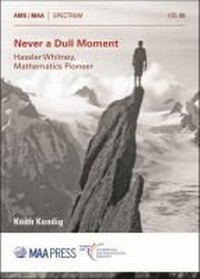
Never a Dull Moment
Hassler Whitney, Mathematics Pioneer
Will be published approx. on 30. November 2018
Book
Paperback/Softback
381 pages
978-1-4704-4828-8 (ISBN)
Description
Hassler Whitney was a giant of twentieth-century mathematics. This biography paints a picture of him and includes dozens of revealing anecdotes. Mathematically, he had a rare detector that went off whenever he spotted a piece of mathematical gold, and he would then draw countless pictures, gradually forging a path from hunch to proof. This geometric path is seldom reflected in the rigor of his formal papers, but thanks to a close friendship and many conversations over decades, author Kendig was able to see how he actually worked. This book shows this through accessible accounts of his major mathematical contributions, with figures copiously supplied.
Whitney is probably best known for introducing the grandfather of today's innumerable embedding theorems--his strong embedding theorem stating that any smooth manifold can be smoothly embedded in a Euclidean space of twice the manifold's dimension. This in turn led to several standard techniques used every day in algebraic topology. Whitney also established the fundamentals of graph theory, the four-color problem, matroids, extending smooth functions, and singularities of smooth functions. He almost never used complicated technical machinery, so most of his work is accessible to a general reader with a modest mathematical background.
His math-music connection was intense: He played piano, violin, and viola and won ``best composition of the year'' while earning a Bachelor's degree in music at Yale. He was an accomplished mountain climber, and as a tinkerer, at age sixteen he built the large-format camera used to take this book's cover photograph. Whitney's family generously provided dozens of photographs appearing here for the very first time. This biography is a revealing portrait of a fascinating personality and a titan of twentieth-century mathematics.
Whitney is probably best known for introducing the grandfather of today's innumerable embedding theorems--his strong embedding theorem stating that any smooth manifold can be smoothly embedded in a Euclidean space of twice the manifold's dimension. This in turn led to several standard techniques used every day in algebraic topology. Whitney also established the fundamentals of graph theory, the four-color problem, matroids, extending smooth functions, and singularities of smooth functions. He almost never used complicated technical machinery, so most of his work is accessible to a general reader with a modest mathematical background.
His math-music connection was intense: He played piano, violin, and viola and won ``best composition of the year'' while earning a Bachelor's degree in music at Yale. He was an accomplished mountain climber, and as a tinkerer, at age sixteen he built the large-format camera used to take this book's cover photograph. Whitney's family generously provided dozens of photographs appearing here for the very first time. This biography is a revealing portrait of a fascinating personality and a titan of twentieth-century mathematics.
More details
Series
Language
English
Place of publication
Providence
United States
Target group
Professional and scholarly
Dimensions
Height: 229 mm
Width: 152 mm
Weight
770 gr
ISBN-13
978-1-4704-4828-8 (9781470448288)
Copyright in bibliographic data and cover images is held by Nielsen Book Services Limited or by the publishers or by their respective licensors: all rights reserved.
Schweitzer Classification
Person
Keith Kendig, Cleveland State University, OH.
Content
Permissions
Some snapshots
How Hassler chose his genes
Growing up
Hassler goes to college
Early days at Harvard
The four-color problem: Some history and Whitney's contributions to it
Whitney and the four-color problem: A closer look
Whitney discovers a big brother to the matrix: The matroid
Topology: Its beginnings
Topology grows into a branch of mathematics
Whitney helped revolutionize algebraic topology
Whitney's extension theorems
Whitney's weak embedding theorem
Whitney's strong embedding theorem
World War II
From Harvard to the Institute, and insights on smooth mappings
Are there decomposition theorems for nonmanifolds?
After research
Evolution or revolution?
Other happenings at the Institute
The unspeakable was about to happen
Sometimes you get to know people through the little things
Parting shots: A gallery of photos
Notes
Bibliography
Index.
Some snapshots
How Hassler chose his genes
Growing up
Hassler goes to college
Early days at Harvard
The four-color problem: Some history and Whitney's contributions to it
Whitney and the four-color problem: A closer look
Whitney discovers a big brother to the matrix: The matroid
Topology: Its beginnings
Topology grows into a branch of mathematics
Whitney helped revolutionize algebraic topology
Whitney's extension theorems
Whitney's weak embedding theorem
Whitney's strong embedding theorem
World War II
From Harvard to the Institute, and insights on smooth mappings
Are there decomposition theorems for nonmanifolds?
After research
Evolution or revolution?
Other happenings at the Institute
The unspeakable was about to happen
Sometimes you get to know people through the little things
Parting shots: A gallery of photos
Notes
Bibliography
Index.