

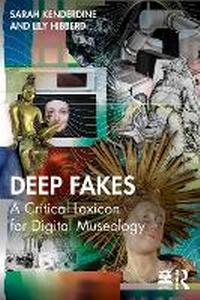
Deep Fakes
A Critical Lexicon for Digital Museology
1st Edition
Published on 11. November 2025
Book
Paperback/Softback
280 pages
978-1-032-36915-0 (ISBN)
Description
Deep Fakes: A Critical Lexicon for Digital Museology is an illustrated monograph articulated through a comprehensive lexicon of key concepts in next-generation museology. Each of the book's ten chapters explores specific terms in the lexicon, further interpreted through installations from the 2021 exhibition Deep Fakes: Art and Its Double in Switzerland.
Deep Fakes: A Critical Lexicon for Digital Museology contends with the intensification of questions compounded by rapid technological change affecting contemporary museological and curatorial authority. This book introduces a novel theorization of computational techniques and their transformation of museological objects in the form of cultural deep fakes-the consummate shape-shifting doppelgaengers of the post-digital age. Conceived by Sarah Kenderdine and written by Lily Hibberd, this volume elaborates on a spectrum of established theoretical concepts, including affect, aura, authenticity, embodied knowledge, mimesis, the post-original, presence, replication, reenactment, and the simulacrum. Grounded in the methods and techniques of computational museology and participatory visitor experience, it critically examines the practical, epistemological, societal, and ethical implications of emerging technologies and their cultural heritage material. Harnessing the affordances of these transformative approaches for communities and societies, this critical lexicon empowers future-focused curatorship for memory organizations.
This book supports museum professionals in navigating the ramifications of dynamic technological change. Readers include directors, curators, researchers, and designers. Archival and imaging scientists, data managers, and software engineers are also broadly implicated. It has added significance for research disciplines in the history and theory of art and media studies, critical and cultural theory, digital humanities, and museum studies, alongside artists and producers in the cultural domain.
The Open Access version of this book, available at www.taylorfrancis.com, has been made available under a Creative Commons Attribution-Non Commercial-No Derivatives (CC-BY-NC-ND) 4.0 license.
Deep Fakes: A Critical Lexicon for Digital Museology contends with the intensification of questions compounded by rapid technological change affecting contemporary museological and curatorial authority. This book introduces a novel theorization of computational techniques and their transformation of museological objects in the form of cultural deep fakes-the consummate shape-shifting doppelgaengers of the post-digital age. Conceived by Sarah Kenderdine and written by Lily Hibberd, this volume elaborates on a spectrum of established theoretical concepts, including affect, aura, authenticity, embodied knowledge, mimesis, the post-original, presence, replication, reenactment, and the simulacrum. Grounded in the methods and techniques of computational museology and participatory visitor experience, it critically examines the practical, epistemological, societal, and ethical implications of emerging technologies and their cultural heritage material. Harnessing the affordances of these transformative approaches for communities and societies, this critical lexicon empowers future-focused curatorship for memory organizations.
This book supports museum professionals in navigating the ramifications of dynamic technological change. Readers include directors, curators, researchers, and designers. Archival and imaging scientists, data managers, and software engineers are also broadly implicated. It has added significance for research disciplines in the history and theory of art and media studies, critical and cultural theory, digital humanities, and museum studies, alongside artists and producers in the cultural domain.
The Open Access version of this book, available at www.taylorfrancis.com, has been made available under a Creative Commons Attribution-Non Commercial-No Derivatives (CC-BY-NC-ND) 4.0 license.
More details
Language
English
Place of publication
London
United Kingdom
Publishing group
Taylor & Francis Ltd
Target group
Professional and scholarly
General
Illustrations
99 s/w Abbildungen, 99 s/w Photographien bzw. Rasterbilder
99 Halftones, black and white; 99 Illustrations, black and white
Dimensions
Height: 234 mm
Width: 156 mm
Thickness: 16 mm
Weight
439 gr
ISBN-13
978-1-032-36915-0 (9781032369150)
Copyright in bibliographic data and cover images is held by Nielsen Book Services Limited or by the publishers or by their respective licensors: all rights reserved.
Schweitzer Classification
Other editions
Additional editions
E-Book
11/2025
Routledge
€0.00
Available for download
E-Book
11/2025
Routledge
€0.00
Available for download
Book
11/2025
1st Edition
Routledge
€208.00
Shipment within 10-20 days
Persons
Lily Hibberd is an interdisciplinary artist, academic, and writer working on questions around frontiers of time, memory, and the cosmos. Presented in more than fifty international exhibitions and festivals, her work combines performance, writing, painting, photography, sound, moving images, and installation art. She is the founding editor of the art writing publication un Magazine and a frequent author and co-author of books, essays, and journal articles. Dr Lily Hibberd is a researcher at Universite Paris Cite and EPFL Laboratory for Experimental Museology, and Adjunct Lecturer at UNSW Sydney.
Sarah Kenderdine is Professor of Digital Museology at the Ecole polytechnique federale de Lausanne (EPFL), Switzerland. She leads the Laboratory for Experimental Museology (eM+), exploring the convergence of immersive visualization, digital aesthetics, and cultural big data. Sarah directed EPFL Pavilions from 2017 to 2024, and now leads international touring exhibitions as curator-at-large. She is Corresponding Fellow of the British Academy, Visiting Professor at Hong Kong Baptist University, and Adjunct Professor at UNSW Sydney. Sarah has produced more than one hundred exhibitions for museums worldwide and numerous scholarly publications.
Sarah Kenderdine is Professor of Digital Museology at the Ecole polytechnique federale de Lausanne (EPFL), Switzerland. She leads the Laboratory for Experimental Museology (eM+), exploring the convergence of immersive visualization, digital aesthetics, and cultural big data. Sarah directed EPFL Pavilions from 2017 to 2024, and now leads international touring exhibitions as curator-at-large. She is Corresponding Fellow of the British Academy, Visiting Professor at Hong Kong Baptist University, and Adjunct Professor at UNSW Sydney. Sarah has produced more than one hundred exhibitions for museums worldwide and numerous scholarly publications.
Content
Introduction; Lexicon; Chapter 1 Deep Fakes: Art and Its Double - the exhibition; Chapter 2 New materialities; Chapter 3 New mimetics; Chapter 4 Simulacrum; Chapter 5 Reenactment; Chapter 6 Peripheral vision; Chapter 07 New values; Chapter 08 Speaking back; Chapter 09 Paradigms of participation; Chapter 10 Voices of visitors; Conclusion - Towards future-focused curatorship; End matter; List of illustrations