

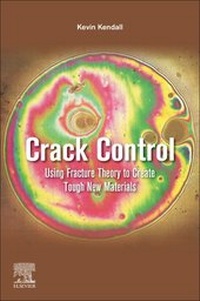
Crack Control
Using Fracture Theory to Create Tough New Materials
Published on 21. October 2020
Book
Paperback/Softback
308 pages
978-0-12-821504-3 (ISBN)
Description
Crack Control: Using Fracture Theory to Create Tough New Materials goes beyond just trying to understand the origin of cracks and fracture in materials by also providing readers with the knowledge and techniques required to stop cracks at the nano- and micro-levels, covering the fundamentals of crack propagation, prevention, and healing. The book starts by providing a concise foundational overview of cracks and fracture mechanics, then looks at real-life ways that new tougher materials have been developed via crack inhibition. Topics such as crack equilibrium, stress criterion, and stress equations are then outlined, as are methods for inventing new crack-resistant materials. The importance of crack healing is emphasized and cracks that grow under tension, bending, compression, crazing, and adhesion are discussed at length as well
More details
Language
English
Place of publication
United States
Target group
Professional and scholarly
Primary: Academic researchers in the field of mechanical engineering and materials science; practicing mechanical engineers and materials scientists
Secondary: Mechanical engineering and materials science postgrad students;
Illustrations
Approx. 155 illustrations (15 in full color)
Dimensions
Height: 229 mm
Width: 152 mm
Weight
560 gr
ISBN-13
978-0-12-821504-3 (9780128215043)
Copyright in bibliographic data and cover images is held by Nielsen Book Services Limited or by the publishers or by their respective licensors: all rights reserved.
Schweitzer Classification
Other editions
Additional editions
E-Book
10/2020
Elsevier
€131.00
Available for download
Person
Professor Kendall was elected Fellow of the Royal Society in 1993, following more than twodecades of advancing research in fuel cells and materials. Previously, he has worked at the University ofKeele and Akron University, and has worked in research at Joseph Lucas, British Railways and ICI.Professor Kendall is especially noted in the USA where his patents on microtubular SOFCs have beenexploited by two companies (Acumentrics and Nanodynamics) which have since received about 30M$ offunding for product development. He is also the founder and chief of the Birmingham start-up company.Adelan which specializes in SOFC technology. He received the Award for Excellence of the AmericanAdhesion Society in 1999, one of only three Britons ever to achieve this, and was awarded the Wakemedal for adhesion in 2005.He is Fellow of the Royal Society, Fellow of the Institute of Physics, Member of the Institute of Materials,Editorial board member for J Adhesion & Adhesives, member of the Hooke Committee of Royal Societyand is Secretary of the Hydrogen & Fuel Cell Centre. His research specializations include fuel cellscience and technology, especially for domestic houses, and Solid oxide fuel cells (SOFCs). He runs themajor SOFC conference in the UK and is also on the Grove and Fuel Cell Forum conference committees.His current research projects include; collaboration with Adelan Ltd on fuel cell development, theREALSOFC European project, collaboration with Shell on fuel reforming and a project with Baxi onimplementation of fuel cell systems in domestic houses.
Content
1. Cracks: A century of toughness 2. Using the Griffith defect idea 3. Cracking observations4. Cracking equilibrium5. Bending history6. Improving fracture mechanics7. Crack equations8. Tough laminates9. Nano-cracks in nature10. Inventing a new tough material11. Cracking future: new tougher materials