

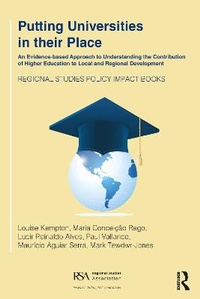
Putting Universities in their Place
An Evidence-based Approach to Understanding the Contribution of Higher Education to Local and Regional Development
1st Edition
Published on 4. August 2021
Book
Paperback/Softback
88 pages
978-1-032-05566-4 (ISBN)
Description
There have been several attempts in recent years to create conceptual frameworks and models to help universities and policy makers understand the role and contribution of higher education to local and regional development. However, these models have failed to fully reflect or give insufficient attention to the impact of the regional context (economic, social, political), the policy environment for higher education and territorial development and the diversity of management and leadership structures of universities themselves. This has led to the development of static models that rarely work outside of the immediate context in which they were developed and therefore risk leading to design of policies that are not fit for purpose.
This Policy Expo is the result of work with partners in Europe, South America, Africa, Asia and Australia to develop a new approach, the ORPHIC Framework, to think about how the university can be adapted to the specificity of institutional and local contexts. The book examines:
* What are the different roles that universities play in local and regional development and how do these manifest themselves?
* How can we learn from comparing practice and experience internationally, and to what extent are policies aimed at promoting university-region relationships transferrable?
* What are the internal university factors, such as management and leadership, history, mission, structures, and the external factors, such as territorial development policy context, governance system, nature of the 'place', that might help us explain the nature of the relationship?
This Policy Expo is the result of work with partners in Europe, South America, Africa, Asia and Australia to develop a new approach, the ORPHIC Framework, to think about how the university can be adapted to the specificity of institutional and local contexts. The book examines:
* What are the different roles that universities play in local and regional development and how do these manifest themselves?
* How can we learn from comparing practice and experience internationally, and to what extent are policies aimed at promoting university-region relationships transferrable?
* What are the internal university factors, such as management and leadership, history, mission, structures, and the external factors, such as territorial development policy context, governance system, nature of the 'place', that might help us explain the nature of the relationship?
More details
Series
Language
English
Place of publication
London
United Kingdom
Publishing group
Taylor & Francis Ltd
Target group
College/higher education
Illustrations
8 s/w Abbildungen, 8 s/w Zeichnungen, 5 s/w Tabellen
5 Tables, black and white; 8 Line drawings, black and white; 8 Illustrations, black and white
Dimensions
Height: 248 mm
Width: 174 mm
Weight
170 gr
ISBN-13
978-1-032-05566-4 (9781032055664)
Copyright in bibliographic data and cover images is held by Nielsen Book Services Limited or by the publishers or by their respective licensors: all rights reserved.
Schweitzer Classification
Other editions
Additional editions
Louise Kempton | Maria Conceicao Rego | Lucir Reinaldo Alves
Putting Universities in their Place
An Evidence-based Approach to Understanding the Contribution of Higher Education to Local and Regional Development
E-Book
08/2021
1st Edition
Routledge
€19.49
Available for download
Louise Kempton | Maria Conceicao Rego | Lucir Reinaldo Alves
Putting Universities in their Place
An Evidence-based Approach to Understanding the Contribution of Higher Education to Local and Regional Development
E-Book
08/2021
1st Edition
Routledge
€19.49
Available for download
Persons
Louise Kempton is Senior Research Associate at the Centre for Urban and Regional Development Studies (CURDS), Newcastle University, UK.
Maria Conceicao Rego is Professor in the Department of Economics and a researcher in the Centre for Advanced Studies in Management and Economics (CEFAGE), University of Evora, Portugal.
Lucir Reinaldo Alves is Professor in the Department of Economics and a researcher in the Centre for Regional Development (NDR), Western Parana State University, Brazil and a researcher in the Centre of Geographical Studies (CEG) at the University of Lisbon, Portugal.
Paul Vallance is a Research Associate in the Centre for Regional Economic and Enterprise Development (CREED), Sheffield University Management School, University of Sheffield, UK.
Mauricio Aguiar Serra is Professor of Economic Development in the Institute of Economics, University of Campinas, Brazil.
Mark Tewdwr-Jones is UCL Bartlett Professor of Cities and Regions, The Bartlett Centre for Advanced Spatial Analysis (CASA), University College London, UK.
Maria Conceicao Rego is Professor in the Department of Economics and a researcher in the Centre for Advanced Studies in Management and Economics (CEFAGE), University of Evora, Portugal.
Lucir Reinaldo Alves is Professor in the Department of Economics and a researcher in the Centre for Regional Development (NDR), Western Parana State University, Brazil and a researcher in the Centre of Geographical Studies (CEG) at the University of Lisbon, Portugal.
Paul Vallance is a Research Associate in the Centre for Regional Economic and Enterprise Development (CREED), Sheffield University Management School, University of Sheffield, UK.
Mauricio Aguiar Serra is Professor of Economic Development in the Institute of Economics, University of Campinas, Brazil.
Mark Tewdwr-Jones is UCL Bartlett Professor of Cities and Regions, The Bartlett Centre for Advanced Spatial Analysis (CASA), University College London, UK.
Content
1. Introduction 2. Understanding the contributions of universities to regional development 3. Examining university models in regional development 4. Placing universities and regional relationships in context 5. Putting universities in their place: The ORPHIC Framework 6. Recommendations for policymakers