

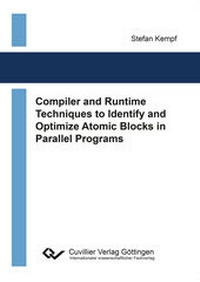
Compiler and Runtime Techniques to Identify and Optimize Atomic Blocks in Parallel Programs
1st Edition
Published on 3. November 2014
Book
184 pages
978-3-95404-840-3 (ISBN)
Description
Atomic blocks are a programming language construct that marks sections of code that multiple threads may not execute concurrently. The implementation of the mutual exclusion is left to the compiler or the runtime system. To avoid race conditions however, developers are still responsible to detect all places in the code where atomic blocks are needed. It is of course also important that mutual exclusion is implemented efficiently.
This thesis therefore pursues two goals. First, we develop a data dependence analysis that identifies potential critical sections in a parallel program, presents them to the programmer, and then adds atomic blocks to the code. Second, we enhance existing techniques - software transactional memory (STM) and lock inference - to implement atomic blocks. Our approach combines the advantages of STM and lock inference, which allows atomic blocks to be implemented more efficiently.
The evaluation shows that our approach identifies atomic blocks that closely match those atomic blocks that an expert would add to the code. Compared to a pure STM or lock inference implementation, our combined approach to implement atomic blocks speeds up execution times by a factor between 1.1 and 6.3.
More details
Other editions
Additional editions
E-Book
11/2014
Cuvillier Verlag eBooks
€25.41
Available for download